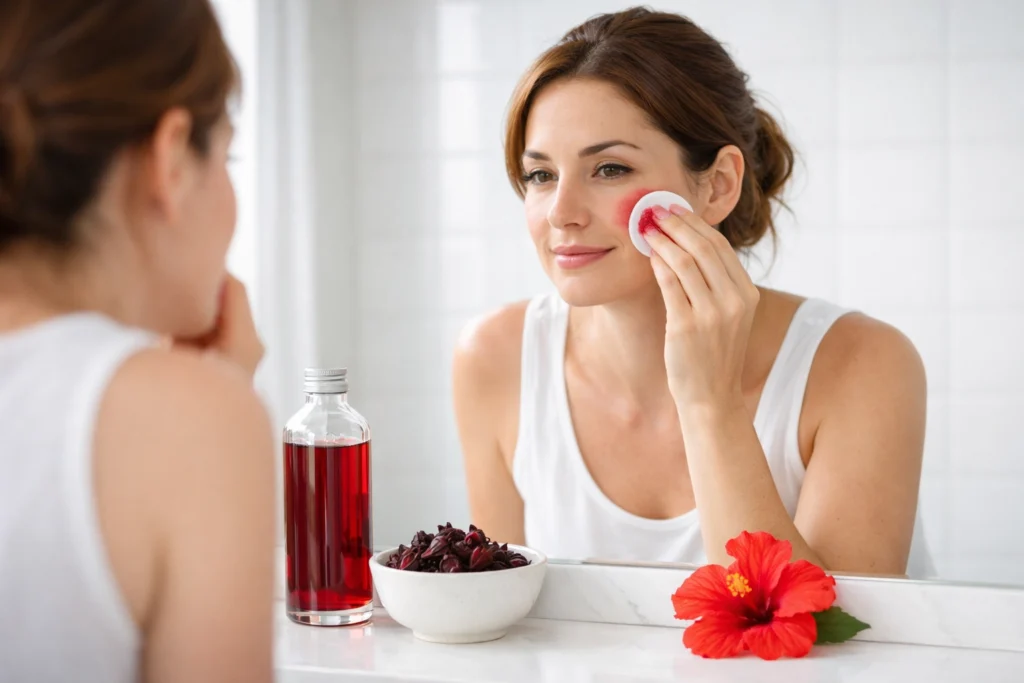
Yes — hibiscus tea can absolutely be used topically on skin, and it offers genuine benefits beyond what drinking it alone provides. The key is knowing which method suits your skin concern, what concentration to use, and what safety rules apply. This guide covers all 6 topical methods with step-by-step preparation.
📋 Table of Contents
- Can You Really Use Hibiscus Tea on Your Skin?
- Why Topical Use Works Differently From Drinking
- What Hibiscus Tea Does to Skin When Applied Directly
- Method 1 — Hibiscus Tea Toner
- Method 2 — Cold Compress
- Method 3 — Face Mask
- Method 4 — Bath Soak
- Method 5 — Facial Steam
- Method 6 — Hair & Scalp Rinse
- Which Method Is Right for Your Skin Concern?
- Safety Rules — What Not to Do
- Frequently Asked Questions
Can You Really Use Hibiscus Tea on Your Skin?
Yes — and the cosmetics industry has known this for decades. Hibiscus sabdariffa extract is a documented ingredient in professional skincare products ranging from anti-aging serums to sensitive skin toners, acne treatments, and hair care formulations. The same active compounds that make hibiscus tea beneficial internally — anthocyanins, natural AHAs, quercetin, vitamin C, mucilage, and hibiscus acid — are all skin-active when applied topically, delivering benefits directly to the skin surface and underlying dermis.
Lab studies specifically on topical hibiscus application confirm it increases fibronectin production in wound explants (accelerating wound closure), stimulates collagen synthesis in dermal fibroblasts, delivers direct antimicrobial action against skin pathogens, and provides localised anti-inflammatory activity via anthocyanin penetration. These are benefits that drinking hibiscus tea alone cannot fully replicate — because some compounds, particularly the AHAs, are metabolised before they reach skin tissue via the bloodstream.
This guide covers every practical method of topical hibiscus tea application — with step-by-step preparation, the right concentration for each use, and specific skin concerns each method addresses best. For the complete overview of hibiscus tea’s skin benefits via both routes, see our guide: hibiscus tea benefits for skin.
Why Topical Use Works Differently From Drinking
| Compound | Works Internally? | Works Topically? | Why Topical Is Needed |
|---|---|---|---|
| AHAs (malic, citric acid) | ❌ Metabolised in gut | ✅ Direct surface exfoliation | AHAs only exfoliate when directly in contact with skin surface — cannot reach skin via bloodstream at effective concentrations |
| Anthocyanins | ✅ Systemic antioxidant | ✅ Localised anti-inflammatory | Both routes effective — topical delivers concentrated localised action to specific patches; internal provides systemic coverage |
| Quercetin | ✅ Systemic anti-inflammatory, IgE reduction | ✅ Direct mast cell stabilisation at skin site | Topical provides faster localised effect on inflamed patches; internal builds systemic background protection |
| Vitamin C | ✅ Collagen synthesis cofactor systemically | ✅ Direct collagen support + brightening topically | Topical vitamin C reaches the dermis directly — more effective for localised collagen support than relying solely on systemic delivery |
| Mucilage | ✅ Gut/digestive hydration | ✅ Direct film-forming humectant on skin | Mucilage creates a physical moisture-retaining layer only when in direct contact with skin — no topical benefit from internal use |
| Hibiscus acid | ✅ Stimulates collagen + hyaluronic acid in fibroblasts systemically | ✅ Direct fibroblast stimulation in dermis | PMC lab study confirmed topical hibiscus acid stimulates collagen and hyaluronic acid in dermal fibroblasts — topical concentration at the dermis may exceed systemic delivery |
| Antimicrobial phenolics | ⚠️ Limited systemic reach to skin | ✅ Direct antimicrobial at skin surface | Surface bacteria (C. acnes, S. aureus) are best addressed by direct topical antimicrobial contact — systemic delivery is insufficient for meaningful antibacterial effect at skin surface |
What Hibiscus Tea Does to Skin When Applied Directly
AHA Chemical Exfoliation — Cell Renewal at the Surface
The malic and citric acids in hibiscus function as natural alpha-hydroxy acids — dissolving the protein bonds between dead corneocytes on the skin surface, promoting their removal and accelerating cell turnover. This process reveals fresher, smoother skin beneath, reduces the appearance of dull, uneven texture, helps fade hyperpigmentation and acne scars, and keeps pores clear of the debris accumulation that leads to congestion and breakouts. Board-certified cosmetic dermatologist Dr. Michele Green confirmed to mindbodygreen that hibiscus AHAs “gently exfoliate and brighten the skin” with a particularly favourable tolerance profile. This exfoliating effect is entirely topical — it cannot be achieved by drinking the tea.
Wound Healing Acceleration — Fibronectin Stimulation
Lab studies using human skin explant wound models confirmed that topically applied hibiscus extract increases the production of fibronectin — a structural glycoprotein that draws wound edges together during the initial healing phase — and stimulates expression of genes involved in skin hydration and regeneration. For practical skin concerns this translates to: faster fading of acne scars and post-inflammatory marks, improved healing of minor skin damage, and progressive improvement in skin texture on areas of chronic inflammation. This wound-healing acceleration is a direct topical effect — the fibronectin stimulation occurs at the site of application, not systemically.
pH Restoration — Acid Mantle Support
The skin’s natural acid mantle sits at pH 4.5–5.5. Many cleansers, hard water, and harsh skincare products disrupt this by raising skin pH above 6.0 — making the barrier more permeable, more reactive, and more susceptible to bacterial overgrowth. Diluted hibiscus tea (at 1:1 or 1:2 dilution with water) has an effective pH of approximately 4.0–4.5 — almost exactly the target range for skin pH restoration. Applied as a toner after cleansing, it gently restores the acid mantle disrupted by cleansing, progressively improving barrier function, reducing sensitivity and reactivity, and creating an environment less hospitable to acne-causing bacteria.
Surface Antimicrobial Protection
A 2024 PMC comprehensive review of hibiscus antimicrobial properties confirmed that Hibiscus sabdariffa extracts demonstrate significant activity against a range of skin-relevant bacteria and fungi. Applied topically as a toner or compress, hibiscus creates a mildly acidic, anthocyanin-rich surface environment that directly inhibits Cutibacterium acnes (primary acne bacterium), Staphylococcus aureus (major eczema trigger and wound complication bacterium), and various dermatophytes. This surface antimicrobial action is not achievable via internal consumption at meaningful skin-surface concentrations — topical application is the only route that delivers sufficient antimicrobial compound concentrations directly to the skin surface.
Method 1 — Hibiscus Tea Toner
Best for: Daily skincare routine, brightening, pore-clearing, acne prevention, pH restoration, oily and combination skin
🌺 Hibiscus Tea Toner — Step-by-Step
-
1
Brew the tea
Add 1–2 teaspoons loose-leaf dried hibiscus calyxes to 240ml water heated to 85–90°C. Steep for 8 minutes. Use loose-leaf for maximum anthocyanin concentration — tea bags typically contain lower-quality, lower-potency material.
-
2
Strain thoroughly
Strain through a fine mesh strainer — twice if needed. No loose plant particles should remain in the liquid used on the face. Any residue on skin can cause uneven staining or clog pores.
-
3
Dilute for your skin type
Normal/oily skin: Use undiluted or dilute 1:1 with cooled water
Combination/dry skin: Dilute 1:1 with cooled water
Sensitive/rosacea skin: Dilute 1:2 (1 part tea to 2 parts water) initially
Eczema-prone skin: Dilute 1:2 or 1:3; always patch test first -
4
Cool completely in refrigerator
Pour into a clean glass bottle and refrigerate for 20–30 minutes minimum. The toner should be cool to cold when applied — never warm. Cold application provides additional vasoconstrictive (pore-minimising) benefit and is essential for rosacea or inflamed skin.
-
5
Apply after cleansing
Cleanse face as normal. Apply hibiscus toner to a soft cotton pad and sweep gently across clean face and neck. Avoid the eye area. Allow 60 seconds to absorb then apply moisturiser or prescribed topical immediately.
-
6
Timing and storage
Use in the evening (AHAs increase photosensitivity — use SPF if applying in the morning). Refrigerate — use within 3 days. Make fresh batches every 2–3 days for maximum potency.
Method 2 — Cold Compress
Best for: Active inflammation, eczema flares, rosacea flushing, sunburn soothing, acne papules, post-procedure skin calming
🌺 Hibiscus Cold Compress — Step-by-Step
-
1
Brew double-strength tea
Use 3–4 teaspoons loose-leaf per 240ml at 85–90°C, steep 10 minutes. Double strength maximises compound concentration for direct therapeutic action on inflamed skin.
-
2
Strain and cool
Strain thoroughly twice. Cool to room temperature then refrigerate until very cold — at least 30 minutes. The colder the better for inflamed skin.
-
3
Soak and apply
Soak a clean soft cotton cloth or muslin in the cold tea. Wring gently — damp but not dripping. Lay gently on the inflamed area. Do not rub or press. Hold for 10–15 minutes.
-
4
Follow with emollient
Pat dry gently. Apply moisturiser or emollient immediately while skin is still slightly damp. The AHA-softened, temporarily more permeable skin absorbs emollient more effectively in this window.
For the complete compress method specifically for psoriasis and eczema plaques, see our detailed guide: how to make a hibiscus tea compress for psoriasis.
Method 3 — Hibiscus Face Mask
Best for: Weekly deep exfoliation, hyperpigmentation, acne scars, skin brightening, anti-aging treatment, dull or congested skin
🌺 Three Hibiscus Face Mask Recipes
Recipe A — Brightening Mask (for hyperpigmentation, dull skin)
- 1
Mix 2 tbsp cooled brewed hibiscus tea + 1 tbsp kaolin clay + 1 tsp honey. Stir to a smooth paste. Apply evenly to clean face avoiding eye area. Leave 10–12 minutes. Rinse with cool water. Pat dry. Apply moisturiser immediately.
Recipe B — Anti-Aging Mask (for fine lines, firmness)
- 1
Mix 2 tbsp cooled hibiscus tea + 1 tsp rosehip oil + 1 tbsp plain full-fat yoghurt (lactic acid adds gentle exfoliation). Apply to face and neck. Leave 15 minutes. Rinse with cool water. Apply moisturiser immediately.
Recipe C — Soothing Mask (for sensitive, rosacea, or eczema skin)
- 1
Mix 3 tbsp diluted hibiscus tea (1:2 dilution) + 1 tbsp aloe vera gel + 1 tsp colloidal oat powder. Apply to affected areas only. Leave 8–10 minutes maximum. Rinse with cool water. Apply prescribed emollient immediately.
Method 4 — Hibiscus Bath Soak
Best for: Widespread eczema, psoriasis on body, general skin softening, body brightening, post-sun skin calming
🌺 Hibiscus Bath Soak — Preparation
-
1
Brew large batch
Brew 6–8 cups of double-strength hibiscus tea. Use 3–4 teaspoons loose-leaf per 240ml. Steep 10 minutes. Strain extremely thoroughly — no plant particles in the bath.
-
2
Temperature — critical for eczema and rosacea
Run a lukewarm bath only — not hot. Hot water is one of the top eczema and rosacea triggers. It also degrades anthocyanins and reduces therapeutic potency. The bath water should feel comfortable but not warm — around 33–35°C maximum.
-
3
Add the hibiscus tea
Pour the brewed, strained hibiscus tea directly into the bath. Optionally add 1–2 cups colloidal oat powder for additional soothing for eczema-prone skin. The water will turn a beautiful deep red — this is normal and does not stain skin permanently.
-
4
Soak 15–20 minutes
Soak for 15–20 minutes maximum. Pat dry gently — never rub. Apply body emollient or moisturiser immediately while skin is still slightly damp to seal in the skin-softening benefits.
Frequency: 2–3 times per week for active skin conditions. Once per week for maintenance. Hibiscus may temporarily tint bath surfaces — rinse the bath immediately after use.
Method 5 — Hibiscus Facial Steam
Best for: Deep pore cleansing, pre-mask preparation, normal and oily skin, blackhead softening
🌺 Hibiscus Facial Steam — Method
-
1
Brew 2 cups of strong hibiscus tea. Pour into a large heat-safe bowl.
-
2
Drape a towel over your head and lean over the bowl at a comfortable distance — at least 30cm from the surface. Close eyes. Allow steam to open pores for 5–8 minutes maximum.
-
3
Pat face dry gently. Follow immediately with a face mask or toner while pores are open for maximum compound penetration. Apply moisturiser to finish.
Frequency: Maximum once per week for oily skin. The steam opens pores and softens plugs, making the subsequent toner or mask significantly more effective at penetrating and clearing congested pores.
🔗 🌺 Full Guide: Hibiscus Tea for Psoriasis & Eczema — 7 Proven Benefits
This article covers topical application methods for all skin types. For the complete evidence-based guide on hibiscus tea for psoriasis and eczema specifically — including the full anti-inflammatory mechanisms and clinical evidence — read our pillar article:
👉 7 Proven Benefits of Hibiscus Tea for Psoriasis & Eczema →
Method 6 — Hair & Scalp Rinse
Best for: Scalp pH restoration, dandruff reduction, hair shine, scalp inflammation, hair colour enhancement (red/dark hair)
Hibiscus has a long traditional use in hair care across African, South Asian, and Caribbean traditions — and this use is now supported by phytochemical evidence. The same compounds that benefit facial skin provide scalp benefit: antimicrobial action against dandruff-causing Malassezia, pH restoration of the scalp acid mantle disrupted by alkaline shampoos, and direct anti-inflammatory action on inflamed scalp conditions.
🌺 Hibiscus Hair Rinse — Method
-
1
Brew 4 cups of standard or double-strength hibiscus tea. Strain thoroughly. Cool to lukewarm (not hot — apply comfortably warm to scalp).
-
2
After shampooing and conditioning, pour the hibiscus tea over scalp and hair as a final rinse. Massage gently into the scalp for 2–3 minutes.
-
3
Leave in for 5 minutes then rinse with cool water. Pat hair dry gently.
Hair colour note: Hibiscus anthocyanins can temporarily enhance red, auburn, and dark brown hair tones — providing a natural subtle colour boost. This effect is temporary and washes out gradually. For blonde or light hair, be aware that it may impart a light pink or rose tint which fades with washing.
Which Method Is Right for Your Skin Concern?
| Skin Concern | Best Method | Frequency | Key Caution |
|---|---|---|---|
| Acne prevention | Toner (daily evening) | Daily | Evening use — AHA photosensitivity |
| Active acne papules | Cold compress on spots | 2–3× daily on active spots | Never on open/infected skin |
| Rosacea — maintenance | Cold toner (diluted 1:1) | Daily evening | Always cold — heat triggers flush |
| Rosacea — active flush | Cold compress immediately | As needed | Very cold — straight from fridge |
| Eczema patches | Cold compress | 3–4× per week | Never on broken/infected skin |
| Hyperpigmentation / dark spots | Toner (daily) + mask (weekly) | Toner daily; mask weekly | SPF essential — AHAs increase UV sensitivity |
| Dull / uneven texture | Toner + weekly mask | Toner daily; mask weekly | Evening use preferred |
| Blackheads / congested pores | Steam then toner or mask | Steam weekly max | Not for rosacea/eczema/sensitive skin |
| Anti-aging / fine lines | Toner + anti-aging mask | Toner daily; mask fortnightly | Combine with internal consumption for best results |
| Widespread body eczema | Bath soak | 2–3× per week | Lukewarm water only — never hot |
| Dandruff / scalp inflammation | Hair and scalp rinse | 2× per week | May tint light hair temporarily |
| Sunburn / post-sun redness | Cold compress + bath soak | As needed | Very cold compress; lukewarm bath |
Safety Rules — What Not to Do
❌ Never apply warm or hot hibiscus to inflamed skin
Heat worsens rosacea, eczema, and acne. All topical hibiscus applications for inflammatory skin conditions must be cold — straight from the refrigerator. The only exception is the hair rinse (lukewarm is appropriate for scalp).
❌ Never apply to broken, weeping, infected, or open skin
Hibiscus tea is acidic (pH 2.5–3.5). Applying to broken or infected skin causes stinging, may impair healing, and introduces potential infection risk. Wait until skin is fully intact before topical use.
❌ Never skip the patch test
Apply diluted hibiscus tea to the inner wrist and leave for 24 hours before first face application. Allergic contact reactions to hibiscus are rare but possible — particularly for those with Malvaceae family plant allergies (okra, hollyhock, marshmallow root).
❌ Never leave face masks on longer than stated
Extended AHA contact causes irritation, over-exfoliation, and potential barrier damage. Follow the timing strictly — 10–15 minutes maximum. Remove sooner if any stinging or redness develops.
❌ Never apply topically then go in direct sun without SPF
AHAs temporarily thin the outermost skin layer, significantly increasing UV sensitivity. Always apply broad-spectrum SPF30+ if using hibiscus topically in the morning. Evening use is strongly preferred for this reason.
❌ Never store brewed hibiscus toner for more than 3 days
Brewed hibiscus tea without preservatives degrades rapidly — anthocyanins oxidise and antimicrobial potency diminishes. Refrigerate immediately after brewing and use within 3 days maximum. Make small fresh batches regularly rather than large stored batches.
Try Our Free Herb & Tea Benefit Finder
Type hibiscus or any herb to instantly see its full benefits, preparation methods, and safety notes.
🔍 Open the Herb & Tea Benefit Finder →Frequently Asked Questions
Yes — cooled or cold hibiscus tea can be applied directly to the face as a toner, compress, or mask ingredient. Always strain thoroughly first to remove all plant particles. Dilute 1:1 with cool water for most skin types; dilute 1:2 for sensitive, rosacea, or eczema-prone skin. Always patch test on your inner wrist for 24 hours before first face application. Apply in the evening and follow with moisturiser. Never apply warm hibiscus to the face — always cold or cool.
As a toner — 60 seconds to absorb then apply moisturiser. As a compress — 10–15 minutes maximum. As a face mask — 10–12 minutes (brightening mask), 15 minutes (anti-aging mask), 8–10 minutes (soothing mask for sensitive skin). As a bath soak — 15–20 minutes maximum. Never exceed these times as extended AHA contact can cause over-exfoliation, redness, and irritation. If you experience stinging or significant redness at any point during application, remove immediately with cool water.
Hibiscus anthocyanins may temporarily tint the skin a pale reddish-pink immediately after application — particularly with higher concentrations like double-strength compress tea. This is completely harmless and fades within 15–30 minutes as the compounds are absorbed or removed. It does not cause permanent staining on skin. However, hibiscus can stain fabric and light-coloured surfaces — avoid white towels and white clothing immediately after application, and rinse the bath immediately after a hibiscus soak.
Brewed hibiscus tea without preservatives lasts 3 days maximum when refrigerated in a clean, sealed glass bottle. Beyond this, anthocyanins begin to oxidise, antimicrobial potency diminishes, and there is increasing risk of bacterial contamination. The characteristic deep red-ruby colour of fresh hibiscus tea fades to a brownish-red as it ages — this colour change is a reliable indicator that the toner has passed its useful life and should be discarded. Make small batches of 200–300ml every 2–3 days for consistent potency.
Daily toner use is appropriate for most skin types — particularly oily, combination, and acne-prone skin. For sensitive, rosacea, or eczema-prone skin, start with every other day for 2 weeks before progressing to daily use. Face masks should not be used more than once per week for normal skin or once per fortnight for sensitive skin. Compresses can be used as needed for active inflammation. Daily use of correctly diluted hibiscus toner is well-tolerated by most skin types and produces cumulative brightening and barrier-improving benefits over weeks of consistent use.
Neither is better — they are complementary and work through different mechanisms. Topical application is better for: AHA exfoliation (AHAs only work on skin surface contact), surface antimicrobial protection against acne bacteria, direct wound healing acceleration via fibronectin stimulation, and skin pH restoration. Drinking is better for: systemic antioxidant protection, IgE reduction and antihistamine action, collagen synthesis stimulation via hibiscus acid reaching fibroblasts systemically, and reducing the overall inflammatory load that drives chronic skin conditions. For maximum skin benefit from hibiscus, combine both — drink 1–2 cups daily and apply topically 3–5 times per week.
Yes — for many people, a properly prepared hibiscus tea toner replaces the need for a commercial toner entirely. It provides AHA exfoliation, pH restoration, antimicrobial protection, and anti-inflammatory benefit in a single zero-additive, preservative-free preparation. The main trade-offs compared to a commercial toner are: shorter shelf life (3 days vs months), no added ingredients like niacinamide or hyaluronic acid, and variable potency depending on loose-leaf quality. For those seeking a clean, natural skincare routine with proven active ingredients, homemade hibiscus toner is an excellent and cost-effective commercial toner alternative.
For standard toner use: 1–2 teaspoons loose-leaf per 240ml water brewed at 85–90°C for 8 minutes, then diluted 1:1 with cool water. For compresses and masks where higher concentration is beneficial: 3–4 teaspoons per 240ml (double strength), used undiluted or diluted 1:1. For sensitive, rosacea, or eczema skin: always dilute to 1:2 or 1:3 (tea to water) initially, increasing concentration gradually over 2–4 weeks. For children: dilute 1:2 minimum — see our full guide on hibiscus tea for eczema in children for age-specific dilution guidance.
📚 Related Health Guides
How to Make a Hibiscus Tea Compress for Psoriasis
Deep-dive on the compress method specifically for psoriasis plaques — strength, timing, and technique.
Hibiscus Tea Benefits for Skin: Anti-Aging, Acne, Hydration & More
All 10 skin benefits with the 2025 RCT evidence — the complete skin benefits reference guide.
Hibiscus Tea for Rosacea, Acne & Sensitive Skin
How hibiscus addresses the specific mechanisms of rosacea and acne — with the critical cold-only rule.
Hibiscus Tea Side Effects: What to Know Before Drinking Daily
Complete safety guide — drug interactions, dental precautions, blood pressure effects.