Hibiscus tea has several properties that match exactly what rosacea, acne, and sensitive skin need. It fights oxidative stress, calms blood vessel inflammation, kills bacteria, and helps restore your skin’s natural pH.
📋 Table of Contents
- Why Rosacea & Sensitive Skin Patients Are Turning to Hibiscus
- What’s Actually Driving Rosacea Redness
- Hibiscus Tea for Rosacea — How It Helps
- Hibiscus Tea for Acne — Three Actions at Once
- Hibiscus Tea for Sensitive Skin
- The Antioxidant Connection — Key 2024 Evidence
- How to Use Hibiscus Tea for Rosacea & Acne
- Hibiscus vs Other Natural Rosacea Remedies
- Dosage Guide
- Important Cautions
- Conclusion
- Frequently Asked Questions
Why Rosacea & Sensitive Skin Patients Are Turning to Hibiscus
Rosacea affects more than 400 million people worldwide. One-third of people with rosacea report significant depression linked to the condition. Many patients quit their prescribed treatment because it stops working or causes side effects.
That is why so many rosacea patients look for natural support options. Hibiscus tea has caught attention for a good scientific reason: its active compounds match exactly the pathways driving rosacea.
🛠️ Free Health Tools — Water Intake Calculator, BMI Calculator, Intermittent Fasting Calculator & more
🔍 Browse All Free Health Tools →A 2024 review confirmed that the most promising natural rosacea compounds are those with anti-inflammatory, antioxidant, and blood-vessel-protecting effects. That is an exact description of what’s in hibiscus tea.
This article gives you an honest look at what hibiscus can and cannot do for rosacea, acne, and sensitive skin. We cover the evidence, practical use, and the key safety rules. For the complete guide on hibiscus for inflammatory skin conditions, see our pillar article: 7 proven benefits of hibiscus tea for psoriasis and eczema.
What’s Actually Driving Rosacea Redness
Rosacea is not just “sensitive skin” or “flushing.” It is a chronic inflammatory condition with several different drivers working together. Understanding these helps you see why hibiscus may help.
| What’s Driving Rosacea | What Happens | How Hibiscus Targets It |
|---|---|---|
| Oxidative stress | Free radicals damage blood vessel walls and trigger inflammation | Anthocyanins and quercetin are powerful antioxidants that neutralize free radicals |
| Immune overreaction | Overactive immune cells release too many inflammatory chemicals | Quercetin calms mast cells; anthocyanins reduce inflammatory signaling |
| Blood vessel problems | Vessels dilate too easily — causing flushing and visible veins | Hibiscus acid relaxes vessels gently; vitamin C strengthens vessel walls |
| Skin barrier disruption | Skin pH is off, allowing irritants and triggers in more easily | Natural fruit acids help restore the skin’s protective acid layer |
| Microbe involvement | Demodex mites and certain bacteria may contribute | Phenolic acids fight harmful skin microbes |
🔬 What the 2024 Research Says
A 2024 Pharmaceuticals review identified that the most promising natural compounds for rosacea have anti-inflammatory, antioxidant, and vasoprotective properties — including polyphenols, flavonoids, anthocyanins, and phenolic acids. This is an exact match to hibiscus tea’s compound profile.
Hibiscus Tea for Rosacea — How It Helps
Here are the four main ways hibiscus tea’s compounds address rosacea.
Fights the Oxidative Stress Behind Rosacea
Oxidative stress is now confirmed as a central driver of rosacea. Free radicals damage blood vessel walls and trigger the inflammation that causes flushing and redness.
A 2024 clinical study with 160 rosacea patients found that high dietary antioxidant intake reduced rosacea impact by 40–45%. Hibiscus tea is one of the richest dietary antioxidant sources available — delivering the exact types of compounds that drove the improvement in this study.
Vitamin C Strengthens Fragile Blood Vessels
Visible broken blood vessels and diffuse facial redness in rosacea come partly from weak, fragile capillary walls. They dilate too easily and leak more than they should.
The 2024 study specifically noted that vitamin C has a “sealing and strengthening effect on blood vessels.” Hibiscus tea gives you 12–15mg of vitamin C per cup. Drunk daily, this supports the structural integrity of facial capillaries over time.
Calms Overactive Immune Cells in the Skin
Rosacea skin has immune cells (mast cells) that fire too easily. Small triggers like heat, UV, or stress cause these cells to release inflammatory chemicals that drive flushing and papules.
Hibiscus contains quercetin — a documented mast cell stabilizer. Instead of blocking histamine after it’s released (like antihistamine pills), quercetin stops the cells from releasing it in the first place.
🔬 The Immune Pathway
Quercetin also suppresses the TLR-2 pathway — one of the most consistently identified immune mechanisms in rosacea. Overactivation of TLR-2 drives excess cathelicidin production, which fuels the chronic inflammation cycle.
Restores Skin pH — Fixing a Disrupted Barrier
Rosacea skin has a disrupted pH. The skin’s natural acid layer is off, making it more reactive to triggers and more open to irritants.
Hibiscus tea is naturally mildly acidic. When correctly diluted and applied as a cold toner, it gently nudges the skin pH back toward the healthy range. This reduces water loss, calms reactivity, and may help balance the skin microbiome.
Hibiscus Tea for Acne — Three Actions at Once
For acne-prone skin, hibiscus tea is one of the most comprehensive natural options. It tackles three separate acne causes simultaneously.
Fruit Acids Prevent Pore Clogging
Acne starts when dead skin cells and oil pile up in pores. Hibiscus contains natural fruit acids that gently dissolve the “glue” holding dead cells together, preventing this buildup at the source.
Unlike harsh synthetic exfoliants, hibiscus fruit acids come packaged with calming anti-inflammatory compounds. This means less irritation and less rebound redness on reactive, acne-prone skin.
Fights Acne Bacteria
The bacterium Cutibacterium acnes drives inflammatory acne. It grows best in clogged, oily pores and triggers the immune response that makes pimples red and painful.
Hibiscus creates a mildly acidic surface environment that this bacterium doesn’t like. The acne bacterium grows best above pH 6.0 — hibiscus tea’s natural acidity disrupts that.
Reduces Pimple Inflammation
The jump from a blocked pore to an angry, red pimple is driven by your immune system’s response to the bacteria inside. Hibiscus compounds directly reduce the inflammatory chemicals responsible for the redness, swelling, and pain.
Applied topically on active pimples, hibiscus tea delivers calming compounds right to the inflamed spot. Drunk daily, it reduces the overall inflammatory load that makes acne-prone skin more reactive.
Hibiscus Tea for Sensitive Skin — Why It Works When Others Irritate
Sensitive skin reacts to almost everything — stinging, redness, and irritation from products that work fine for other people. Paradoxically, properly diluted hibiscus tea is one of the things sensitive skin often tolerates well.
Sensitive skin’s reactivity often comes from a disrupted pH. When the skin’s protective acid layer is off, everything gets in more easily and triggers more reactions. A diluted hibiscus toner gently pushes pH back toward normal. This calms reactivity rather than worsening it — as long as you dilute properly.
Hibiscus also forms a light soothing layer on the skin that helps lock in moisture. The anti-inflammatory compounds reduce the background redness and reactivity that defines sensitive skin.
🌺 Why Sensitive Skin Tolerates Hibiscus Better Than Most Actives
vs Retinol: No purging, no irritation phase, no photosensitivity at normal levels
vs Glycolic acid: Gentler, buffered by calming compounds, doesn’t strip the barrier
vs Benzoyl peroxide: No bleaching, no dryness, no barrier damage
vs Strong vitamin C serums: More buffered and less irritating form of vitamin C
vs Niacinamide: Similar calming benefit plus antimicrobial and antioxidant action
The Antioxidant Connection — Key 2024 Clinical Evidence
The strongest indirect evidence for hibiscus and rosacea comes from a 2024 clinical trial. This was not a hibiscus study — it studied the role of dietary antioxidants in rosacea quality of life.
| Study Detail | What It Found |
|---|---|
| Published | PMC, 2024 — registered clinical trial NCT06271135 |
| Participants | 160 rosacea patients |
| What they measured | Dietary Antioxidant Quality Index — 12 antioxidant components including polyphenols, vitamin C, flavonoids |
| Key finding | Highest antioxidant intake reduced rosacea impact by 40–45% vs lowest intake |
| Symptoms | High antioxidant diet reduced rosacea symptom occurrence by 8–11% |
| Why hibiscus is relevant | Hibiscus tea provides polyphenols, anthocyanins, flavonoids, and vitamin C — all components that drove the improvement |
How to Use Hibiscus Tea for Rosacea & Acne
There are three ways to use hibiscus tea for these skin conditions. Each serves a different purpose.
Method 1 — Daily Drinking (Body-Wide Antioxidant Benefit)
Brew 1–2 teaspoons of loose-leaf hibiscus in 240ml water at 85–90°C for 7–8 minutes. For rosacea, drink it cold or at room temperature — never hot. Hot drinks are a major rosacea trigger. Use a straw to protect tooth enamel. Check drug interactions before starting if you take medications.
Method 2 — Cold Toner for Rosacea & Acne (Skin pH Restoration)
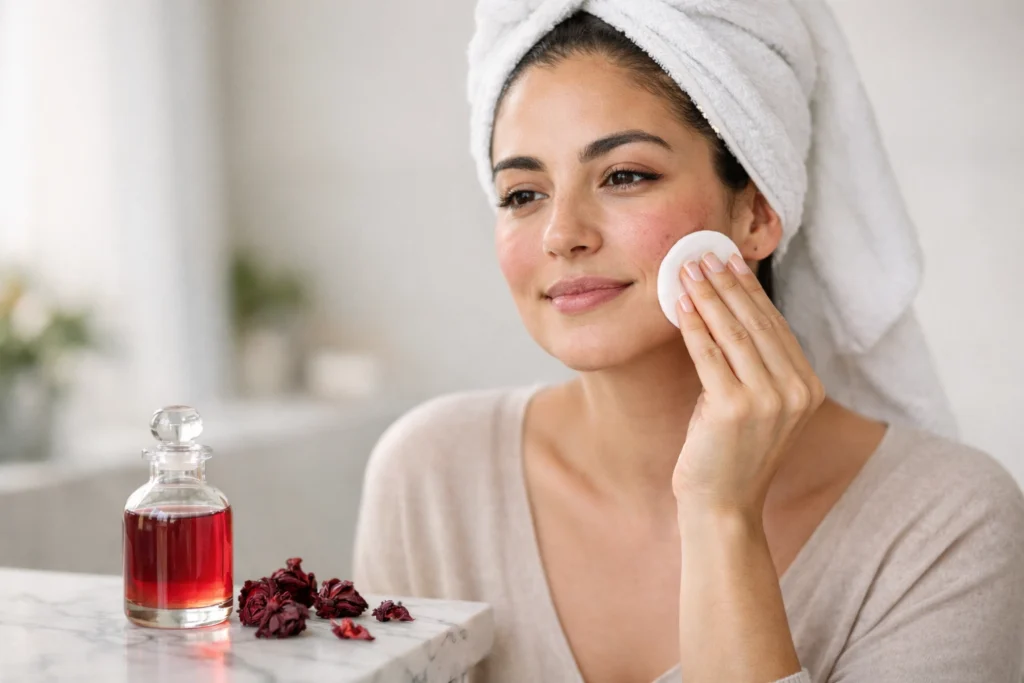
Brew standard strength, strain thoroughly, dilute 1:1 with cool water, and refrigerate until cold. Apply with a soft cotton pad to clean skin after cleansing. Leave to absorb 60 seconds, then apply your moisturizer or prescribed cream. Use in the evening — fruit acids increase sun sensitivity slightly. For rosacea, the toner must always be cold from the fridge.
Method 3 — Cold Compress for Active Rosacea Flush or Acne Papules
Brew double-strength (3–4 tsp per 240ml), strain, refrigerate until very cold. Soak a soft cotton cloth, wring gently, apply to flushed or inflamed areas for 5–10 minutes. The physical cold combined with the plant compounds gives the fastest calming response for an active rosacea flush or inflamed pimple. Moisturize right after.
🌿 How should you use hibiscus tea for your skin? Type it in our free Herb & Tea Benefit Finder — get preparation method, timing, dosage, and safety notes instantly.
🔍 Try the Herb & Tea Benefit Finder →| Skin Condition | Best Method | How Often | Temperature |
|---|---|---|---|
| Rosacea — maintenance | Cold toner (diluted 1:1) + daily drinking (cold) | Toner daily evening; 1–2 cups cold | Cold from fridge — always |
| Rosacea — active flush | Cold compress on flushed areas | As needed during flare | Very cold from fridge |
| Acne — prevention | Toner after cleansing | Daily evening | Cool to cold |
| Acne — active pimples | Diluted compress on spots | 2–3× daily on active spots | Cool to cold |
| Sensitive skin | Diluted toner (1:2) or compress | 3–4× per week; increase as tolerated | Cool to cold |
🔗 🌺 Full Guide: Hibiscus Tea for Psoriasis & Eczema — 7 Proven Benefits
This article covers rosacea, acne, and sensitive skin. For the complete deep-dive on hibiscus for eczema and psoriasis — including the compress method and clinical evidence — read our pillar guide:
👉 7 Proven Benefits of Hibiscus Tea for Psoriasis & Eczema →
Hibiscus vs Other Natural Rosacea Remedies
How does hibiscus compare to other popular natural options for rosacea? Here is a fair side-by-side.
| Natural Remedy | How It Helps Rosacea | Evidence | Where Hibiscus Has the Edge |
|---|---|---|---|
| Green tea | Anti-inflammatory; reduces sebum; UV protection | ⭐⭐⭐⭐ Clinical evidence for skin redness (6-week trial) | Hibiscus adds fruit acid exfoliation, pH restoration, and vessel-protecting acid |
| Aloe vera | Soothing, cooling, barrier repair | ⭐⭐⭐ Traditional use + some trial evidence | Hibiscus adds antibacterial, antioxidant, and fruit acid action |
| Licorice root | Gentle steroid-like anti-inflammatory; calms mast cells | ⭐⭐⭐⭐ Clinical evidence for cream use | Licorice wins for topical potency; hibiscus is better as a daily toner and internal antioxidant |
| Azelaic acid | Antibacterial; anti-inflammatory; FDA-approved for rosacea | ⭐⭐⭐⭐⭐ Strongest evidence of any natural compound | Azelaic acid wins on evidence; hibiscus is safer with zero side effects and adds antioxidant support |
| Niacinamide | Reduces inflammation; improves barrier; reduces redness | ⭐⭐⭐⭐ Good human clinical evidence | Hibiscus adds antibacterial, antioxidant, and fruit acid benefits; combine both for best results |
| Chamomile | Anti-inflammatory; calms stress-triggered flushing | ⭐⭐⭐ Traditional use + studies | Hibiscus has stronger antioxidant and antibacterial action; chamomile is better specifically for stress-triggered flushing |
For rosacea, the best evidence-supported combination is azelaic acid (prescribed) + hibiscus tea daily (internal antioxidant + cold topical toner).
Dosage Guide
Important Cautions
These safety rules apply to anyone using hibiscus tea for rosacea, acne, or sensitive skin.
🌡️ Temperature — rosacea patients must use cold only
This is the most important rule. Heat is a top rosacea trigger. Applying warm hibiscus tea topically or drinking it hot may trigger a flush that cancels out any benefit. Always drink cold or room temperature. Always apply from the fridge.
☀️ Sun sensitivity after topical use
The natural fruit acids in hibiscus slightly increase UV sensitivity. Rosacea skin is already sun-reactive. Apply hibiscus topically in the evening, or always follow morning use with SPF30+.
🩸 Blood pressure medication
Hibiscus lowers blood pressure. If you take BP medication, talk to your doctor before drinking it daily. For the full drug interaction list, see our hibiscus tea side effects guide.
🔬 Patch test — essential for rosacea skin
Rosacea skin is highly reactive. Always do a 24–48 hour patch test on your inner wrist before any topical use. Start with a more diluted solution (1:2 or 1:3 with water) and gradually increase over 2–4 weeks.
🤰 Pregnancy — avoid internally
Hibiscus tea is not safe to drink during pregnancy. For topical use on small areas, ask your obstetrician. Topical use on limited skin areas is lower risk than drinking it, but caution is still warranted.
🦷 Tooth enamel — use a straw
Hibiscus tea is acidic. Daily drinkers should use a straw and rinse with water after. This is especially important when sipping cold hibiscus tea slowly throughout the day.
Conclusion
For rosacea, hibiscus tea is a scientifically sound complementary choice. Its active compounds target the same oxidative stress, blood vessel inflammation, and immune overreaction that 2024–2025 research has identified as the drivers of the condition. The 2024 clinical study showing 40–45% less rosacea impact from high antioxidant intake directly supports drinking hibiscus daily.
For acne, hibiscus works on three fronts at once — gentle exfoliation, antibacterial action, and inflammation reduction — with better tolerance on reactive skin than most conventional actives. For sensitive skin, a properly diluted cold toner restores pH balance and calms reactivity.
The key rules: always cold for rosacea, always diluted for sensitive skin, always patch test first, and always alongside prescribed treatment — not instead of it. Used correctly, hibiscus tea is one of the most well-matched natural additions for these chronic skin conditions.
For more on hibiscus skin benefits, see hibiscus tea benefits for skin. For safety details, see hibiscus tea side effects and drug interactions.
Try Our Free Herb & Tea Benefit Finder
Type hibiscus or any herb to instantly see its full benefits, best preparation method, safety notes, and who should be careful.
🔍 Open the Herb & Tea Benefit Finder →Frequently Asked Questions
Hibiscus tea has strong biological reasons to help rosacea. Its compounds target the oxidative stress, immune overreaction, and blood vessel problems that drive the condition. A 2024 clinical trial confirmed that high dietary antioxidant intake reduces rosacea impact by 40–45%.
However, no clinical trial has tested hibiscus specifically for rosacea yet. Use it as a well-supported complement to your prescribed treatment, not as a replacement.
Yes — but it must be cold. This is the most important rule for rosacea. Heat is a top trigger — even lukewarm tea may cause a flush. Always apply straight from the fridge.
Dilute the tea 1:1 with cooled water before using as a toner. Patch test on your inner wrist for 24–48 hours first. Apply in the evening and follow with your regular moisturizer or prescribed cream right after.
Yes — hibiscus addresses acne through three actions at once. Its natural fruit acids gently unclog pores. Its phenolic acids fight the acne bacterium. And its quercetin and anthocyanins reduce the inflammation that makes pimples red and painful.
Applied as a cooled toner after cleansing, hibiscus delivers all three benefits with better tolerance on reactive skin than many store-bought actives.
Yes — diluted, cooled hibiscus tea is generally well-tolerated on sensitive skin. It can actually improve skin tolerance over time by restoring pH toward the normal acid layer range.
The key is dilution. For sensitive skin, start with 1:2 (one part tea to two parts water) and increase gradually over 2–4 weeks. Always patch test first. Always apply cold. Follow with moisturizer immediately.
Heat is one of the top three rosacea triggers — alongside UV and stress. When heat touches rosacea skin, blood vessels dilate and cause flushing and redness — no matter what anti-inflammatory compounds are in the liquid.
Cold application does the opposite. It constricts surface vessels, reducing redness, and activates cooling nerve receptors that calm neurovascular reactivity. Every hibiscus application for rosacea must come straight from the fridge.
A cold compress gives immediate redness reduction during application — that’s the fastest effect. For deeper improvements — less background redness, fewer flares, better skin texture — expect 6–10 weeks of consistent daily use.
The antioxidant benefits build up over time as your body’s antioxidant levels increase with daily intake. Rosacea is chronic — think gradual improvement over months, not a fast cure.
Cold or room temperature — never hot. Hot drinks are a well-known rosacea trigger. They raise core body temperature and cause flushing. Hibiscus is naturally delicious as an iced tea — brew it, cool it, and chill in the fridge.
Drinking it cold also preserves more of the heat-sensitive antioxidants and vitamin C than drinking it hot from the kettle.
No. Prescribed treatments like metronidazole, azelaic acid, and ivermectin target specific rosacea mechanisms with strong clinical evidence and regulatory approval. Hibiscus adds antioxidant, vessel-protecting, and anti-inflammatory support that prescriptions don’t cover.
The best approach combines both — hibiscus as a daily complement to your prescribed plan, not a replacement. Always tell your dermatologist about any herbal additions to your skincare routine.
📚 Related Health Guides
7 Proven Benefits of Hibiscus Tea for Psoriasis & Eczema
The complete pillar guide — all 7 benefits, dosage, compress method, and full evidence.
Hibiscus Tea Benefits for Skin: Anti-Aging, Acne, Hydration & More
All 10 skin benefits of hibiscus tea — with clinical evidence and internal vs topical guide.
Hibiscus Tea Side Effects: What to Know Before Drinking Daily
Complete safety guide — drug interactions, dental care, blood pressure, and who should avoid it.
7 Best Herbal Teas for Psoriasis Flare-Up Relief (Ranked)
How hibiscus ranks among green tea, chamomile, rooibos and more for skin conditions.