
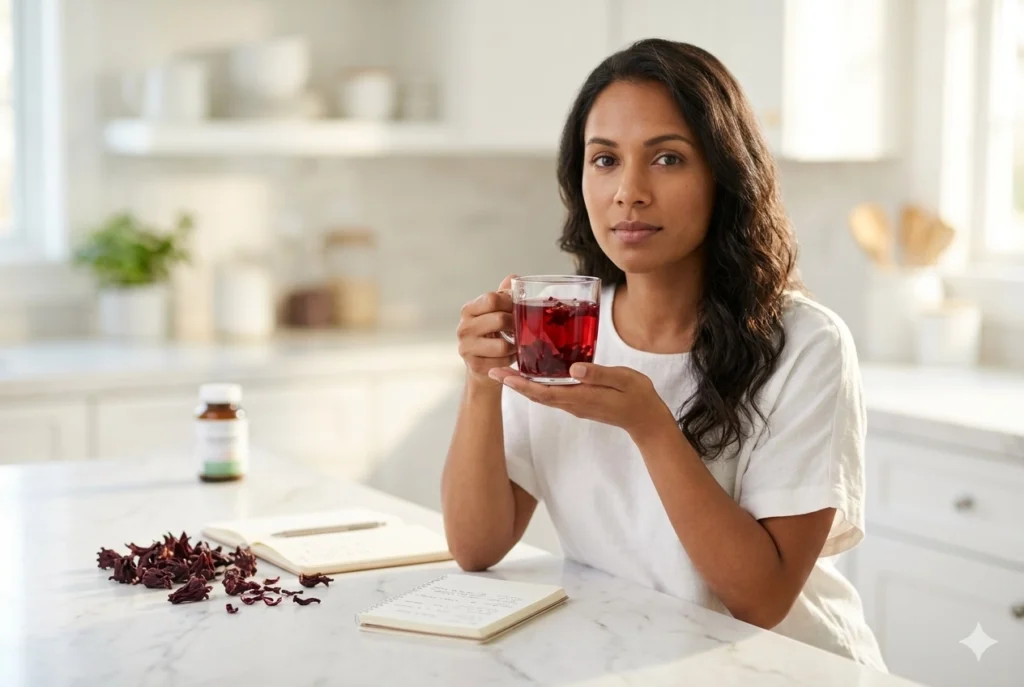
Hibiscus tea is very safe for most healthy adults at 1–3 cups per day. But some groups face real risks, and it can interact with several common medications.
📋 Table of Contents
- How Safe Is Hibiscus Tea Really?
- Overall Safety Profile
- 8 Known Side Effects
- Drug Interactions — Complete List
- Who Should Avoid Hibiscus Tea
- Hibiscus Tea in Pregnancy & Breastfeeding
- Hibiscus Tea & Liver Health
- Dental Enamel — The Overlooked Side Effect
- Safe Daily Amount & How to Lower Risks
- Is Hibiscus Tea Still Worth It for Skin?
- Frequently Asked Questions
How Safe Is Hibiscus Tea Really?
Hibiscus tea has a strong reputation as a safe everyday drink. People in Egypt, Nigeria, Mexico, and South Asia have been drinking it for centuries. The US FDA classifies it as safe for use as a food.
A 2025 review found hibiscus tea is “very safe, except for minor stomach issues” at normal amounts. That is a strong safety record by herbal tea standards.
🛠️ Free Health Tools — Water Intake Calculator, BMI Calculator, Intermittent Fasting Calculator & more
🔍 Browse All Free Health Tools →But “generally safe” does not mean “safe for everyone.” Hibiscus tea contains active compounds that have real effects on your body. The same compounds that make it useful for blood pressure, inflammation, and eczema can cause problems in some situations.
This guide gives you the full, honest picture. You will learn every documented side effect, every confirmed drug interaction, and every group that should be careful or avoid hibiscus completely.
If you drink hibiscus tea daily for skin conditions, this is your essential safety reference. For the full benefits guide, see our pillar article: 7 Proven Benefits of Hibiscus Tea for Psoriasis & Eczema.
Overall Safety Profile
The research on hibiscus safety is strong. A 2025 review looked at 18 studies with 732 people. It found hibiscus is very safe at normal amounts. Only minor stomach issues were reported.
Another 2025 review covered 26 trials with 1,797 people. It also found hibiscus was well tolerated. The main effect was lower blood pressure — not harm.
| Safety Marker | Detail |
|---|---|
| FDA status | Generally Recognised As Safe (GRAS) as a food |
| Herb safety class | Class 1 — very safe in normal amounts |
| Studied safe daily amount | Up to 720ml (3 cups) daily for 6 weeks in trials |
| 2025 review finding | Very safe — minor stomach upset only |
| Common side effects | Rare — occasional upset stomach, gas |
| Serious side effects | None at normal amounts in studies |
| Main risk groups | Pregnant women, people on certain medications, low BP |
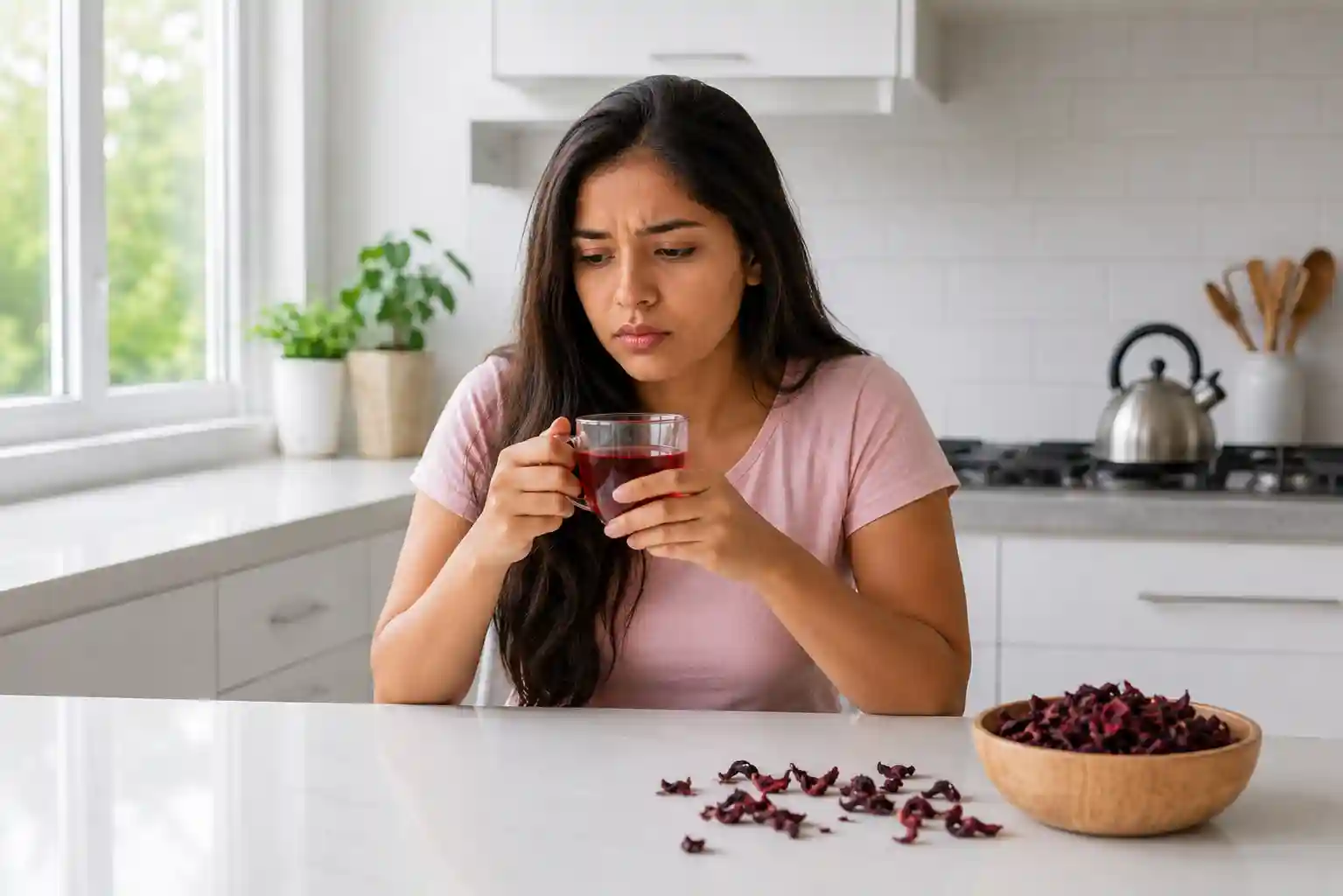
8 Known Side Effects — What the Research Says
Here are the eight side effects you should know about before drinking hibiscus tea every day.
Lowers Blood Pressure — Good or Bad Depending on You
The most consistent effect of hibiscus tea is lowering blood pressure. A 2025 review of 26 trials confirmed this clearly. The drop in pressure is comparable to some prescription drugs.
If your blood pressure is high, this is a benefit. If you take blood pressure medication, or if your pressure is already low, this becomes a risk. Pressure that drops too low causes dizziness, fainting, and falls.
Lowers Blood Sugar — Risk for Diabetics on Medication
Studies show hibiscus tea reduces blood sugar levels. A 2025 study found it lowered post-meal glucose. A 2024 study found it improved blood sugar in type 2 diabetes patients.
If you take insulin or diabetes pills, hibiscus can add to their effect. Your blood sugar could drop too low. Signs include shakiness, sweating, confusion, and in bad cases, passing out.
Stomach Upset — The Most Common Mild Side Effect
The most common side effect in studies is mild stomach trouble. This includes upset stomach, gas, constipation, or nausea. It is the main complaint in safety reviews.
This usually happens when you drink hibiscus on an empty stomach or in larger amounts than you are used to. The natural acid in the tea can irritate your stomach lining if no food is there. Drinking it with food usually solves the problem.
Hormone Effects — Concerns for Reproductive Health
Hibiscus contains plant compounds that can mildly mimic estrogen in your body. This is the main reason it is unsafe in pregnancy. It also raises questions about hormone medications.
Hibiscus may possibly interfere with birth control pills, hormone replacement therapy, and gender-affirming hormones. No human studies have confirmed these interactions yet. But if you take any hormonal medication, talk to your doctor before starting hibiscus tea.
🔬 The Compounds at Work
Hibiscus contains phytoestrogens — plant chemicals that can bind weakly to estrogen receptors. The effect is much weaker than actual hormones, but in sensitive situations like pregnancy or hormone therapy, even small effects matter.
Dizziness and Fatigue — From the Blood Pressure Drop
Some people feel dizzy, lightheaded, or unusually tired after drinking hibiscus tea. This is most common in the first few weeks or when drinking more than 2–3 cups a day.
This is almost always from the blood pressure drop. When pressure falls in someone whose pressure was already normal, less blood reaches the brain. The fix is simple — drink less, and don’t stand up suddenly after drinking.
Allergic Reactions — Rare but Possible
True hibiscus allergy is rare but real. Hibiscus is in the mallow plant family. This family also includes okra, cotton, and marshmallow root. People allergic to these plants may react to hibiscus.
Symptoms can range from mild skin rash to hives or — rarely — a severe allergic reaction. If you get any allergic symptoms after drinking or applying hibiscus tea, stop right away. Get medical help if symptoms are severe.
Tooth Enamel Erosion — The Most Overlooked Daily Risk
This is the side effect most people don’t know about. Hibiscus tea is naturally very acidic. It is acidic enough to slowly wear down tooth enamel over time.
One cup causes very little damage. But daily drinking for months and years without protection can erode your enamel. This causes tooth sensitivity and more cavities. The good news — prevention is easy. Use a straw, rinse with water after, and don’t brush your teeth right away.
Pre-Surgery Risk — Stop 2 Weeks Before Surgery
Stop drinking hibiscus tea at least 2 weeks before any planned surgery. Its blood pressure effects can complicate anesthesia. Its effects on liver enzymes can also change how surgery medications work.
Always tell your surgeon and anesthetist about any herbal teas you drink regularly. Most healthcare guidelines recommend stopping non-essential herbal remedies 2 weeks before surgery.
Drug Interactions — Complete List
This is the most important section if you take prescription medications. Hibiscus affects the liver enzymes that process most drugs. This can change how well your medications work.
🔬 The Mechanism
Hibiscus affects the Cytochrome P450 enzyme system in the liver — the main system that metabolizes most pharmaceutical drugs. Depending on the drug, hibiscus can either speed up or slow down metabolism, changing the drug’s blood levels and effects.
| Medication | What Happens | Risk Level | What to Do |
|---|---|---|---|
| Blood pressure drugs (ACE inhibitors, ARBs, beta-blockers, diuretics) | Adds to the blood pressure lowering effect | ⭐⭐⭐⭐⭐ HIGH | Avoid unless your doctor agrees. Risk of dangerous low BP. |
| Losartan (Cozaar) | Hibiscus increases losartan blood levels | ⭐⭐⭐⭐⭐ HIGH | Avoid combination. Can cause too-low BP and stronger drug effects. |
| Chloroquine (antimalarial) | Hibiscus cuts chloroquine absorption to one-third | ⭐⭐⭐⭐⭐ HIGH | Avoid completely. Can make malaria treatment fail. |
| Insulin & diabetes pills (metformin, sulfonylureas) | Adds to blood sugar lowering effect | ⭐⭐⭐⭐ HIGH | Avoid unless doctor-supervised. Watch blood sugar closely. |
| Simvastatin (Zocor) | Hibiscus reduces drug levels and effectiveness | ⭐⭐⭐ MODERATE | Talk to your doctor. May need dose change or timing adjustment. |
| Diclofenac (Voltaren) | Hibiscus increases drug blood levels | ⭐⭐⭐ MODERATE | Separate by several hours. Higher levels mean more side effects. |
| Acetaminophen / Paracetamol (Tylenol) | Hibiscus speeds up elimination of the drug | ⭐⭐ LOW–MODERATE | Separate by 2–3 hours. Watch if pain relief seems weaker. |
| Birth control pills | Plant estrogens may affect hormone levels (theoretical) | ⭐⭐ LOW | Talk to your doctor. No human studies yet confirm this. |
| Hormone therapy / HRT | Plant estrogens may modulate hormone effects (theoretical) | ⭐⭐ LOW | Tell your doctor. Monitor hormone levels if combining. |
| Digoxin (heart medication) | Can cause false readings in some digoxin blood tests | ⭐⭐⭐ MODERATE | Tell your doctor and lab. May need a different test method. |
| Caffeine medications | May slightly raise caffeine blood levels | ⭐ LOW | Be aware if combining with caffeine supplements. |
If you are using hibiscus for eczema itch relief, our guide explains how to use it safely with prescribed treatments: does hibiscus tea stop eczema itching.
Who Should Avoid Hibiscus Tea
The following groups should avoid hibiscus tea or be very careful with it.
🤰 Pregnant women
Avoid completely throughout pregnancy. Hibiscus may stimulate uterine contractions. This raises miscarriage risk in early pregnancy and premature labor risk later. This is a firm rule, not just a precaution.
👶 Breastfeeding mothers
Avoid while breastfeeding. Safety has not been studied well. Hibiscus compounds may pass into breast milk. Effects on the baby are unknown.
🩸 People with low blood pressure
If your blood pressure is naturally low (below 90/60 mmHg), hibiscus may push it lower. This raises your risk of dizziness, fainting, and falls. Avoid it or use only in tiny amounts with medical guidance.
🦟 People taking chloroquine
Avoid completely. A study found hibiscus tea cuts chloroquine blood levels to about one-third. This could make malaria treatment fail — a life-threatening problem in malaria areas.
✂️ Anyone scheduled for surgery within 2 weeks
Stop hibiscus tea at least 2 weeks before any surgery. Tell your surgeon you have been drinking it. Its effects on blood pressure and liver enzymes can complicate surgical care.
🌿 People with mallow family allergies
If you are allergic to okra, cotton, marshmallow, or hollyhock, be very careful with hibiscus. Do a patch test before any topical use. Talk to your doctor before drinking it.
🔗 🌺 Full Guide: Hibiscus Tea for Psoriasis & Eczema — 7 Proven Benefits
This article focuses on safety and side effects. For the complete picture — all 7 benefits, nutritional profile, traditional uses, dosage, and how to use hibiscus tea for skin conditions — read our full pillar guide:
👉 7 Proven Benefits of Hibiscus Tea for Psoriasis & Eczema →
Hibiscus Tea in Pregnancy & Breastfeeding
This topic gets its own section because the answer is clear and important. The recommendation is firm.
Some cultures have used hibiscus during pregnancy in the past. This causes confusion. But traditional use does not equal safety. Modern research clearly points the other way.
Why Hibiscus Is Unsafe in Pregnancy
1. It can stimulate the uterus. Hibiscus has properties that can bring on a delayed period. The same effect can also stimulate uterine contractions during pregnancy. This raises miscarriage risk in the first trimester and premature labor later.
2. It contains plant estrogens. These compounds can affect hormone levels. During pregnancy, hormone balance is critical for the baby’s development. Even small disruptions could be harmful.
3. Animal studies show effects on fertility and pregnancy. While animal data does not directly apply to humans, the findings are enough reason to be careful.
4. Major medical sources warn against it. Both WebMD and drugs.com classify hibiscus as “possibly unsafe” during pregnancy and breastfeeding. The guidance is clear: avoid it.
🍵 Safer Tea Choices During Pregnancy
If you are pregnant and want a calming herbal tea, these are generally safer (always check with your midwife or obstetrician first):
Chamomile tea — in moderate amounts; widely considered low-risk
Rooibos tea — caffeine-free with no known pregnancy concerns
Ginger tea — well-studied for pregnancy nausea; safe in moderate amounts
Hibiscus Tea & Liver Health — The Real Story
You may have read scary claims that hibiscus tea damages the liver. Here is the full story with the right context.
What Animal Studies Found
Some animal studies found that very high doses of concentrated hibiscus extract caused liver stress in rats. The dose used was 300mg per kg body weight per day for 3 months. That is a huge amount — far more than any human would get from drinking tea.
What Human Studies Show
In human studies at normal tea amounts (1–3 cups daily), no liver damage has been reported. In fact, hibiscus has shown liver-protective effects in some research. One study found it improved fatty liver in human participants.
The 2025 review of 18 studies covering 732 people found no liver-related side effects.
The Bottom Line on Liver Safety
Tooth Enamel — The Most Overlooked Daily Side Effect
Most articles focus on blood pressure and pregnancy. Few address the dental risk. But for healthy adults drinking hibiscus tea daily for skin, this is one of the most relevant concerns.
Hibiscus tea is one of the most acidic herbal teas. Its acid level is similar to fruit juice or cola. Below is how it compares to other drinks.
| Drink | Acid Level (pH) | Enamel Risk |
|---|---|---|
| Water | 7.0 | None |
| Chamomile tea | 6.0–7.0 | Very low |
| Green tea | 7.0–8.0 | Very low |
| Rooibos tea | 5.5–6.5 | Very low |
| Coffee | 4.8–5.0 | Low–moderate |
| Orange juice | 3.5–4.0 | Moderate–high |
| Hibiscus tea | 2.5–3.5 | Moderate–high |
| Cola / fizzy drinks | 2.4–3.5 | High |
| Enamel erosion threshold | ~5.5 | Erosion starts below this |
Lost enamel does not grow back. But the risk is easy to manage with simple habits.
• Drink through a straw — keeps acid off your teeth
• Rinse with plain water right after drinking
• Do not brush for at least 30 minutes after drinking
• Drink in one sitting — slow sipping spreads the acid exposure
• Drink with or after a meal when possible — food helps neutralize acid
🌿 How should you use hibiscus tea? Type it in our free Herb & Tea Benefit Finder — get preparation method, timing, dosage, and safety notes instantly.
🔍 Try the Herb & Tea Benefit Finder →Safe Daily Amount & How to Lower All Risks
The amounts below are based on clinical trial data. Stick within these limits and use the protective habits to keep risks low.
Risk-Lowering Checklist
| Risk | How to Lower It |
|---|---|
| Blood pressure drop | Check your BP for the first 2 weeks; avoid if on BP meds without doctor approval |
| Blood sugar drop | Check blood glucose if diabetic; talk to doctor before starting |
| Stomach upset | Drink with food; start with 1 cup daily and increase slowly |
| Tooth enamel erosion | Use a straw; rinse with water after; don’t sip slowly for hours |
| Drug interactions | Tell your doctor and pharmacist; space tea 2–3 hours from medications |
| Tooth staining | Rinse mouth with water after drinking; brush normally |
| Skin staining (topical) | Normal and temporary — fades within 30 minutes; avoid light clothing after |
Is Hibiscus Tea Still Worth It for Skin Conditions?
After reading all those side effects, you might wonder: is hibiscus tea still a good choice for psoriasis and eczema? For most people — yes, absolutely.
The side effects in this article are real but specific. If you are a healthy adult with normal blood pressure, not on the listed medications, not pregnant, and have no plant allergies — your risk from 1–2 cups daily is very low. The main daily risk (tooth enamel) is easy to manage with a straw and water rinse.
The benefits for eczema and psoriasis are real. Hibiscus calms inflammation, reduces itch, softens plaques, and fights skin bacteria. These are all backed by research.
The key is using it wisely. Know who should avoid it. Check your medications. Use the dental protection habits. With these in mind, hibiscus tea is one of the best and safest herbal teas for skin conditions.
📋 Quick Safety Checklist Before Starting Daily Hibiscus Tea
✅ Not pregnant or breastfeeding
✅ Not taking blood pressure medication
✅ Not taking chloroquine for malaria
✅ Not taking insulin or diabetes pills
✅ Not taking losartan, simvastatin, or hormonal medications
✅ No allergy to mallow family plants (okra, cotton, hollyhock)
✅ No surgery scheduled in the next 2 weeks
✅ Blood pressure is normal or high (not naturally low)
If all boxes are ticked — hibiscus tea at 1–2 cups daily is very likely safe for you. If any box is uncertain — talk to your doctor or pharmacist first.
For safe topical use — which avoids most internal risks — see our complete guide: how to make a hibiscus tea compress for psoriasis.
Try Our Free Herb & Tea Benefit Finder
Type hibiscus or any herb to instantly see its benefits, how to use it, and who should be careful — all in one place.
🔍 Open the Herb & Tea Benefit Finder →Frequently Asked Questions
For most healthy adults, yes — 1–3 cups daily is very safe. A 2025 review of 18 studies with 732 participants found hibiscus is “very safe except for minor stomach issues.” Clinical trials have used up to 720ml (3 cups) daily for 6 weeks without serious problems.
The exceptions: don’t drink daily if you are pregnant, take blood pressure or diabetes medication, take chloroquine, or have naturally low blood pressure. Use a straw and rinse with water after drinking to protect your tooth enamel.
Yes — this is hibiscus tea’s most consistent effect and its biggest risk. Multiple trials confirm it lowers blood pressure. For people with high BP not on medication, this is good. For people on BP medication or with naturally low BP, it can drop pressure too low.
Symptoms include dizziness, lightheadedness, fainting, and fatigue. If you have any blood pressure concerns, check your BP before starting and watch it for the first 2 weeks of daily use.
Not without doctor guidance. Hibiscus tea lowers blood pressure through similar mechanisms as your medication. The combination can drop pressure too low.
This is especially important with losartan — hibiscus has been shown to increase losartan blood levels and boost its effect. Other BP drugs (ACE inhibitors, beta-blockers, calcium channel blockers, diuretics) also carry added risk. Always check with your cardiologist or GP first.
No — hibiscus tea should be avoided completely during pregnancy. Major sources like WebMD and drugs.com classify it as “possibly unsafe.” Hibiscus contains compounds that may stimulate uterine contractions, raising miscarriage risk in early pregnancy and premature labor risk later.
Don’t be misled by traditional use — old practice doesn’t confirm safety. Choose safer options like rooibos or ginger tea, and always check herbal teas with your midwife or obstetrician.
No — at normal tea amounts (1–3 cups daily), hibiscus does not damage the liver in healthy people. The liver concern comes from animal studies using very high doses of concentrated extract — far more than any tea provides.
Human studies at normal amounts have shown no liver damage. Hibiscus has actually shown some liver-protective effects in research. People with existing liver disease should still talk to their doctor before starting.
Studies have used up to 720ml (about 3 cups of 240ml) daily for up to 6 weeks without serious side effects in healthy adults. For everyday use, 1–2 cups is a safe and well-tolerated amount.
For skin conditions, 1–2 cups daily for 4–8 weeks is the recommended approach. More than 3 cups is not recommended — extra benefit is small while the risks (BP, dental, stomach) grow.
Yes — hibiscus has several documented drug interactions. Key ones include: chloroquine (cuts absorption to one-third — avoid completely), losartan (raises blood levels — avoid without medical supervision), simvastatin (reduces effect), diclofenac (raises levels), and acetaminophen (faster elimination).
It also adds to blood pressure and diabetes medication effects. May theoretically interact with hormonal medications. Always tell your doctor and pharmacist that you drink hibiscus tea — especially when starting any new medication.
Yes, though it is uncommon. Hibiscus is in the mallow plant family. People allergic to related plants — okra, cotton, hollyhock, marshmallow root — may react to hibiscus.
Symptoms range from mild rash to hives to severe reactions in rare cases. Do a patch test before topical use. Start with a small amount internally if you have plant allergies. Stop right away and seek medical help if you get any allergic symptoms.
For teens aged 12–18, hibiscus has been considered possibly safe at moderate doses (2g three times daily for up to 4 weeks). For children under 12, there is not enough safety data for internal use.
Always talk to a pediatrician before giving hibiscus tea to any child under 12. For younger children with eczema, topical use (diluted compress) is safer than drinking it. Always dilute with equal water, patch test first, and watch closely for any reaction.
📚 Related Health Guides
7 Proven Benefits of Hibiscus Tea for Psoriasis & Eczema
The full pillar guide — all 7 skin benefits, dosage, and how to use hibiscus tea safely.
Hibiscus Tea vs Green Tea for Eczema: Which Is Better?
Head-to-head comparison — mechanisms, evidence, itch relief, and how to combine both.
How to Make a Hibiscus Tea Compress for Psoriasis
Step-by-step topical guide with safety rules for when NOT to apply.
Is Ginger Tea Good for You? Benefits, Best Time & How to Make It
A safer alternative to hibiscus for pregnant women and those with BP concerns.

I take locartan and 1-2 cups of hibiscus tea. The tea helps bring my blood pressure down to more healthy levels, but also. Causes very itchy skin on my forearms. Does that mean it is doing damage elsewhere in my body? Is there anything I can do to relieve the itching?
Thank you for your help.
Hi Maria,
The itching is most likely a mild skin reaction to hibiscus. It does not usually mean internal damage. Some people are sensitive to the plant acids in hibiscus tea. Forearm skin can be especially reactive.
That said, please talk to your doctor. You are already taking losartan for blood pressure. Hibiscus also lowers blood pressure. Together, they may push your levels lower than intended.
To reduce itching, try cutting back to one cup a day. Cool-brewed hibiscus (no hot water) may also be gentler on your skin. A fragrance-free moisturiser on the forearms after drinking may help too.
Always check with your doctor before continuing — especially with a medication combination.
You may also find this helpful: https://dailyhealthleaf.com/hibiscus-tea-compress-for-psoriasis/
DailyHealthLeaf Editorial Team