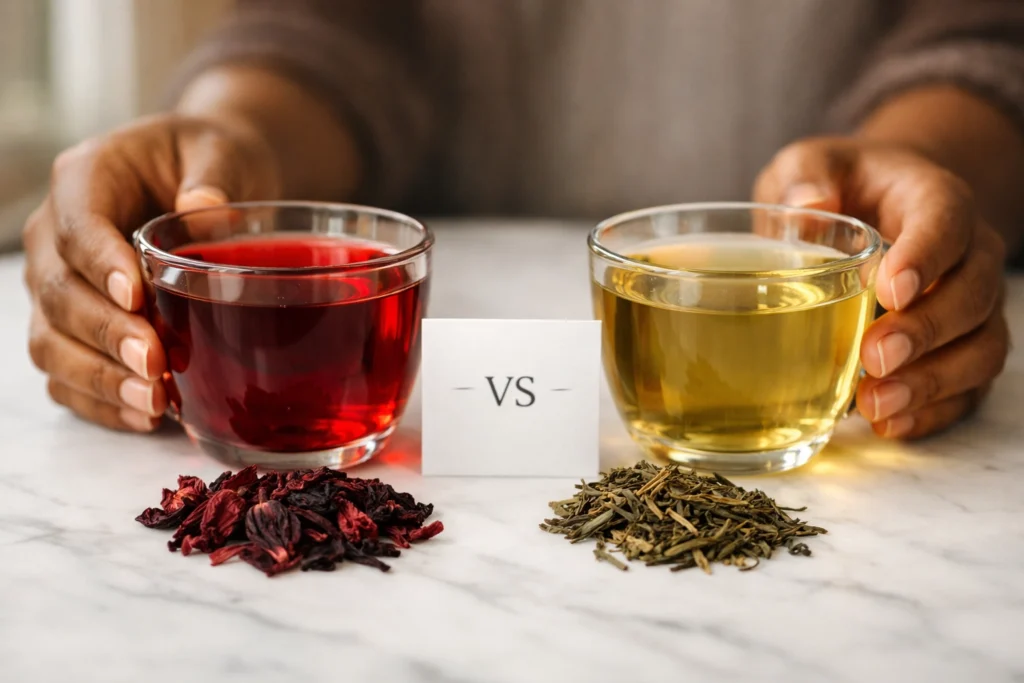
Hibiscus tea and green tea both help eczema — but in different ways. The best results come from using both together at different times of day.
📋 Table of Contents
- Two Teas, Two Different Approaches
- What Is Hibiscus Tea? Key Compounds for Eczema
- What Is Green Tea? Key Compounds for Eczema
- How Each Tea Targets Eczema
- What the Research Says
- Which Is Better for Eczema Itching?
- Which Is Better for Eczema Inflammation?
- Which Is Better Used on Skin?
- Caffeine Comparison
- Full Head-to-Head Table
- The Verdict — Which Should You Choose?
- How to Use Both Together
- Dosage & Brewing Guide
- Side Effects & Precautions
- Frequently Asked Questions
Two Teas, Two Different Approaches to Eczema
“Should I drink hibiscus tea or green tea for my eczema?” People ask this all the time. They expect a simple answer. But the real answer is more useful — both teas help, just in different ways.
Eczema affects over 230 million people worldwide. It’s caused by a mix of immune problems, weak skin barrier, bacteria, itch chemicals, and oxidative stress. No single drink fixes all of these.
🛠️ Free Health Tools — Water Intake Calculator, BMI Calculator, Intermittent Fasting Calculator & more
🔍 Browse All Free Health Tools →But two well-chosen teas — each working on a different part of the problem — can cover much more than either alone. This guide breaks down the science behind both teas. We compare them across every angle that matters for eczema. We give clear winners for specific symptoms. And we show you exactly how to combine them.
This is part of our pillar guide: 7 Proven Benefits of Hibiscus Tea for Psoriasis & Eczema.
What Is Hibiscus Tea? Key Compounds for Eczema
Hibiscus tea comes from the dried red parts of the Hibiscus sabdariffa flower. It is a deep red, tart drink with no caffeine. People in Africa, the Middle East, the Caribbean, and South Asia have used it for centuries.
🔬 The Active Compounds in Hibiscus
The red color comes from anthocyanins — mainly delphinidin-3-sambubioside and cyanidin-3-sambubioside. These lower IgE antibodies and histamine. Hibiscus also contains natural AHAs (malic acid, citric acid) that gently exfoliate, plus quercetin and vitamin C.
| Compound | Type | What It Does for Eczema |
|---|---|---|
| Anthocyanins | Plant pigment | Lowers itch antibodies and histamine |
| Quercetin | Flavonoid | Reduces inflammation chemicals |
| Malic acid | Fruit acid | Softens thick eczema skin gently |
| Citric acid | Fruit acid | Restores skin pH; mild antibacterial |
| Hibiscus acid | Organic acid | Helps blood vessels and reduces swelling |
| Vitamin C | Vitamin | Builds collagen; supports immunity |
| Phenolic acids | Polyphenol | Fights staph bacteria on eczema skin |
Local names: Karkadé (Arabic), Zobo (Nigerian), Bissap (Senegalese), Flor de Jamaica (Mexican), Sorrel (Caribbean), Lal Ambadi (Hindi/Urdu)
Caffeine: Zero | Taste: Tart, like cranberry | Color: Deep ruby red
What Is Green Tea? Key Compounds for Eczema
Green tea comes from the Camellia sinensis plant — the same plant that gives us black, white, and oolong tea. Green tea is made by steaming or pan-firing fresh leaves to stop them from oxidizing. This keeps the active compounds intact.
Green tea is the most researched drink in the world. There are thousands of published studies on its health effects.
🔬 The Active Compounds in Green Tea
The main active compound is EGCG (epigallocatechin-3-gallate) — a powerful catechin. EGCG blocks mast cells from releasing histamine and lowers Th2 cytokines (IL-4 and IL-5) that drive allergic inflammation. Green tea also contains L-theanine, an amino acid that reduces stress.
| Compound | Type | What It Does for Eczema |
|---|---|---|
| EGCG | Catechin | Blocks histamine release; reduces allergic inflammation |
| Other catechins | Catechins | Antioxidant; work together with EGCG |
| L-theanine | Amino acid | Lowers stress and cortisol — helps stress-triggered flares |
| Quercetin | Flavonoid | Reduces inflammation (same as in hibiscus) |
| Rutin | Flavonoid | Antioxidant; supports blood vessels |
| Chlorogenic acid | Polyphenol | Antioxidant; anti-inflammatory |
| Vitamin C | Vitamin | Antioxidant and immune support |
Caffeine: Low–moderate (~25–35mg per cup) | Taste: Grassy, slightly bitter | Color: Pale golden-green
How Each Tea Targets Eczema
This is the most important section. Both teas help eczema — but they attack different parts of the problem.
Best at: Stopping Itch & Softening Thick Skin
Hibiscus works “upstream” in the itch process. It lowers the antibodies that cause itch before they can act. It also reduces the histamine in your body that triggers the itch signal.
One 2025 study found hibiscus reduced itch antibodies by 26.6% — better than a steroid drug. Hibiscus also has natural fruit acids that gently soften thick, scaly skin from chronic scratching. Green tea cannot do this.
Best at: Calming Deep Inflammation & Stress
Green tea works at the cellular level. EGCG stops the cells that release histamine from doing so. It also lowers the inflammation chemicals that drive allergic reactions in eczema.
A 2025 study found green tea extracts reduced eczema-like skin damage as well as a steroid drug. Green tea also contains L-theanine — an amino acid that calms stress. Stress is a major eczema trigger that hibiscus cannot directly address.
What the Research Actually Says
Here is how the evidence stacks up for each tea.
| Study Type | 🌺 Hibiscus Tea | 🍃 Green Tea |
|---|---|---|
| Human eczema trials | ❌ No direct trials yet; reviews confirm anti-inflammatory effects broadly | ✅ Pilot study: green tea bath therapy 3×/week for 4 weeks improved eczema scores significantly |
| Animal eczema studies | ✅ 2025 study: 62.9% reduction in skin thickness, IgE down 26.6%, less scratching | ✅ Multiple studies: EGCG reduced eczema-like skin damage in mice |
| Cell studies | ✅ Anthocyanins reduce inflammation chemicals by 73–85% | ✅ EGCG blocks histamine release; reduces skin thickening as well as a steroid (2025) |
| Systematic reviews | ✅ 2025 review confirms steady anti-inflammatory effects across 14 studies | ✅ Multiple reviews confirm green tea catechins help inflammation and allergies |
| Topical evidence | ✅ Traditional use; cell studies on anthocyanins and AHAs | ✅ EGCG cream and bath therapy have shown clinical improvement |
| Antibacterial action | ✅ Strong against staph (2024 review) | ✅ Strong against staph (EGCG is naturally antibacterial) |
| Overall evidence quality | ⭐⭐⭐⭐ Strong science; limited human eczema trials | ⭐⭐⭐⭐⭐ Strong science + animal + human trials |
Which Is Better for Eczema Itching?
Winner: Hibiscus Tea — for most people.
Both teas fight itch through the histamine pathway, but at different stages. Green tea stops cells from releasing histamine. Hibiscus does that AND lowers the itch antibodies that trigger the cells in the first place.
So hibiscus acts earlier in the chain. It also works through more pathways at once. Many people in eczema forums say hibiscus tea calms their skin “within an hour” during a flare.
Hibiscus also wins as a topical compress. The cold tea cools sensitive skin nerves while delivering anti-itch compounds directly. No other tea on this list is used this way as commonly.
One point in green tea’s favor: a human pilot study showed green tea bath therapy reduced itch scores after 4 weeks. Hibiscus has no equal human itch study yet.
🏆 Itch Verdict
Hibiscus wins for fast itch relief (especially as a cold compress) and for itch driven by high antibody levels.
Green tea wins if your itch is mostly stress-driven (L-theanine calms stress) and for bath therapy.
Combined approach wins overall — hibiscus blocks the upstream signals while green tea calms the downstream cells.
Which Is Better for Eczema Inflammation?
Winner: Green Tea — by a small margin.
Both teas turn down the master inflammation switch in your skin cells. But green tea’s EGCG has been studied more for this. It shows more consistent results in cell research.
A 2025 study found green tea extracts reduced eczema skin damage as well as a steroid drug. That’s a strong benchmark hibiscus has not yet matched in eczema-specific research.
Green tea also lowers IL-4 and IL-5 — the main allergy chemicals in eczema. This is especially helpful for moderate-to-severe eczema patients. It calms the immune bias at its root.
Hibiscus is close behind. It reduces other inflammation chemicals strongly. But for eczema-specific anti-inflammatory power, green tea has the edge right now.
Which Is Better Used on Skin?
Winner: Hibiscus Tea — for most topical uses.
Both teas can be applied to the skin as a compress or rinse. Green tea bath therapy has human study evidence for eczema. But hibiscus has a key topical advantage green tea cannot match.
Hibiscus contains natural fruit acids (AHAs) that gently soften thick, scarred eczema skin. Green tea has no fruit acid content. So for chronic, lichenified eczema patches, hibiscus is the clear winner topically.
Here is the breakdown by use case:
For acute flare compress: Hibiscus wins. The cold compress calms itch instantly while delivering anti-inflammatory compounds.
For bath therapy: Green tea wins — it has clinical evidence. Hibiscus baths are used traditionally but lack equivalent studies.
For thick or scarred skin patches: Hibiscus wins clearly — only its fruit acids can soften this skin.
🌿 How should you use hibiscus or green tea? Type either in our free Herb & Tea Benefit Finder — get preparation method, timing, dosage, and safety notes instantly.
🔍 Try the Herb & Tea Benefit Finder →For a complete step-by-step guide to making and applying hibiscus tea topically, see: how to make a hibiscus tea compress for psoriasis.
Caffeine Comparison — Why It Matters for Eczema
This is an underrated factor in the hibiscus vs green tea debate. Caffeine raises stress hormones, and stress is a major eczema trigger.
| Factor | 🌺 Hibiscus Tea | 🍃 Green Tea |
|---|---|---|
| Caffeine content | Zero | ~25–35mg per cup |
| Stress hormone (cortisol) impact | None | Moderate — caffeine raises cortisol |
| Sleep disruption risk | None — safe anytime | Moderate — avoid after 3–4pm |
| Stress-triggered eczema | ✅ Better — calming | ⚠️ Caution with heavy use |
| Evening use | ✅ Ideal | ❌ Not after midday for sensitive people |
| Histamine in tea | Very low | Low |
For people with stress as a major eczema trigger, hibiscus is the clear evening choice. Its zero caffeine means no cortisol spike and no sleep disruption. Poor sleep alone triggers eczema flares — so green tea late in the day can backfire.
For more on hibiscus tea and itch specifically, see our dedicated guide on does hibiscus tea stop eczema itching — what the research says.
Full Head-to-Head Comparison Table
Here is the full comparison across every angle that matters for eczema.
| Category | 🌺 Hibiscus Tea | 🍃 Green Tea | Winner |
|---|---|---|---|
| Itch relief | ⭐⭐⭐⭐⭐ Strongest antihistamine action | ⭐⭐⭐⭐ Blocks histamine release | 🌺 Hibiscus |
| Anti-inflammatory power | ⭐⭐⭐⭐ Strong | ⭐⭐⭐⭐⭐ Comparable to a steroid drug in studies | 🍃 Green Tea |
| Softening thick skin | ⭐⭐⭐⭐⭐ Natural fruit acids do this | ⭐ No fruit acid content | 🌺 Hibiscus |
| Human clinical evidence | ⭐⭐⭐ Strong reviews; no eczema trial yet | ⭐⭐⭐⭐⭐ Pilot trial improved eczema scores | 🍃 Green Tea |
| Antibacterial action | ⭐⭐⭐⭐⭐ Strong against staph | ⭐⭐⭐⭐⭐ Also strong against staph | 🤝 Tie |
| Stress management | ⭐⭐⭐ No caffeine — neutral | ⭐⭐⭐⭐⭐ L-theanine actively reduces stress | 🍃 Green Tea |
| Topical compress | ⭐⭐⭐⭐⭐ Fruit acids + cooling effect | ⭐⭐⭐ Effective but no fruit acid | 🌺 Hibiscus |
| Bath therapy evidence | ⭐⭐⭐ Traditional use | ⭐⭐⭐⭐ Pilot human trial | 🍃 Green Tea |
| Caffeine safety | ⭐⭐⭐⭐⭐ Zero caffeine | ⭐⭐⭐ Low-moderate caffeine | 🌺 Hibiscus |
| Skin pH balance | ⭐⭐⭐⭐⭐ Restores skin acid mantle | ⭐⭐ Mildly acidic | 🌺 Hibiscus |
| Taste | ⭐⭐⭐⭐ Tart and fruity | ⭐⭐⭐ Grassy and slightly bitter | 🌺 Hibiscus |
| Cost & availability | ⭐⭐⭐⭐ Widely available | ⭐⭐⭐⭐⭐ Very widely available | 🍃 Green Tea |
🔗 🌺 Full Guide: Hibiscus Tea for Psoriasis & Eczema — 7 Proven Benefits
This article compares hibiscus and green tea for eczema. For the complete picture on hibiscus — all 7 benefits, dosage, traditional uses, compress method, and side effects — read our pillar guide:
👉 7 Proven Benefits of Hibiscus Tea for Psoriasis & Eczema →
The Verdict — Which Should You Choose?
There is no single winner. The best choice depends on your main eczema symptoms.
Itch Is Your Worst Symptom
Hibiscus is your better choice if itching is your most disabling symptom. It is also better if your skin has thickened or scarred from chronic scratching — the natural fruit acids will soften it over time.
Choose hibiscus if you are caffeine-sensitive and want tea in the evening. Pick it if you want a tea you can also use as a topical compress for direct skin treatment. It is also the best fit if you follow a low-histamine diet for your eczema.
Inflammation or Stress Is Your Main Problem
Green tea is your better choice if your eczema is driven by deep inflammation rather than acute itch. Pick it if stress is a major trigger for your flares — L-theanine directly addresses this.
Choose green tea if you want to do bath therapy — it has the human clinical evidence that hibiscus lacks for baths. Or if you can’t find good loose-leaf hibiscus and green tea is your only realistic option.
🎯 The Real Answer: Use Both
The best evidence-based answer is to use both teas at different times of day. Hibiscus covers itch, antibodies, fruit acid skin softening, and antibacterial protection. Green tea covers deep cell inflammation, stress modulation, and immune balance. Together they cover almost every part of eczema that herbal tea can reach.
How to Use Both Teas Together for Maximum Benefit
Here is the day-by-day plan for combining both teas.
| Time | Tea | How | Why |
|---|---|---|---|
| Morning | 🍃 Green Tea | 1 cup hot, 30 min after breakfast | Starts inflammation control and stress modulation early; caffeine is fine in morning |
| Afternoon | 🍃 Green Tea (optional 2nd cup) | 1 cup hot or iced, before 2pm | Maintains EGCG levels; last caffeine drink of the day |
| Evening | 🌺 Hibiscus Tea | 1 cup warm, 1 hr before bed | Caffeine-free; antihistamine effect works overnight; reduces morning itch |
| During a flare | 🌺 Hibiscus Tea | Drink 1 cup + cold compress on the spot | Fastest combined inside-and-outside relief |
| After your shower | 🌺 Hibiscus Tea | Cool tea rinse over affected skin; then moisturize | Damp skin absorbs the active compounds best |
| Weekly bath | 🍃 Green Tea | 4–6 cups strong green tea in lukewarm bath, soak 15–20 min | Has human clinical evidence for eczema bath therapy |
Dosage & Brewing Guide
Use these amounts as your daily plan. Always start low and adjust based on how your body responds.
| Tea | Amount | Water Temp | Steep Time | Key Tip |
|---|---|---|---|---|
| 🌺 Hibiscus (drink) | 1–2 tsp / 240ml | 85–90°C | 7–8 min | Use loose-leaf only — tea bags have far fewer active compounds |
| 🌺 Hibiscus (compress) | 3–4 tsp / 240ml | 85–90°C | 10 min | Double-strength; cool fully in fridge before applying |
| 🍃 Green Tea (drink) | 1–2 tsp / 240ml | 80–85°C | 2–3 min | Never use boiling water — it destroys the active compounds and makes tea bitter |
| 🍃 Green Tea (bath) | 700ml extract / full bath | 37°C bath water | 30 min soak | Based on the clinical study protocol |
Side Effects & Precautions
Both teas are safe for most people, but each has specific concerns to be aware of.
🌺 Hibiscus — Blood pressure medication
Hibiscus lowers blood pressure noticeably. If you take BP medication, talk to your doctor before regular use. Green tea is not a concern at normal amounts.
🍃 Green Tea — Caffeine sensitivity
Green tea has 25–35mg caffeine per cup. If caffeine-sensitive, limit to 1 cup before midday. Avoid if your eczema worsens with caffeine. Hibiscus is the caffeine-free alternative.
🌺 Hibiscus — Pregnancy
Avoid hibiscus during pregnancy — it may stimulate contractions. Green tea in moderate amounts is generally safer in pregnancy, though caffeine should still be limited.
🍃 Green Tea — Iron absorption
Green tea can reduce iron absorption from food. If you are iron-deficient, don’t drink green tea with meals. Hibiscus is a better mealtime option for iron-sensitive people.
🌺 Hibiscus — Tooth enamel
Hibiscus is naturally acidic. Drink through a straw and rinse with water after. Green tea is much less acidic and not a dental concern at normal amounts.
Both — Patch test before using on skin
Always patch test any new tea before applying topically to eczema skin. Apply to inner wrist, wait 24 hours, check for any reaction. Both teas are well-tolerated topically but individual sensitivities happen.
⚠️ Full Side Effects & Drug Interactions Guide
Before drinking either tea daily, especially hibiscus, read our complete safety reference covering all 8 side effects, 11 drug interactions, and who should avoid it:
👉 Hibiscus Tea Side Effects: What to Know Before Drinking Daily →
Conclusion
Hibiscus tea and green tea are not rivals. They are partners in managing eczema. Hibiscus is the best for itch, antibody reduction, and softening thick skin. Green tea is the best for deep inflammation, mast cell calming, and stress relief.
Together, they cover almost every part of eczema that herbal tea can reach. The simple plan: drink green tea in the morning for its anti-inflammatory and stress-calming effects. Drink hibiscus in the evening for its antihistamine action. Use hibiscus as a compress on flare-ups. Add a weekly green tea bath for proven eczema relief.
Neither tea replaces prescribed eczema treatment. But used alongside medical care, this two-tea strategy covers more of the eczema picture than most people have ever tried.
Try Our Free Herb & Tea Benefit Finder
Type hibiscus, green tea, or any other herb to instantly see its benefits, best time to use, preparation method, and who should be careful.
🔍 Open the Herb & Tea Benefit Finder →Frequently Asked Questions
Neither is better overall — they target different parts of eczema. Hibiscus is better for itch relief, softening thick skin, and evening use (no caffeine). Green tea is better for deep inflammation, stress-triggered flares, and bath therapy.
The best plan is using both — green tea morning, hibiscus evening — to cover more biological ground than either alone.
Yes — combining both is the recommended strategy. Drink 1–2 cups of green tea in the morning (before 2pm to avoid sleep issues from caffeine). Drink 1 cup of hibiscus tea in the evening.
Total of 3–4 cups across both teas is safe for most healthy adults. There are no known negative interactions between the two teas.
For most people, green tea is helpful or neutral for eczema. But some experts note that green tea may stimulate the same allergy pathway already overactive in eczema — but only at very high amounts.
If you drink 1–2 cups daily and notice your eczema getting worse, cut back or try decaf green tea. Most people benefit from moderate green tea consumption for the EGCG anti-inflammatory effect.
For children, hibiscus is generally the safer drink because it has zero caffeine. Green tea’s caffeine is not appropriate for young children.
Always check with your child’s doctor before giving any herbal tea internally to children under 12. Hibiscus should be avoided in children with blood pressure concerns. For topical use, both teas can be used as diluted compresses — always dilute with equal water and patch test first.
For both teas, you may notice less itching within 1–2 weeks of daily use. Bigger improvements in flare frequency and skin redness usually take 4–8 weeks of consistent use.
The green tea bath therapy study showed eczema score improvements over a 4-week period with 3 sessions per week. Topical hibiscus compress can give immediate soothing relief during flares. Consistency is key — skipping days resets the benefit.
Yes — combining both in a lukewarm bath is a reasonable approach. Brew 3 cups of each tea separately, strain well, cool to lukewarm, and add to your bath. The green tea provides EGCG action while hibiscus adds antibacterial and skin-softening benefits.
The hibiscus will turn the bathwater deep red — this is harmless and won’t permanently stain your skin. Keep bath water lukewarm (around 37°C), not hot.
For wet, weepy eczema (acute flares with oozing): green tea is preferable. Its EGCG is strongly antibacterial, and it calms acute inflammation. Don’t apply hibiscus to actively weeping skin — the acidity may sting.
For dry, thick, scarred eczema: hibiscus wins clearly. Its natural fruit acids gradually soften and thin the skin layers that green tea cannot affect topically. Both can be drunk for either type.
No major interactions between hibiscus tea and common eczema medications (steroid creams, calcineurin inhibitors, dupilumab, methotrexate) have been documented.
Hibiscus’s main drug interactions are with blood pressure and diabetes medications. Green tea’s main concern is with blood thinners (vitamin K content) and iron absorption supplements. Always tell your doctor about herbal teas you drink.
📚 Related Health Guides
7 Proven Benefits of Hibiscus Tea for Psoriasis & Eczema
The complete hibiscus pillar guide — all benefits, dosage, traditional uses, and compress method.
Does Hibiscus Tea Stop Eczema Itching? What the Research Says
Deep dive into the itch science — histamine, IgE, and how hibiscus breaks the itch-scratch cycle.
7 Best Herbal Teas for Psoriasis Flare-Up Relief (Ranked)
How hibiscus and green tea rank among 7 teas — plus oolong, chamomile, rooibos, and more.
How to Make a Hibiscus Tea Compress for Psoriasis
Step-by-step guide to making and applying a hibiscus compress directly to skin.