
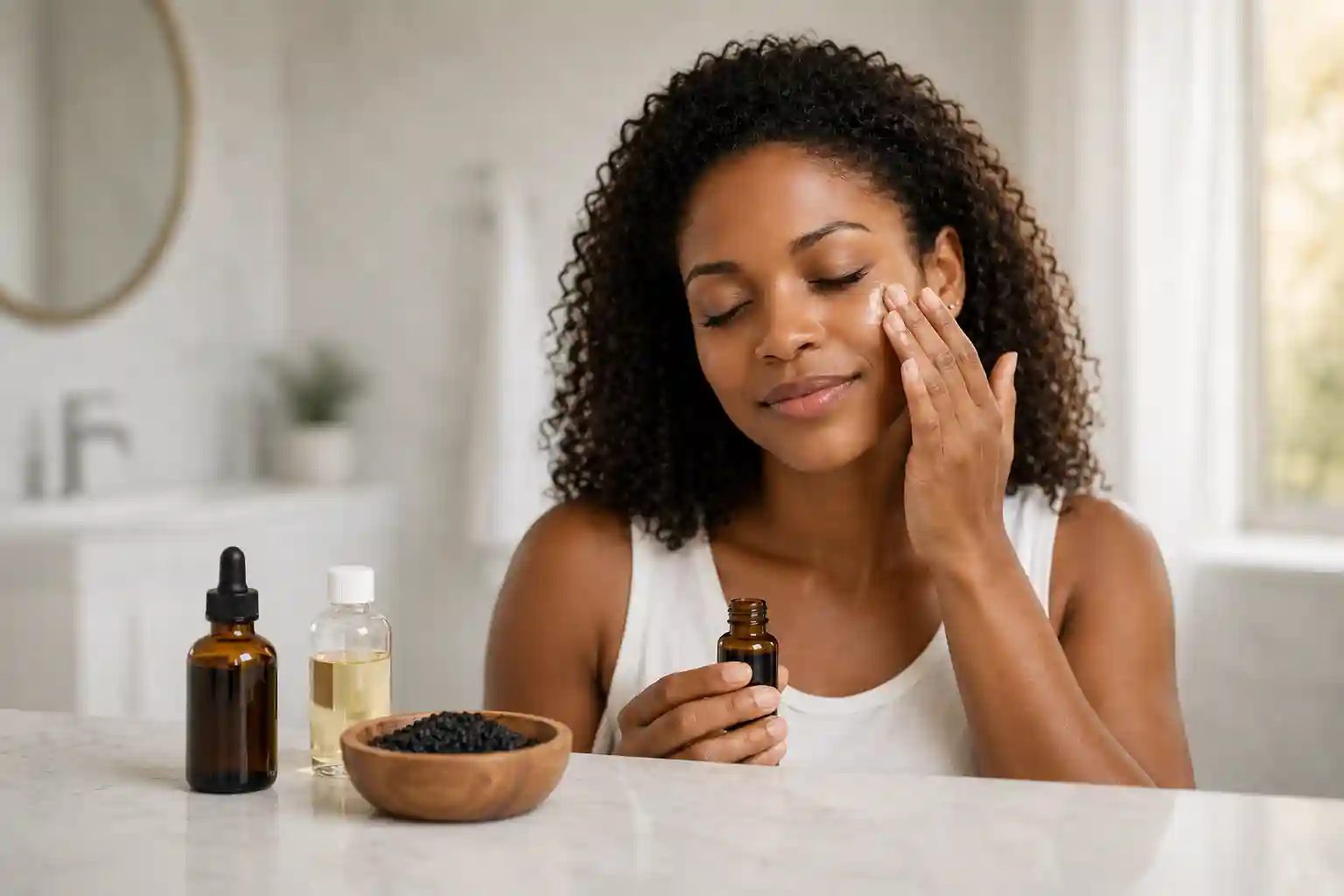
Black seed oil has strong clinical evidence for several skin conditions — especially acne. A 2020 clinical trial found it reduced acne severity by 78%. A 2022 review of 14 studies confirmed it is effective for acne, eczema, psoriasis, and other skin conditions. Here is what the science says and how to use it safely.
📋 Table of Contents
- Does Black Seed Oil Really Work for Skin?
- Benefit 1 — Reduces Acne & Pimples
- Benefit 2 — Soothes Eczema & Dry Skin
- Benefit 3 — Helps with Psoriasis
- Benefit 4 — Speeds Up Wound Healing
- Benefit 5 — Anti-Ageing & Photoprotection
- Benefit 6 — Reduces Dark Spots & Uneven Tone
- How to Apply Black Seed Oil on Face & Skin
- Side Effects & Who Should Be Careful
- Frequently Asked Questions
Does Black Seed Oil Really Work for Skin?
Black seed oil (Nigella sativa / Kalonji oil) is one of the most popular natural skin treatments in South Asia and the Middle East — and it has more clinical evidence behind it than most natural skincare ingredients.
A 2022 systematic review and meta-analysis that looked at 14 randomised controlled trials confirmed that black seed preparations are effective for multiple skin conditions including acne, eczema, psoriasis, and vitiligo. The meta-analysis found an odds ratio of 4.59 in favour of black seed — meaning people using it were over four times more likely to see improvement than those on placebo.
The strongest evidence is for acne — where a 2020 clinical trial found 78% improvement in severity. But the benefits extend well beyond acne to wound healing, eczema, anti-ageing, and skin tone.
🔗 🌿 Full Guide: All 10 Black Seed Benefits
This article covers skin benefits. For the complete black seed guide see:
👉 Black Seed (Kalonji): 10 Proven Benefits, Uses & Side Effects →
Benefit 1 — Reduces Acne & Pimples
This is black seed oil’s strongest and most well-proven skin benefit. The evidence comes from a proper clinical trial — not just anecdotes.
A 2020 randomised double-blind clinical trial gave 60 acne patients either a black seed hydrogel or a placebo gel to apply twice daily for 60 days. The results were striking — the black seed group saw a 78% reduction in acne severity on the standard Investigator’s Global Assessment scale. The placebo group improved by just 3.3%. No adverse effects were reported in the black seed group.
Black seed works against acne in three ways. It kills the bacteria (Cutibacterium acnes) that cause spots. It reduces the inflammation that makes spots red and swollen. And it helps regulate sebum production — the excess oil that clogs pores in the first place.
📊 Black Seed vs Benzoyl Peroxide
An earlier study comparing a 20% black seed oil lotion against standard 5% benzoyl peroxide (the most common pharmaceutical acne treatment) found both produced similar reductions in lesion counts. Importantly, the black seed group reported far fewer side effects — only 20% experienced minor issues, compared to the higher irritation and dryness rates typical with benzoyl peroxide. This suggests black seed may be a gentler but similarly effective alternative for mild to moderate acne.
Benefit 2 — Soothes Eczema & Dry Skin
Eczema causes red, itchy, dry, inflamed patches of skin. It is driven by a combination of skin barrier weakness and immune overreaction. Black seed oil addresses both problems.
The essential fatty acids in black seed oil — particularly linoleic acid (omega-6) — help repair the skin barrier. A weakened skin barrier is the core problem in eczema. When the barrier is stronger, the skin holds moisture better and is less reactive to irritants.
Thymoquinone reduces the inflammatory response that drives eczema flares — calming redness, itching, and swelling. Studies included in the 2022 meta-analysis confirmed improvements in eczema symptoms with black seed preparations.
Benefit 3 — Helps with Psoriasis
Psoriasis causes thick, scaly, red patches of skin — driven by an overactive immune system that speeds up skin cell turnover. Black seed oil’s combination of immune modulation and anti-inflammatory action makes it relevant for this condition.
A 2017 review found that combining oral black seed extract with topical application reduced psoriasis symptoms and improved skin lesions. The 2022 meta-analysis of 14 RCTs also included psoriasis patients in its positive findings.
Black seed does not cure psoriasis — nothing does. But it may help reduce the severity and frequency of flares as a complementary approach alongside prescribed treatment.
For scalp psoriasis specifically, see our guide: black seed oil for hair and scalp.
Benefit 4 — Speeds Up Wound Healing
Black seed oil helps wounds heal faster. It does this in three ways working together.
First — it boosts collagen production. Collagen is the structural protein that rebuilds skin tissue after damage. More collagen means faster, stronger healing.
Second — it speeds up new skin cell growth. Thymoquinone stimulates the migration of new skin cells to cover the wound site.
Third — it protects against infection. Black seed oil has confirmed antibacterial properties against the bacteria most commonly responsible for wound infections.
This makes diluted black seed oil useful for minor cuts, post-acne scars, and dry cracked skin. Always apply to clean, uninfected skin. Do not use on open, actively bleeding, or deeply infected wounds — see a doctor for these.
Benefit 5 — Anti-Ageing & UV Protection
A 2025 review in Experimental and Therapeutic Medicine confirmed that black seed helps prevent photoaging — the premature skin ageing caused by UV sun exposure.
UV rays damage skin by generating reactive oxygen species (ROS) — unstable molecules that break down collagen and elastin, the proteins that keep skin firm and smooth. This damage shows up as wrinkles, sagging, and dark spots over time.
Thymoquinone is a powerful antioxidant that neutralises ROS before they can damage collagen. It also suppresses the enzymes that break down existing collagen. The result is better-preserved skin structure and slower visible ageing.
Black seed oil is not a replacement for SPF sunscreen — it does not physically block UV rays. But using it as part of a daily skincare routine alongside sun protection may help slow photoaging over time.
Benefit 6 — Reduces Dark Spots & Uneven Skin Tone
Black seed oil has been studied for its effect on vitiligo — an autoimmune condition that causes white patches where skin loses pigment. A clinical trial found black seed oil applied to vitiligo lesions was more effective than fish oil at reducing the size of lesions over 6 months.
For post-inflammatory hyperpigmentation — the dark marks left after spots or eczema — black seed oil’s combination of anti-inflammatory action and antioxidant protection may help fade marks over time by reducing ongoing inflammation that drives excess pigment production.
Results for pigmentation take longer than acne — expect at least 8–12 weeks of consistent daily application to see noticeable fading of dark marks.
How to Apply Black Seed Oil on Face & Skin
| Skin Concern | Dilution | How to Apply | How Often |
|---|---|---|---|
| Acne (face) | 1:4 with jojoba oil | Apply to clean skin after washing. Leave on overnight. | Twice daily |
| Eczema patches | 1:3 with coconut oil | Apply to affected areas on damp skin after bathing | Twice daily |
| Psoriasis plaques | 1:2 with coconut oil | Massage gently into plaques. Leave 30–60 minutes then rinse. | Once or twice daily |
| Dry / ageing skin | 1:4 with argan oil | Apply as facial oil at night after serum or moisturiser | Every night |
| Dark spots / scars | 1:4 with rosehip oil | Apply directly to spots/scars at night | Every night |
| Wound healing (minor) | 1:3 with almond oil | Apply to clean healed skin (not open wounds) | Once or twice daily |
🌿 Simple Black Seed Face Oil Blend
-
1
Patch test first — apply a few drops of your diluted blend to your inner wrist. Wait 24–48 hours. If no redness or itching — proceed.
-
2
Make your blend — mix 5 drops black seed oil with 20 drops jojoba oil (1:4 ratio) in a small dark glass bottle
-
3
Cleanse your face with a gentle cleanser and pat dry
-
4
Apply 3–4 drops of the blend to your face. Massage gently in upward circular motions.
-
5
Leave on overnight or for minimum 20 minutes before rinsing. For best results use every night.
Side Effects & Who Should Be Careful
🌿 Contact dermatitis — most important risk
At least three documented cases of allergic contact dermatitis from pure undiluted black seed oil have been published in medical journals. Symptoms are redness, intense itching, and rash. This is why dilution and patch testing before first use are essential — not optional. If a rash develops, stop immediately and wash the area with mild soap and water.
👁️ Keep away from eyes
Black seed oil is a strong oil and will cause intense irritation if it gets into the eyes. Do not apply close to the eye area. If accidental eye contact occurs, rinse immediately with clean running water for several minutes.
🤰 Pregnancy
Topical use of small amounts of diluted black seed oil on limited skin areas is generally considered lower risk than internal use. However, therapeutic topical application over large body areas is not recommended during pregnancy due to potential systemic absorption of thymoquinone. Consult your doctor before using it on your skin if you are pregnant.
🌞 May stain light skin or clothing
Black seed oil has a dark amber colour. It can temporarily stain very fair skin a light yellow-amber tone, and will stain light-coloured clothing and pillowcases. Use old pillowcases for overnight treatments. The skin staining fades with washing.
For the complete safety guide covering drug interactions and all side effects see: black seed side effects — who should be careful.
Try Our Free Herb & Tea Benefit Finder
Type black seed or any herb to instantly see its benefits, how to use it, and safety notes.
🔍 Open the Herb & Tea Benefit Finder →Frequently Asked Questions
Yes — and this is backed by a proper clinical trial. A 2020 randomised double-blind placebo-controlled trial found that a black seed hydrogel applied twice daily for 60 days reduced acne severity by 78% — compared to just 3.3% with placebo. No side effects were reported. A separate study found black seed lotion performed similarly to 5% benzoyl peroxide but with fewer side effects. The evidence for acne is the strongest of all black seed skin applications.
No — never apply pure undiluted black seed oil directly to your face. It is too concentrated and can cause contact dermatitis — a rash with intense redness and itching. Always dilute it first: mix 1 part black seed oil with 4 parts carrier oil (jojoba, almond, or argan oil work well for the face). Always do a patch test on your inner wrist and wait 24–48 hours before applying to your face for the first time.
The 2020 acne clinical trial ran for 60 days — and that is a reasonable minimum timeframe for most skin conditions. For acne, some improvement may appear within 2–3 weeks but the full effect takes 6–8 weeks of consistent twice-daily application. For eczema and psoriasis, allow 6–8 weeks minimum. For dark spots and anti-ageing benefits, 8–12 weeks. Consistency is essential — applying it occasionally will not produce results. Daily use at the right dilution for the full trial period is what produces the clinical results seen in studies.
Yes — there is good evidence for eczema. The 2022 meta-analysis of 14 RCTs confirmed black seed preparations are effective for atopic dermatitis and eczema. Black seed works by repairing the skin barrier (using its essential fatty acids), reducing inflammation (through thymoquinone), and killing bacteria that can infect eczema-damaged skin. Apply diluted black seed oil (1:3 with coconut oil) to affected areas on damp skin after bathing. Use consistently twice daily for at least 6 weeks.
Black seed oil is not a skin lightening agent in the way that products containing kojic acid or niacinamide are. It does not directly inhibit melanin production. However, its anti-inflammatory and antioxidant properties may help fade post-inflammatory dark marks over time — the marks left by healed spots or eczema patches. It has also been studied for vitiligo where it showed some effectiveness at reducing lesion size. Expect gradual fading over 8–12 weeks — not dramatic bleaching. For more pronounced dark spots, combine with a dedicated vitamin C serum alongside black seed oil treatment.
The best carrier oil depends on your skin type. For oily or acne-prone skin — jojoba oil is ideal because it closely mimics the skin’s natural sebum and is non-comedogenic (does not clog pores). For dry or mature skin — argan oil adds extra nourishment and antioxidants. For eczema or sensitive skin — coconut oil provides additional barrier repair. For dark spots and anti-ageing — rosehip oil has its own evidence for vitamin A and C content that supports skin renewal. Whatever carrier you choose, always use a 1:4 ratio (1 part black seed oil to 4 parts carrier oil) for face application.
📚 Related Health Guides
Black Seed (Kalonji): 10 Proven Benefits
The complete guide — all 10 benefits including internal health, immunity, and more.
Black Seed Oil Benefits: 8 Proven Uses
Full guide to black seed oil — internal health, quality selection, and dosage.
Black Seed Oil for Hair: Does Kalonji Really Work?
Clinical evidence and step-by-step scalp treatment guide for hair loss and dandruff.
Black Seed Side Effects: Who Should Be Careful?
Complete safety guide — drug interactions, pregnancy, children, and topical risks.


Very well done article with application information, that many others keave out!
Thank you, Dan! Really glad you found it helpful. 😊