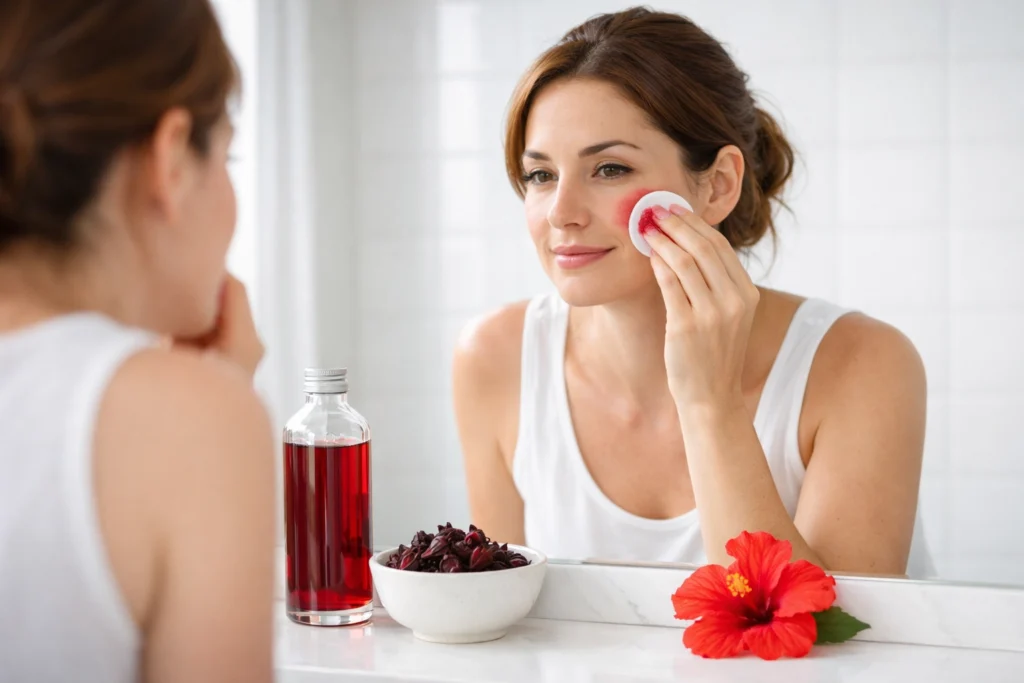
Yes — hibiscus tea works great on skin. You can use it as a toner, compress, face mask, bath soak, hair rinse, or facial steam. Each method has different benefits depending on your skin concern.
📋 Table of Contents
- Can You Really Use Hibiscus Tea on Your Skin?
- Why Topical Use Works Differently From Drinking
- What Hibiscus Does to Skin When Applied Directly
- Method 1 — Toner
- Method 2 — Cold Compress
- Method 3 — Face Mask
- Method 4 — Bath Soak
- Method 5 — Facial Steam
- Method 6 — Hair & Scalp Rinse
- Which Method Is Right for You?
- Safety Rules
- Conclusion
- Frequently Asked Questions
Can You Really Use Hibiscus Tea on Your Skin?
Yes — and the skincare industry has known this for years. Hibiscus extract is used in professional anti-aging serums, acne treatments, sensitive skin toners, and hair care products.
The same compounds that make hibiscus tea helpful when you drink it — plant pigments, natural fruit acids, quercetin, vitamin C — also work when you put them directly on your skin.
🛠️ Free Health Tools — Water Intake Calculator, BMI Calculator, Intermittent Fasting Calculator & more
🔍 Browse All Free Health Tools →Lab studies on topical hibiscus confirm it speeds up wound healing, builds collagen, fights bacteria on the skin surface, and reduces inflammation right where it’s applied. Some of these benefits — especially the fruit acid exfoliation — only work topically. Drinking the tea cannot deliver them.
This guide covers all 6 practical ways to use hibiscus tea on your skin. Each method has step-by-step preparation and the specific skin concerns it works best for. For the full overview of hibiscus skin benefits, see hibiscus tea benefits for skin.
Why Topical Use Works Differently From Drinking
Drinking hibiscus tea and putting it on your skin are not the same thing. Some compounds work both ways. Others only work in one direction. Here is the breakdown.
| Compound | Works by Drinking? | Works on Skin? | Why You Need Topical |
|---|---|---|---|
| Fruit acids (AHAs) | ❌ Broken down in gut | ✅ Exfoliates skin surface | AHAs only exfoliate when touching skin directly — can’t reach skin via bloodstream |
| Red plant pigments | ✅ Body-wide antioxidant | ✅ Localized anti-inflammatory | Both routes work — topical gives stronger effect on specific patches |
| Quercetin | ✅ Body-wide inflammation reduction | ✅ Calms skin cells directly | Topical is faster for specific inflamed spots |
| Vitamin C | ✅ Builds collagen body-wide | ✅ Builds collagen + brightens locally | Topical vitamin C reaches skin cells more directly |
| Mucilage | ✅ Helps gut hydration | ✅ Forms moisture-locking layer on skin | Only creates a physical protective film when touching skin |
| Antibacterial compounds | ⚠️ Limited reach to skin surface | ✅ Kills bacteria on contact | Surface bacteria are best fought by direct contact — not through the bloodstream |
🔬 The Key Insight
Drinking hibiscus tea and applying it to skin are complementary, not interchangeable. Drinking handles body-wide antioxidant, antibody-lowering, and collagen effects. Topical handles surface exfoliation, bacteria-fighting, and direct anti-inflammatory action on specific spots. For the best skin results, do both.
What Hibiscus Does to Skin When Applied Directly
Here are the four main things hibiscus tea does when it touches your skin.
Gentle Exfoliation — Removes Dead Skin Cells
The fruit acids in hibiscus dissolve the “glue” holding dead cells on your skin surface. This reveals fresher, smoother skin underneath. It helps fade dark spots, evens out texture, and keeps pores clear.
Unlike harsh synthetic exfoliants, hibiscus fruit acids come paired with calming anti-inflammatory compounds. This means less irritation, especially for reactive skin. This effect is entirely topical — drinking the tea cannot deliver it.
Faster Wound Healing
Lab studies on human skin confirmed that hibiscus extract increases the production of a protein called fibronectin. This protein helps pull wound edges together during healing.
For everyday skin, this means faster fading of acne scars, better healing of minor damage, and smoother texture on chronically inflamed areas. This happens at the site where you apply the tea.
🔬 The Science
Studies using human skin wound models confirmed topical hibiscus extract increases fibronectin production (wound closure protein) and stimulates genes involved in skin hydration and regeneration. Hibiscus acid also directly stimulates collagen and hyaluronic acid production in dermal fibroblasts.
Restores Skin pH — Fixes the Protective Acid Layer
Your skin has a natural acid layer (pH 4.5–5.5) that protects it from irritants and bacteria. Many cleansers and hard water disrupt this by raising skin pH above 6.0.
Diluted hibiscus tea has a pH of about 4.0–4.5 — almost perfectly matching your skin’s target range. Used as a toner after cleansing, it gently pushes skin pH back to normal. This reduces sensitivity, improves barrier strength, and makes skin less hospitable to acne bacteria.
Surface Bacteria Protection
A 2024 review confirmed hibiscus fights several skin-relevant bacteria and fungi when applied directly. This includes the acne bacterium Cutibacterium acnes, the eczema-worsening Staphylococcus aureus, and various skin fungi.
This antibacterial action only works with direct contact — drinking hibiscus tea cannot deliver enough of these compounds to the skin surface to meaningfully fight surface bacteria.
Method 1 — Hibiscus Tea Toner
Best for: Daily use, brightening, pore-clearing, acne prevention, pH restoration, oily and combination skin
🌺 Hibiscus Tea Toner — Step-by-Step
-
1
Brew the tea
Add 1–2 teaspoons loose-leaf hibiscus to 240ml water at 85–90°C. Steep 8 minutes. Use loose-leaf for best results — tea bags have much less active compound content.
-
2
Strain thoroughly
Strain through a fine mesh — twice if needed. No plant particles should remain. Residue on skin can cause uneven staining or clog pores.
-
3
Dilute for your skin type
Normal/oily: Undiluted or 1:1 with water
Combo/dry: 1:1 with water
Sensitive/rosacea: 1:2 (1 part tea, 2 parts water)
Eczema-prone: 1:2 or 1:3; patch test first -
4
Cool in the fridge
Pour into a clean glass bottle and refrigerate 20–30 minutes. Apply cool or cold — never warm. Cold also helps minimize pores.
-
5
Apply after cleansing
Put some on a soft cotton pad and sweep gently over clean face and neck. Avoid the eye area. Wait 60 seconds to absorb, then apply moisturizer.
-
6
Timing and storage
Use in the evening — fruit acids slightly increase sun sensitivity. If using in the morning, apply SPF after. Refrigerate and use within 3 days. Make fresh small batches regularly.
Method 2 — Cold Compress
Best for: Active inflammation, eczema flares, rosacea flushing, sunburn, acne papules, post-procedure calming
🌺 Hibiscus Cold Compress — Step-by-Step
-
1
Brew double-strength tea
Use 3–4 teaspoons loose-leaf per 240ml at 85–90°C, steep 10 minutes. Double strength gives more active compounds for direct skin action.
-
2
Strain and cool
Strain thoroughly twice. Cool to room temperature then refrigerate until very cold — at least 30 minutes. The colder the better for inflamed skin.
-
3
Soak and apply
Soak a clean soft cotton cloth in the cold tea. Wring gently — damp but not dripping. Lay gently on the inflamed area. Don’t rub. Hold 10–15 minutes.
-
4
Moisturize right away
Pat dry gently. Apply moisturizer immediately while skin is still slightly damp. The fruit acids have temporarily softened the skin surface, making this the best window for moisture absorption.
For the complete compress method for psoriasis and eczema plaques, see our detailed guide: how to make a hibiscus tea compress for psoriasis.
Method 3 — Face Mask
Best for: Weekly deep exfoliation, dark spots, acne scars, brightening, anti-aging, dull or congested skin
🌿 How should you use hibiscus on your skin? Type it in our free Herb & Tea Benefit Finder — get preparation method, dilution ratios, and safety notes instantly.
🔍 Try the Herb & Tea Benefit Finder →🌺 Three Hibiscus Face Mask Recipes
Recipe A — Brightening Mask (for dark spots, dull skin)
- 1
Mix 2 tbsp cooled hibiscus tea + 1 tbsp kaolin clay + 1 tsp honey. Stir smooth. Apply to clean face (avoid eyes). Leave 10–12 minutes. Rinse with cool water. Moisturize right away.
Recipe B — Anti-Aging Mask (for fine lines, firmness)
- 1
Mix 2 tbsp cooled hibiscus tea + 1 tsp rosehip oil + 1 tbsp plain full-fat yogurt. Apply to face and neck. Leave 15 minutes. Rinse with cool water. Moisturize right away.
Recipe C — Soothing Mask (for sensitive, rosacea, or eczema skin)
- 1
Mix 3 tbsp diluted hibiscus tea (1:2 ratio) + 1 tbsp aloe vera gel + 1 tsp colloidal oat powder. Apply to affected areas only. Leave 8–10 minutes max. Rinse with cool water. Apply prescribed cream right away.
Method 4 — Bath Soak
Best for: Widespread eczema, body psoriasis, general skin softening, body brightening, post-sun calming
🌺 Hibiscus Bath Soak
-
1
Brew a big batch
Make 6–8 cups of double-strength hibiscus tea (3–4 tsp per 240ml). Steep 10 minutes. Strain very thoroughly — no plant bits in the bath.
-
2
Temperature is critical
Run a lukewarm bath only — never hot. Hot water triggers eczema and rosacea, strips your skin barrier, and destroys the active compounds in the tea. The water should feel neutral, around 33–35°C.
-
3
Add the tea
Pour the strained tea into the bath. You can also add 1–2 cups of colloidal oat powder for extra soothing. The water will turn deep red — this is normal and won’t permanently stain your skin.
-
4
Soak 15–20 minutes
Pat dry gently after — never rub. Apply body moisturizer right away while skin is still damp.
How often: 2–3 times per week for active skin issues. Once per week for maintenance. Rinse the bath right after — hibiscus can stain light surfaces.
Method 5 — Facial Steam
Best for: Deep pore cleansing, pre-mask prep, normal and oily skin, softening blackheads
🌺 Hibiscus Facial Steam
-
1
Brew 2 cups of strong hibiscus tea. Pour into a large heat-safe bowl.
-
2
Drape a towel over your head and lean over the bowl — at least 30cm from the surface. Close your eyes. Let the steam open your pores for 5–8 minutes max.
-
3
Pat face dry gently. Follow right away with a mask or toner while pores are open for deeper penetration. Finish with moisturizer.
How often: Maximum once per week for oily skin. Steam opens pores and softens plugs, making any toner or mask used after it much more effective.
🔗 🌺 Full Guide: Hibiscus Tea for Psoriasis & Eczema — 7 Proven Benefits
This article covers topical methods for all skin types. For the complete guide on hibiscus for psoriasis and eczema — including internal use, clinical evidence, and dosage — read our pillar article:
👉 7 Proven Benefits of Hibiscus Tea for Psoriasis & Eczema →
Method 6 — Hair & Scalp Rinse
Best for: Scalp pH restoration, dandruff reduction, hair shine, scalp inflammation, color enhancement (red/dark hair)
Hibiscus has been used in hair care across African, South Asian, and Caribbean traditions for generations. Modern science now supports this — the same compounds that help facial skin also work on the scalp.
🌺 Hibiscus Hair Rinse
-
1
Brew 4 cups of standard or double-strength hibiscus tea. Strain thoroughly. Cool to lukewarm (comfortably warm for scalp is fine here).
-
2
After shampooing and conditioning, pour the tea over your scalp and hair as a final rinse. Massage gently into scalp for 2–3 minutes.
-
3
Leave for 5 minutes then rinse with cool water. Pat hair dry gently.
Color note: Hibiscus can temporarily enhance red, auburn, and dark brown tones — a natural subtle color boost that washes out gradually. For blonde or light hair, it may give a light pink tint. This also fades with washing.
Which Method Is Right for Your Skin Concern?
Use this table to pick the best method for your specific skin issue.
| Skin Concern | Best Method | How Often | Key Rule |
|---|---|---|---|
| Acne prevention | Toner (daily evening) | Daily | Evening — fruit acids increase sun sensitivity |
| Active pimples | Cold compress on spots | 2–3× daily | Never on open/infected skin |
| Rosacea — maintenance | Cold toner (diluted 1:1) | Daily evening | Always cold from fridge |
| Rosacea — active flush | Cold compress right away | As needed | Very cold from fridge |
| Eczema patches | Cold compress | 3–4× per week | Never on broken/infected skin |
| Dark spots / uneven tone | Toner daily + mask weekly | Toner daily; mask weekly | SPF essential after morning use |
| Dull / rough texture | Toner + weekly mask | Toner daily; mask weekly | Evening use preferred |
| Blackheads / clogged pores | Steam then toner or mask | Steam weekly max | NOT for rosacea/eczema/sensitive skin |
| Fine lines / aging | Toner + anti-aging mask | Toner daily; mask every 2 weeks | Combine with drinking tea for best results |
| Widespread body eczema | Bath soak | 2–3× per week | Lukewarm only — never hot |
| Dandruff / scalp issues | Hair and scalp rinse | 2× per week | May tint light hair temporarily |
| Sunburn / post-sun redness | Cold compress + bath soak | As needed | Very cold compress; lukewarm bath |
💡 Making Hibiscus Skincare Preparations Safely
Use distilled water. For any topical skin preparation — toner, compress, or infusion — use distilled (demineralised) water rather than tap water. Tap water minerals and chlorine can affect product stability and skin compatibility.
Check the pH. Hibiscus is naturally acidic. Before applying a homemade hibiscus preparation to your face, test the pH with strips. The safe range for skin is 4.5–5.5. Dilute with distilled water to bring it into this range if needed.
Add a preservative for storage. Water-based preparations spoil quickly. Use within 2–3 days if stored in the fridge, or add a cosmetic-grade preservative if making larger batches to keep longer.
Safety Rules — What Not to Do
Hibiscus tea is safe on most skin. But there are six rules you should never break.
❌ Never apply warm or hot to inflamed skin
Heat worsens rosacea, eczema, and acne. All topical hibiscus for inflammatory conditions must be cold from the fridge. The only exception is the hair rinse (lukewarm is fine for scalp).
❌ Never apply to broken, weeping, or infected skin
Hibiscus tea is acidic (pH 2.5–3.5). It will sting on broken skin and may slow healing. Wait until skin is fully intact before using.
❌ Never skip the patch test
Apply diluted hibiscus tea to your inner wrist. Wait 24 hours before using on your face. Allergic reactions are rare but possible, especially if you’re allergic to okra, hollyhock, or marshmallow root (same plant family).
❌ Never leave masks on too long
Stick to the stated times — 10–15 minutes max. Extended fruit acid contact causes over-exfoliation, redness, and barrier damage. Remove sooner if stinging develops.
❌ Never go in the sun without SPF after topical use
Fruit acids temporarily thin the outer skin layer, increasing UV sensitivity. Always apply SPF30+ if using hibiscus topically in the morning. Evening use is safer.
❌ Never store brewed toner more than 3 days
Brewed hibiscus without preservatives goes bad fast. The active compounds break down and bacteria can grow. Refrigerate right away and use within 3 days. If the deep red color fades to brownish, discard and make fresh.
Conclusion
Hibiscus tea is a genuinely useful topical skin treatment backed by lab research. Its six methods — toner, compress, face mask, bath soak, facial steam, and hair rinse — cover virtually every common skin concern from acne to eczema to aging.
The most important points to remember: always apply cold for inflammatory conditions, always patch test before first use, always dilute for sensitive skin, and always moisturize right after. Fruit acids increase sun sensitivity, so evening use is safer — or apply SPF if using in the morning.
For maximum results, combine topical use with drinking 1–2 cups daily. Topical handles the surface work — exfoliation, bacteria-fighting, and direct inflammation calming. Drinking handles the body-wide work — antioxidant protection, antibody reduction, and collagen building. Together, they cover more than either can alone.
For the full guide on hibiscus skin benefits, see hibiscus tea benefits for skin. For safety info, see hibiscus tea side effects.
Try Our Free Herb & Tea Benefit Finder
Type hibiscus or any herb to instantly see its full benefits, preparation methods, and safety notes.
🔍 Open the Herb & Tea Benefit Finder →Frequently Asked Questions
Yes — cooled or cold hibiscus tea can be applied directly to your face as a toner, compress, or mask ingredient. Always strain well to remove all plant particles. Dilute 1:1 for most skin types; 1:2 for sensitive, rosacea, or eczema skin.
Always patch test on your inner wrist for 24 hours first. Apply in the evening and follow with moisturizer. Never apply warm — always cold or cool.
As a toner — 60 seconds to absorb, then moisturize. As a compress — 10–15 minutes max. As a face mask — 8–15 minutes depending on the recipe. As a bath soak — 15–20 minutes max.
Never go over these times. Extended fruit acid contact causes over-exfoliation and irritation. If you feel stinging at any point, remove right away with cool water.
It may temporarily tint your skin pale reddish-pink right after use. This is from the plant pigments and is harmless — it fades within 15–30 minutes. No permanent skin staining.
However, hibiscus can stain fabric and light surfaces. Avoid white towels and clothes right after applying. Rinse the bath right away after a soak.
Maximum 3 days in a clean, sealed glass bottle in the fridge. After that, the active compounds start breaking down and bacteria can grow.
The deep red color is your quality indicator. If it fades to brownish-red, the toner is past its useful life. Make small batches of 200–300ml every 2–3 days for best results.
Daily toner use works well for most skin types — especially oily, combination, and acne-prone. For sensitive, rosacea, or eczema skin, start every other day for 2 weeks before going daily.
Face masks should be max once per week (once every two weeks for sensitive skin). Compresses can be used as needed for active inflammation. Consistent daily toner use produces the best cumulative brightening and barrier results over weeks.
Neither is better — they do different things. Topical is better for exfoliation (fruit acids only work on contact), fighting surface bacteria, speeding wound healing, and restoring skin pH. Drinking is better for body-wide antioxidant protection, lowering itch antibodies, and building collagen from the inside.
For the best skin results, do both — drink 1–2 cups daily and apply topically 3–5 times per week.
For many people, yes. Homemade hibiscus toner gives you fruit acid exfoliation, pH restoration, antibacterial protection, and anti-inflammatory benefit in one zero-additive, preservative-free product.
The trade-offs: shorter shelf life (3 days vs months), no added ingredients like niacinamide, and strength varies by loose-leaf quality. But for a clean, natural skincare routine with proven active compounds, hibiscus toner is an excellent and very affordable option.
For toner: 1–2 tsp per 240ml, diluted 1:1 with water for most skin types. For compresses and masks: 3–4 tsp per 240ml (double strength). For sensitive, rosacea, or eczema skin: always dilute 1:2 or 1:3 to start, increasing gradually over 2–4 weeks.
For children: dilute 1:2 minimum — see our guide on hibiscus tea for eczema in children for age-specific ratios.
📚 Related Health Guides
How to Make a Hibiscus Tea Compress for Psoriasis
Deep-dive on the compress method for psoriasis plaques — strength, timing, and technique.
Hibiscus Tea Benefits for Skin: Anti-Aging, Acne, Hydration & More
All 10 skin benefits — the complete reference guide.
Hibiscus Tea for Rosacea, Acne & Sensitive Skin
How hibiscus targets rosacea — with the critical cold-only rule.
Hibiscus Tea Side Effects: What to Know Before Drinking Daily
Complete safety guide — drug interactions, dental care, and who should avoid it.