Hibiscus tea can be a safe option for children with eczema — but only with the right age-specific rules, careful dosing, and important precautions that differ from adult use.
📋 Table of Contents
- Why Parents Seek Natural Options for Eczema
- How Child Eczema Differs from Adult Eczema
- Why Hibiscus Tea? What It Does for Child Eczema
- Safety by Age — What’s OK at Each Stage
- Topical Use — The Safest Starting Point
- Drinking It — When and How for Older Children
- Age-Specific Dosage Guide
- Precautions & When Not to Use
- Using Hibiscus with Prescribed Treatment
- What to Expect — Timeline & Results
- Parent Safety Checklist
- Conclusion
- Frequently Asked Questions
Why Parents Seek Natural Options for Eczema
Eczema affects up to 25% of children. It is the most common chronic skin condition in kids. For many families, it starts in the first year of life and disrupts sleep for everyone in the house.
Standard treatments like moisturizers, steroid creams, and newer drugs work well. But many parents worry about long-term steroid use on young skin. Biologic drugs are expensive and not approved for the youngest children.
🛠️ Free Health Tools — Water Intake Calculator, BMI Calculator, Intermittent Fasting Calculator & more
🔍 Browse All Free Health Tools →A national health survey found that 47% of families with eczema children already use natural remedies. They are looking for safe options whether guidelines recommend them or not. What they need is honest, evidence-based guidance on what actually works.
Hibiscus tea is one of the options parents ask about most. This guide gives you a clear, honest answer. We cover the evidence, a practical age-by-age safety plan, the safest ways to use it for children, and the important rules that apply specifically to kids.
For the complete adult guide, see our pillar article: 7 proven benefits of hibiscus tea for psoriasis and eczema.
How Child Eczema Differs from Adult Eczema
Child eczema is not just “adult eczema in a smaller person.” There are key differences that affect how any treatment should be used — natural or conventional.
| Factor | Children | Adults |
|---|---|---|
| Where it shows up | Cheeks and trunk in babies; arm and knee creases in older kids | Mostly creases, hands, and neck |
| Skin thickness | Thinner — absorbs things applied to it more easily | Thicker — absorbs less |
| Itch antibodies (IgE) | Often very high — strong allergy component | Variable — not always allergy-driven |
| Common triggers | Food allergens (milk, egg), dust mites, infections, heat | Stress, environment, contact allergens |
| Staph bacteria on skin | Very high — up to 90% of eczema kids have it | High but somewhat lower |
| Sleep disruption | Severe — affects the whole family | Significant but self-managed |
| Outlook | 60% improve by school age; 40% carry it into adulthood | Chronic with varying remission |
The thinner skin in children is important for topical hibiscus use. Compounds absorb more easily, which helps — but also means you should use diluted solutions, not full strength.
The very high rate of staph bacteria on children’s eczema skin is also relevant. Hibiscus fights this bacteria, making it a particularly good fit for kids.
Why Hibiscus Tea? What It Does for Child Eczema
Hibiscus tea has several properties that are especially relevant to the way eczema works in children.
Lowers the Itch Antibodies That Drive Child Eczema
Child eczema is often strongly driven by high levels of itch antibodies called IgE. A 2025 study found hibiscus reduced IgE by 26.6% — better than the steroid drug prednisolone (21.91%). For children whose eczema has a strong allergy component, this is especially valuable.
🔬 How It Works
Hibiscus anthocyanins lower serum IgE — the antibody that loads up mast cells for histamine release. The same study showed hibiscus also cut TARC/CCL17 chemokines (key immune signals that pull allergy cells into the skin) by 73%.
Fights the Bacteria That Make Child Eczema Worse
Staphylococcus aureus lives on the skin of up to 90% of children with eczema. It doesn’t just cause infections — it actively makes eczema worse by triggering massive immune reactions.
Hibiscus fights this bacteria. Regular topical use creates a germ-fighting layer on the skin without the antibiotic resistance risk that comes with repeated antibiotic prescriptions.
Calms the Immune Signals That Keep Flares Going
The same 2025 study found hibiscus cuts the immune signals that recruit allergy cells to the skin by 71–73%. In children, whose eczema is usually even more allergy-driven than adult eczema, calming these signals may help break the cycle of repeated flares.
Instant Cooling Itch Relief — Especially Valuable for Kids
A cold hibiscus compress gives immediate itch relief within seconds. This works through a separate physical mechanism — the cold activates cooling nerve receptors that override the itch signal.
For a distressed child woken by eczema itch at night, this rapid relief is genuinely valuable and completely safe.
Safety by Age — What’s OK at Each Stage
The rules for hibiscus tea are different at each age. Here is the age-by-age guide.
| Age | Drinking? | On Skin? | Our Advice |
|---|---|---|---|
| Under 12 months | ❌ No — herbal teas should not replace breast milk or formula | ⚠️ Small patch test only — dilute 1:4; doctor guidance first | No internal use. Topical only with medical guidance. |
| 12–24 months | ⚠️ Only with doctor guidance — very diluted (1:3), max 60ml | ✅ Diluted compress (1:2) on intact skin; patch test first | Topical is the main approach. Talk to doctor before any drinking. |
| 2–6 years | ⚠️ Doctor guidance recommended — diluted (1:2), max half cup daily | ✅ Diluted compress (1:1 or 1:2) 3–4 times per week; patch test | Topical is well-tolerated. Internal use with doctor approval only. |
| 6–12 years | ✅ Diluted tea generally safe — half adult strength; max 1 cup daily; discuss with doctor | ✅ Diluted compress (1:1) 3–4 times per week; patch test | Both topical and careful internal use OK with doctor’s knowledge. |
| 12–18 years | ✅ Adult dose generally fine — 1 cup daily; full adult safety rules apply | ✅ Standard adult compress method; patch test first | Follow adult guidelines. Full side effects apply — especially blood pressure. |
Topical Use — The Safest Starting Point for Children
For children of all ages, topical use is always the best starting point. Applying hibiscus tea to the skin delivers the healing compounds directly where they are needed — with minimal body-wide effects.
This means you get the anti-inflammatory, germ-fighting, and itch-cooling benefits without worrying about blood pressure changes.
🌿 How should you use hibiscus tea? Type it in our free Herb & Tea Benefit Finder — get preparation method, timing, dosage, and safety notes instantly.
🔍 Try the Herb & Tea Benefit Finder →🌺 Child-Safe Hibiscus Compress — Step-by-Step
Prep: 5 min | Cool: 30 min | Apply: 10 min
-
1
Patch test first (must do for children)
Apply a small amount of diluted, cooled hibiscus tea to your child’s inner wrist. Leave for 24–48 hours. If any redness, rash, or reaction shows up, do not proceed. Use a longer test period than for adults because children’s skin is more reactive.
-
2
Brew diluted hibiscus tea
Use 1 teaspoon of loose-leaf hibiscus per 240ml water (half the adult amount). Brew at 85°C for 7 minutes. Strain very thoroughly — remove every particle before using on a child’s skin.
-
3
Dilute further for younger children
For children under 6: mix brewed tea with an equal amount of cooled boiled water (1:1). For children under 2: use 1 part tea to 2 parts water (1:2). The tea should look pale pink-red, not deep ruby.
-
4
Cool completely in the fridge
Refrigerate the diluted tea until fully cold — about 20–30 minutes. The cold provides instant itch relief on contact. Never apply warm or hot tea to a child’s skin.
-
5
Apply the compress gently
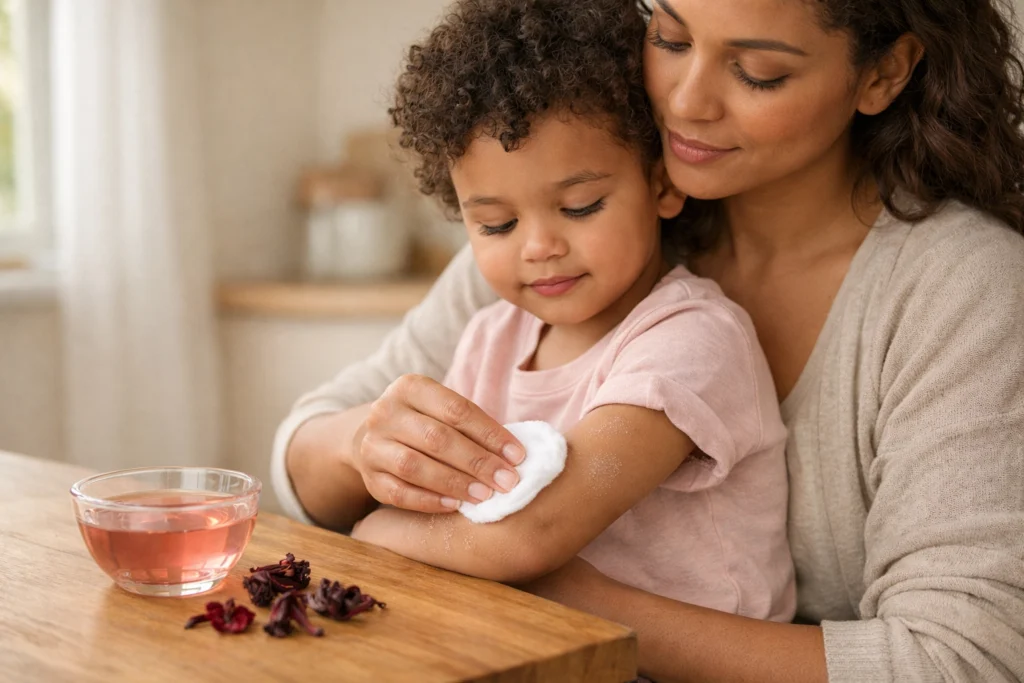
Soak a soft cotton cloth (muslin or flannel works best for kids). Wring gently so it’s damp but not dripping. Lay it gently on the eczema patch — do not rub or press. For facial eczema, use a dampened cotton pad instead of a cloth. Leave on for 10 minutes maximum.
-
6
Moisturize right away
Pat dry very gently with a soft towel. Immediately apply your child’s regular moisturizer or prescribed cream while skin is still slightly damp. This is essential — the fruit acids in the tea temporarily open up the skin, making this the best window for deep moisture absorption.
For the complete adult compress method with all variations, see our guide: how to make a hibiscus tea compress for psoriasis.
Drinking It — When and How for Older Children
Drinking hibiscus tea is a more complex question for children than topical use. It needs a more careful approach.
The US FDA classifies hibiscus as safe as a food. For teens aged 12–18, it’s considered possibly safe at 2 grams three times daily for up to 4 weeks. For younger children, there isn’t enough formal clinical data to confirm safety for therapeutic doses.
But cultural context matters. Hibiscus tea — called Zobo in West Africa, Agua de Jamaica in Latin America, and Karkadé in the Middle East — is a normal daily drink for children in many cultures. Millions of kids worldwide drink it regularly without reported harm.
📋 Internal Use Guidelines by Age
Under 12 months: No — only breast milk/formula and water are appropriate.
12–24 months: Talk to your pediatrician first. If approved, max 60ml very diluted (1:3).
2–6 years: Doctor guidance recommended. If approved, max half cup (120ml) diluted daily. Watch blood pressure for 2 weeks.
6–12 years: Generally tolerated at half adult strength — 1 cup (240ml) diluted daily. Discuss with doctor. Check medication interactions.
12–18 years: Adult guidelines apply — 1 cup daily. Full side effects profile applies including blood pressure.
🔗 🌺 Full Guide: Hibiscus Tea for Psoriasis & Eczema — 7 Proven Benefits
This article covers hibiscus tea specifically for children with eczema. For the full adult guide — all 7 benefits, mechanisms, dosage, and compress method — read our pillar article:
👉 7 Proven Benefits of Hibiscus Tea for Psoriasis & Eczema →
Age-Specific Dosage Guide
| Age | Skin Dilution | Max Apply Time | Drink Dilution | Max Drink Amount |
|---|---|---|---|---|
| Under 12 months | 1:4 (tea:water) if used | 5 minutes | Not appropriate | — |
| 12–24 months | 1:2 (tea:water) | 8–10 minutes | 1:3 (tea:water) | 60ml with doctor only |
| 2–6 years | 1:1 or 1:2 | 10 minutes | 1:1 or 1:2 | 120ml (½ cup) with doctor |
| 6–12 years | 1:1 (tea:water) | 10–15 minutes | Standard strength | 240ml (1 cup) daily |
| 12–18 years | Standard adult | 10–15 minutes | Standard adult | 240–480ml (1–2 cups) |
Precautions & When Not to Use
These are the situations where hibiscus tea should not be used for children.
❌ Babies under 12 months — no internal use
Herbal teas can replace essential nutrition from breast milk or formula. Do not give hibiscus tea internally to babies under 12 months. See a pediatric dermatologist for eczema in this age group.
❌ Open, weeping, or infected eczema
Never apply hibiscus tea — even diluted — to broken, weeping, crusted, or infected skin. Signs of infection include warmth, swelling, pus, spreading redness, or fever. See your pediatrician first. The acidity will sting on broken skin.
⚠️ Blood pressure — watch in all ages
Hibiscus lowers blood pressure. Watch for dizziness, pale skin, or fainting — especially after exercise or in hot weather. Stop and see your doctor if these happen.
⚠️ Children on medications
If your child takes any regular medications — for eczema, asthma, allergies, or anything else — always ask your pediatrician before adding hibiscus. The drug interactions known in adults apply to children too.
⚠️ Tooth enamel
Children’s tooth enamel is thinner than adult enamel. If giving hibiscus tea to drink, always dilute it. Have your child rinse with water after. Don’t let them sip slowly over a long time — that increases acid contact.
⚠️ Plant allergies
Children allergic to okra, hollyhock, or marshmallow root (same plant family) should not use hibiscus without an allergist checking first. Even without known allergies, always do the 24–48 hour patch test before first use.
Using Hibiscus with Prescribed Eczema Treatment
Hibiscus tea is a complement to your child’s treatment — not a replacement. Moisturizers, steroid creams, and calcineurin inhibitors remain the foundation. Hibiscus adds value in the gaps between prescription use and during mild-to-moderate flares.
| Situation | What Hibiscus Does | How to Combine |
|---|---|---|
| Active flare with prescribed cream | Calms acute inflammation and cools itch first | Hibiscus compress → air dry 60 sec → prescribed cream → moisturizer |
| Maintenance between flares | Keeps bacteria low and inflammation steady | Diluted compress 3–4× per week + daily moisturizer |
| Nighttime itch waking | Instant cold itch relief without waiting for medicine to kick in | Keep cold hibiscus tea ready in fridge each evening for quick use |
| Mild patches not needing steroid | May manage mild eczema without prescription cream | Diluted compress + moisturizer. If not improving in 2 weeks, see doctor. |
What to Expect — Timeline & Results in Children
Here is what you can realistically expect with regular use.
📅 Week-by-Week for Children
Session 1: Instant cooling itch relief during the compress. Your child may resist the cold at first but usually responds well to the relief it brings.
Week 1–2: Less nighttime itch with regular evening compress use. Many parents notice better sleep for the whole family.
Week 2–4: Visible improvement in patch texture. Scales softer, skin less rough. Redness around patch edges may start to fade.
Week 4–8: Noticeable drop in flare frequency and severity with consistent use. Some families report needing steroid cream less often.
Important: Child eczema is affected by many factors — food, environment, infections, seasons. It can be hard to tell exactly what hibiscus is doing. Keep a simple diary of flare frequency, itch levels, and sleep quality to track progress.
Parent Safety Checklist Before Starting
Check every box before using hibiscus tea for your child’s eczema.
✅ Your child is over 12 months old (for any use)
✅ You did a 24–48 hour patch test with diluted hibiscus tea
✅ The eczema patches you’ll treat are intact — not broken, weeping, or infected
✅ Your child is not taking chloroquine, blood pressure meds, or diabetes meds
✅ Your child has no known allergy to okra, hollyhock, or related plants
✅ You used the right dilution for your child’s age (see dosage table)
✅ You told your pediatrician or dermatologist you’re using hibiscus tea
✅ You have a plan to watch for dizziness or paleness in the first 2 weeks (if drinking it)
✅ You will always moisturize immediately after each compress
✅ You will not replace prescribed treatments with hibiscus tea
Conclusion
Hibiscus tea can be a safe and helpful option for children with eczema — but it must be used the right way for a child’s age. Topical use as a diluted compress is the recommended starting point for all ages above 12 months. It delivers direct itch relief, germ-fighting action, and anti-inflammatory compounds to the skin with minimal body-wide effects.
Drinking the tea is more nuanced. It’s appropriate for older children and teens with a doctor’s knowledge, but needs careful monitoring in younger kids because of the blood pressure-lowering effect. The complete lack of caffeine makes hibiscus safer than green or black tea for kids of any age.
Hibiscus tea is drunk daily by millions of children across Africa, the Caribbean, and South Asia without reported harm. That cultural track record is meaningful. Used correctly — diluted, topically, consistently, alongside prescribed treatment, and with your doctor informed — hibiscus tea is a worthwhile addition to your child’s eczema toolkit.
For the full adult hibiscus guide, see 7 proven benefits of hibiscus tea for psoriasis and eczema. For how hibiscus compares to other natural antihistamines, see 7 best natural antihistamines for eczema.
Try Our Free Herb & Tea Benefit Finder
Type hibiscus or any herb to instantly see its full benefits, preparation method, safety notes, and who should be careful.
🔍 Open the Herb & Tea Benefit Finder →Frequently Asked Questions
Yes — when used the right way for the child’s age. As a diluted compress, it’s generally well-tolerated for kids over 12 months on intact eczema skin. Always dilute and always patch test first.
For drinking, talk to your pediatrician for children under 12. The main concern is hibiscus’s blood-pressure-lowering effect, which needs monitoring in younger kids. It’s caffeine-free, which makes it safer than green or black tea. Never use internally in babies under 12 months.
No herbal tea should be given internally to babies under 12 months. From 12 months, very diluted hibiscus can be introduced cautiously with a doctor’s knowledge. Children aged 2+ can generally handle diluted tea at up to half a cup daily. Children 6+ can handle one cup per day. Teens 12–18 can follow adult guidelines.
The key at all ages is watching for blood pressure symptoms — dizziness or paleness, especially after exercise.
Yes — diluted, cooled hibiscus tea as a compress is the safest and most recommended way to use it for kids with eczema. Always dilute for children under 12 (1:1 for ages 6–12; 1:2 for ages 2–6; 1:4 for under 2 if used at all).
Always cool fully in the fridge before applying. Never apply to broken or infected skin. Do a 24–48 hour patch test before first use. Apply for max 10 minutes, then moisturize right away. The pink skin tint from the tea is temporary and harmless.
They work differently and are best used together. Antihistamine pills work fast — within 30–60 minutes — by blocking histamine receptors. Hibiscus works slowly but upstream — gradually lowering the itch antibodies that cause histamine release in the first place.
For an acute itch crisis or night waking, pills give faster relief. For long-term management, hibiscus offers benefits pills cannot. The cold hibiscus compress also gives fast physical itch relief within seconds — without medication.
For toddlers 12–24 months: brew 1 teaspoon loose hibiscus in 240ml water at 85°C for 7 minutes. Strain thoroughly. Dilute with 2 parts cooled boiled water (1:2 ratio). Cool fully in fridge. Soak a soft cotton pad, wring gently, and apply to the eczema patch for max 8–10 minutes. Moisturize right away after.
Always patch test on inner wrist for 48 hours first. For babies under 12 months, talk to your pediatrician before any topical herbal use.
Yes — hibiscus tea does lower blood pressure. In adults this is usually fine at 1–2 cups daily. In children, who already have lower baseline blood pressure, even a small drop could cause dizziness or lightheadedness.
This is the main reason internal use needs extra caution in younger kids. Watch for dizziness, unusual paleness, or fainting in the first 2 weeks — especially after physical activity. If any occur, stop and see your doctor. Topical compress use carries minimal blood pressure risk.
Yes — potentially a lot. The cold compress gives rapid itch relief during nighttime waking — within seconds, not minutes. Keep a small container of chilled diluted hibiscus tea ready each evening for quick use when your child wakes up itching.
Over weeks of regular use, the drop in baseline itch and inflammation may reduce nighttime waking frequency. Parents often report better sleep for the whole family after starting a regular compress routine.
Yes — always. This is not optional. Your child’s doctor needs to know about any natural remedies you use, including herbal teas. Hibiscus has real effects on blood pressure, blood sugar, and some medications.
An informed doctor can give better advice, adjust the treatment plan, and flag any issues specific to your child’s health. Herbal teas are not just harmless background additions — they are active plant medicines that deserve the same disclosure as any medication.
📚 Related Health Guides
7 Proven Benefits of Hibiscus Tea for Psoriasis & Eczema
The complete adult guide — all 7 benefits, mechanisms, dosage, and compress method.
Does Hibiscus Tea Stop Eczema Itching? What the Research Says
Full itch science — how hibiscus calms the itch-scratch cycle.
7 Best Natural Antihistamines for Eczema
How hibiscus ranks among the best natural antihistamine options.
Hibiscus Tea Side Effects: What to Know Before Drinking Daily
Complete safety guide — drug interactions, blood pressure, and who should avoid it.