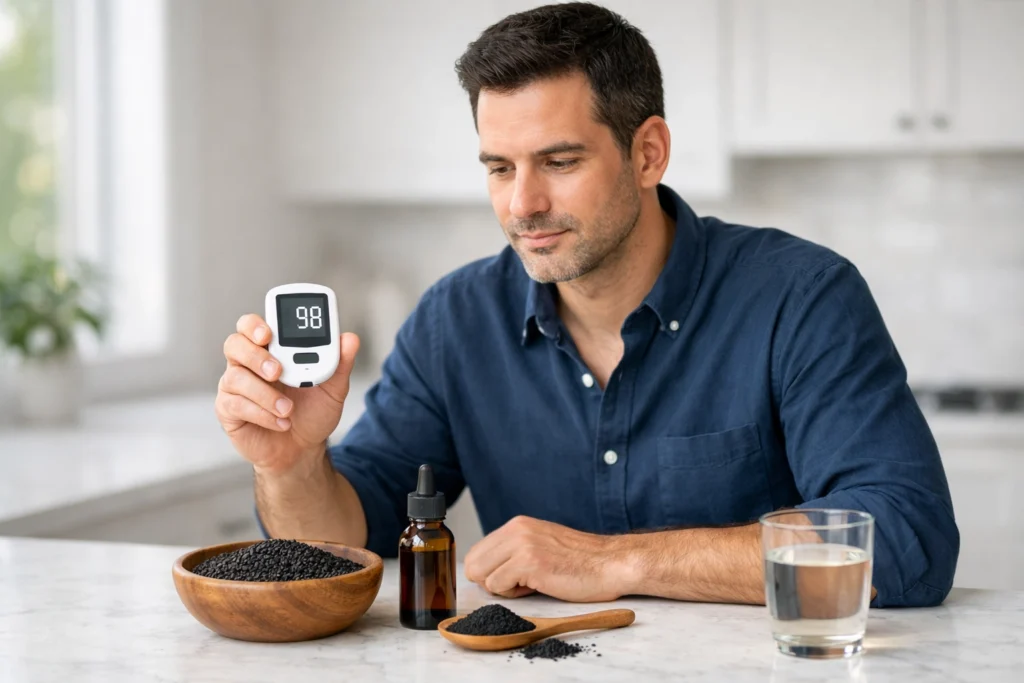
Yes — black seed (Kalonji) can help lower blood sugar in people with type 2 diabetes. Multiple studies back this up. But it works best alongside your prescribed medication — not instead of it. And because it genuinely lowers blood sugar, you need to be careful about combining it with diabetes drugs.
📋 Table of Contents
- Can Black Seed Really Help with Diabetes?
- What Do the Studies Say?
- How Does Black Seed Lower Blood Sugar?
- Does It Help with Diabetes Complications Too?
- How to Use Black Seed for Diabetes
- How Much Should You Take?
- Important Safety Warning — Drug Interactions
- Black Seed vs Other Natural Remedies for Diabetes
- Should You Try Black Seed for Diabetes?
- Frequently Asked Questions
Can Black Seed Really Help with Diabetes?
If you have type 2 diabetes — or know someone who does — you have probably heard about kalonji (black seed) as a natural remedy. People across South Asia, the Middle East, and Africa have used it for blood sugar for centuries.
But does it actually work? The short answer is yes — but with some important conditions.
Clinical studies confirm that black seed can meaningfully lower blood sugar levels in people with type 2 diabetes. It is not a miracle cure. It cannot replace your medication. But when used properly alongside your prescribed treatment, it may help bring your blood sugar down further — and it comes with bonus benefits for cholesterol and heart health too.
This guide explains the evidence simply, tells you exactly how to use it, and — most importantly — warns you about the drug interactions you need to know about before starting.
🔗 🌿 Full Guide: All 10 Black Seed Benefits
Diabetes is just one of black seed’s many benefits. For the complete picture see:
👉 Black Seed (Kalonji): 10 Proven Benefits, Uses & Side Effects →
What Do the Studies Say?
The evidence for black seed and diabetes is stronger than for most natural remedies. It is not just one small study — it is a large review of many studies combined.
In 2025, scientists reviewed 16 separate clinical trials all testing black seed on type 2 diabetic patients. When they combined all the results, the findings were clear and positive.
| What Was Measured | What Happened with Black Seed | Is This a Good Result? |
|---|---|---|
| Fasting blood sugar | Dropped by 21.43 mg/dL | ✅ Yes — meaningful reduction |
| HbA1c (3-month average) | Dropped by 0.44% | ✅ Yes — clinically significant |
| Total cholesterol | Dropped by 18.80 mg/dL | ✅ Yes — good for heart health |
| Bad cholesterol (LDL) | Dropped by 19.53 mg/dL | ✅ Yes — major benefit |
| Post-meal blood sugar | No significant change | Neutral |
| Body weight / BMI | No significant change | Neutral |
📊 Why HbA1c Matters So Much
HbA1c is your average blood sugar over the past 3 months. A drop of 0.44% may sound small but it is clinically meaningful. Research shows that every 1% reduction in HbA1c reduces the risk of diabetic eye disease by 37%, kidney disease by 54%, and nerve damage by 60%. Pharmaceutical diabetes drugs typically reduce HbA1c by 0.5–1.5% at standard doses — so black seed’s 0.44% contribution as an add-on treatment is significant.
A separate 2025 review comparing five natural diabetes remedies — black seed, fenugreek, ginger, cinnamon, and turmeric — found that black seed had the most consistent results across all the studies. It came out on top.
How Does Black Seed Lower Blood Sugar?
Black seed works in several different ways to help control blood sugar. This is actually one of the reasons the evidence is so strong — it targets the problem from multiple angles at once.
Here is a simple way to understand it:
Helps Your Pancreas Make More Insulin
Your pancreas makes insulin — the hormone that moves sugar out of your blood and into your cells. In type 2 diabetes, the pancreas often does not make enough. Black seed helps the pancreas produce more insulin. It also protects the insulin-making cells from damage.
Makes Your Body Respond Better to Insulin
Even when the body makes insulin, cells sometimes ignore it — this is called insulin resistance. It is the core problem in type 2 diabetes. Black seed helps your cells respond to insulin again. This means the insulin your body makes actually works properly.
Slows Down Sugar Absorption After Meals
After you eat carbohydrates, your body breaks them down into sugar quickly. This causes blood sugar to spike. Black seed slows down this process — similar to how some diabetes medications work. When you take it with meals, less sugar enters your blood at once.
🔬 The Science Behind It
Black seed inhibits alpha-glucosidase and alpha-amylase — the digestive enzymes that break carbohydrates into glucose. This is the same mechanism as acarbose, a pharmaceutical diabetes drug. Thymoquinone also inhibits hepatic gluconeogenesis via the AMPK pathway — the same mechanism as metformin, the world’s most prescribed diabetes drug. This is why black seed works so well alongside these medications — and why the combination can sometimes be too powerful.
Reduces Stress Hormones That Raise Blood Sugar
Stress raises blood sugar — it is a well-known trigger for poor blood sugar control. Black seed helps reduce cortisol, the main stress hormone. Lower cortisol means less sugar being released into your blood from your liver. This is especially helpful for people whose blood sugar worsens with stress.
Does It Help with Diabetes Complications Too?
Most people with type 2 diabetes do not just have high blood sugar. They often have high cholesterol, high blood pressure, and a higher risk of heart disease too. Black seed addresses several of these at the same time.
| Complication | Does Black Seed Help? | Evidence Level |
|---|---|---|
| High cholesterol (LDL) | ✅ Yes — drops by 19.53 mg/dL | Strong — confirmed in 2025 meta-analysis |
| High blood pressure | ✅ Yes — reduces both systolic and diastolic | Good — confirmed in multiple RCTs |
| Inflammation | ✅ Yes — reduces CRP and other inflammation markers | Strong — 2025 umbrella review |
| Fatty liver | ✅ Yes — improved liver steatosis in clinical trial | Moderate — 2014 human clinical trial |
| Kidney stress | ✅ Yes — reduces oxidative stress in kidney cells | Moderate — PMC review |
| Body weight | ❌ No significant effect in diabetic patients | Not confirmed in diabetic population |
How to Use Black Seed for Diabetes
The most effective form for blood sugar is ground black seed powder — this is what most clinical studies used. It is more potent than whole seeds because grinding releases more active compounds.
🌿 Black Seed for Diabetes — Daily Protocol
-
1
Tell your doctor first
Before you start, tell your doctor or diabetologist. Ask them to check your blood sugar more often for the first 4 weeks. Show them this article or the clinical study if helpful.
-
2
Start with a small amount — Week 1
Begin with just ½g (a small pinch) of ground black seed powder mixed into warm water or food, once daily with breakfast. Check your fasting blood sugar each morning.
-
3
Increase to the full dose — Week 2 onwards
If your blood sugar is responding well without going too low, increase to 1g (¼ teaspoon) twice daily — once with breakfast and once with dinner. This gives you the 2g daily dose confirmed effective in studies.
-
4
Keep a blood sugar log
Write down your fasting blood sugar every morning. After 8 weeks, share your readings with your doctor. If your blood sugar has improved significantly, they may consider adjusting your medication — but never change your medication dose yourself.
| Form | How to Take | Best Timing |
|---|---|---|
| Ground powder | 1g mixed into water or food — twice daily | With meals — slows sugar absorption |
| Cold-pressed oil | ½ tsp with honey — once or twice daily | Morning on empty stomach or with meals |
| Capsules | 500mg twice daily | With breakfast and dinner |
| Whole seeds | Sprinkle on food — least effective for diabetes | With meals |
How Much Should You Take?
Always take black seed with meals for blood sugar management. This is when the enzyme-blocking effect works best — slowing down sugar absorption from the food you just ate.
Important Safety Warning — Drug Interactions
💊 Metformin
Black seed and metformin both work on the liver to reduce blood sugar. Together they can lower blood sugar more than either one alone. This is useful — but monitor carefully. Check your fasting sugar every morning in the first 4 weeks. Report any reading below 80 mg/dL to your doctor.
💉 Insulin
This combination has the highest risk of low blood sugar. If you take insulin, never add black seed without your doctor’s direct involvement. You may need your insulin dose adjusted. Check blood sugar before meals and at bedtime.
💊 Sulfonylureas (glibenclamide, glipizide)
These drugs already stimulate the pancreas to make more insulin. Black seed does the same thing. The combined effect can be too powerful. Careful monitoring is essential with this combination.
🩸 Blood pressure medications
Many diabetics also take blood pressure medication. Black seed lowers blood pressure too. Watch for signs of low blood pressure — dizziness, lightheadedness when standing up.
Black Seed vs Other Natural Diabetes Remedies
Many people with diabetes ask whether black seed is better than other natural remedies like cinnamon, fenugreek, or turmeric. Here is a simple comparison:
| Herb | Blood Sugar Effect | Evidence Quality | Best Use |
|---|---|---|---|
| Black Seed 🥇 | Strong — fasting sugar ↓ 21.43 mg/dL | ⭐⭐⭐⭐⭐ Strongest | Fasting sugar, HbA1c, cholesterol |
| Fenugreek (Methi) | Good — reduces post-meal sugar | ⭐⭐⭐⭐ Good | Post-meal sugar spikes |
| Cinnamon (Dalchini) | Moderate | ⭐⭐⭐ Moderate | Insulin sensitivity |
| Ginger (Adrak) | Moderate | ⭐⭐⭐ Moderate | Inflammation with diabetes |
| Turmeric (Haldi) | Moderate | ⭐⭐⭐ Moderate | Diabetic inflammation |
Black seed came first in a 2025 review that compared all five herbs across human clinical trials. It was the only herb with consistent positive results across all the studies reviewed.
Should You Try Black Seed for Diabetes?
If you have type 2 diabetes, black seed is worth discussing with your doctor. The evidence is real — 16 clinical trials showing meaningful reductions in blood sugar and HbA1c. That is not nothing.
The key points to remember are simple:
✅ Take 2g of ground black seed powder daily — split into two doses with meals
✅ Give it 8–12 weeks before judging the results
✅ Monitor your blood sugar more closely when you start
✅ Tell your doctor — they may need to adjust your medication
❌ Never stop your prescribed medication because of black seed
For practical guidance on all the ways to take black seed daily see: how to use black seed daily — 7 simple methods. For the full black seed oil guide see: black seed oil benefits and proven uses.
Try Our Free Herb & Tea Benefit Finder
Type black seed or any herb to instantly see its benefits, dosage, and safety notes.
🔍 Open the Herb & Tea Benefit Finder →Frequently Asked Questions
Yes — and this is backed by solid clinical evidence. A 2025 review of 16 randomised controlled trials found black seed significantly reduced fasting blood sugar by 21.43 mg/dL and HbA1c by 0.44% in type 2 diabetic patients. A separate 2025 review ranked it as the most effective natural herb for blood sugar among five commonly used remedies. However it works as an add-on to medication — not a replacement. Always use it under medical supervision.
The dose used in clinical trials is 2g of ground black seed powder per day — approximately ½ teaspoon total. Split it into two doses: 1g (¼ teaspoon) with breakfast and 1g with dinner. If using oil, take ½ teaspoon once or twice daily. Always start with half the dose for the first week and increase gradually. Take it with meals for best blood sugar effect.
Yes — but tell your doctor first and monitor your blood sugar more carefully. Black seed and metformin both lower blood sugar, so together they can lower it more than expected. This is actually the combination studied in clinical trials — one study specifically found black seed was “a beneficial add-on to oral hypoglycaemic agents.” The concern is that combined lowering may sometimes go too far. Check fasting blood sugar every morning for the first 4 weeks and report anything below 80 mg/dL to your doctor.
You may see early changes in fasting blood sugar within 2–4 weeks. But the full effect on HbA1c — your 3-month average blood sugar — takes 8–12 weeks to show up properly. This is because HbA1c reflects the average over 3 months, not just recent days. Check your fasting blood sugar daily in the first 4 weeks. Get your HbA1c tested again at 12 weeks to measure the full impact.
Yes — pre-diabetes is actually one of the best times to try black seed. At this stage your blood sugar is borderline high but you are not yet on medication. Black seed can help bring it back toward normal without the medication interaction risks. Combine it with reduced carbohydrate intake and regular exercise for best results. There is less hypoglycaemia risk when you are not yet on diabetes drugs — making black seed safer to use at this stage.
No — black seed cannot reverse type 2 diabetes on its own. Type 2 diabetes reversal requires significant weight loss, major dietary changes, and sustained lifestyle changes. Black seed is a useful supporting tool — it can help lower blood sugar, protect the insulin-making cells in the pancreas, and improve how your body responds to insulin. But these effects support management, not reversal. Think of it as one helpful piece of a bigger picture that includes diet, exercise, and your prescribed medications.
📚 Related Health Guides
Black Seed (Kalonji): 10 Proven Benefits
Complete guide to all 10 benefits — immunity, skin, hair, blood pressure, and more.
How to Use Black Seed Daily: 7 Simple Methods
Step-by-step guide — oil with honey, powder in water, seeds on food, capsules, and more.
Black Seed Oil Benefits: 8 Proven Uses
How to choose quality oil and use it for health, skin, and hair.
Hibiscus Tea: 12 Science-Backed Benefits
Hibiscus tea also helps blood sugar and blood pressure — a great daily pairing with black seed.