Hibiscus tea is rich in plant compounds that calm inflamed skin. It can help reduce itching, soften plaques, and support the skin barrier in psoriasis and eczema.
📋 Table of Contents
- Introduction — Hibiscus Tea and Skin Conditions
- What Is Hibiscus Tea? Names, Origins & Varieties
- Nutritional Profile & Key Bioactive Compounds
- 7 Proven Benefits for Psoriasis & Eczema
- Hibiscus in Traditional Medicine
- How to Use Hibiscus Tea for Skin Relief
- Hibiscus Tea Recipe — Brew & Compress Method
- Recommended Dosage
- Side Effects & Safety Precautions
- Frequently Asked Questions
Introduction — Can Hibiscus Tea Really Help Psoriasis & Eczema?
Psoriasis affects around 125 million people worldwide. Eczema affects up to 20% of children and 10% of adults. Both cause itchy, inflamed skin that can really hurt your quality of life.
Doctors usually treat these conditions with creams or medicine. But many people also want safe natural options to use alongside their treatment. That is where hibiscus tea comes in.
Hibiscus tea is made from the bright red flower called Hibiscus sabdariffa. People around the world have used it for centuries — both for drinking and for skin care. Today, modern research is starting to confirm what tradition has long claimed.
🛠️ Free Health Tools — Water Intake Calculator, BMI Calculator, Intermittent Fasting Calculator & more
🔍 Browse All Free Health Tools →A 2025 review in Food Science & Nutrition looked at five years of hibiscus research. It confirmed the flower has real anti-inflammatory effects. A 2024 review also showed hibiscus fights Staphylococcus aureus — a skin bacterium that makes eczema worse for over 90% of patients.
In this guide, you will learn the 7 main ways hibiscus tea helps psoriasis and eczema. You will also get safe dosage, simple recipes, and clear safety rules. If you want to know whether hibiscus also helps rosacea or sensitive skin, see our guide on hibiscus tea for rosacea, acne and sensitive skin.
What Is Hibiscus Tea? Names, Origins & Varieties
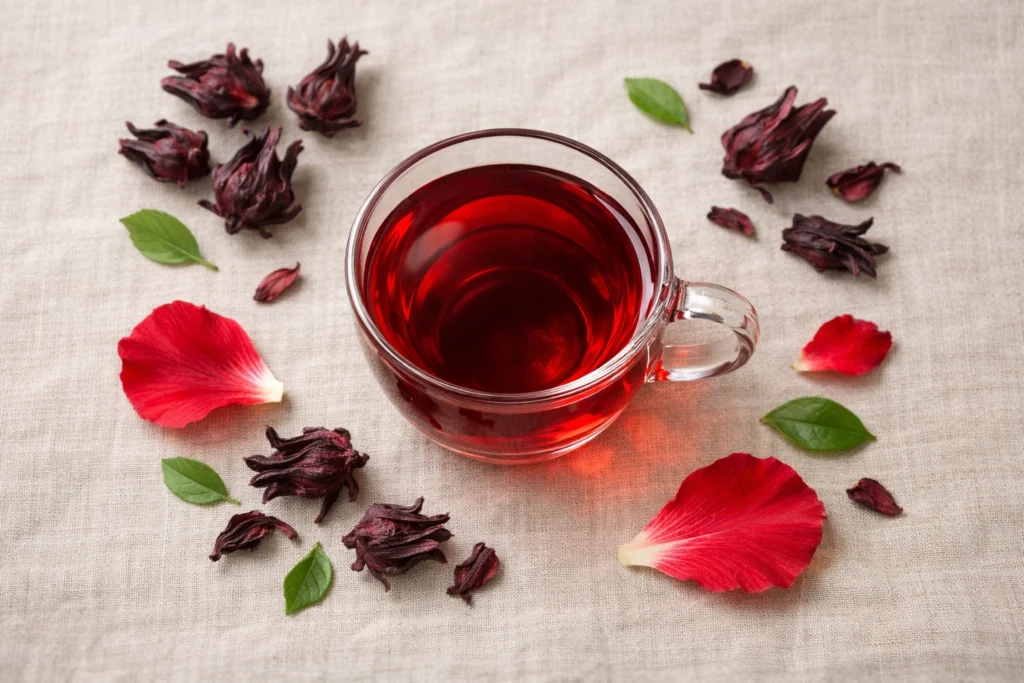
Hibiscus tea comes from the dried red parts of the hibiscus flower. These red parts are called calyxes. They sit at the base of the flower bud and hold all the plant’s color and goodness.
The tea is tart and ruby-red. Many people say it tastes like cranberry or pomegranate. It is naturally caffeine-free, so you can drink it any time of day.
There are many types of hibiscus, but only one is best for skin care. That is Hibiscus sabdariffa, also called Roselle. This is the type used in true hibiscus tea. Other ornamental hibiscus species look pretty but have different uses.
🔬 Botanical Note
Hibiscus sabdariffa belongs to the mallow family (Malvaceae). It is native to West Africa and now grown across tropical regions worldwide. Most skin research has focused on this species, not the ornamental Hibiscus rosa-sinensis.
Hibiscus has many local names depending on where you live. The table below shows the most common ones.
| Language / Region | Local Name | Also Known As |
|---|---|---|
| Botanical (Latin) | Hibiscus sabdariffa | Roselle, Red Sorrel |
| Arabic / Middle East | Karkadé (كركديه) | Sour Tea |
| Caribbean / West Indies | Sorrel | Jamaica Flower |
| Mexico / Latin America | Flor de Jamaica | Agua de Jamaica |
| West Africa (Nigeria) | Zobo / Zoborodo | Bissap (Senegal) |
| South Asia (Hindi/Urdu) | Lal Ambadi / Patwa | Gurhal (ornamental sp.) |
| Southeast Asia (Thai) | Krajeab (กระเจี๊ยบ) | Roselle tea |
| English (global) | Hibiscus Tea | Red Zinger, Hibiscus Flower Tea |
Nutritional Profile & Key Bioactive Compounds
Hibiscus tea is very low in calories and contains zero caffeine. It gives you small amounts of vitamin C, potassium, and other minerals. But the real magic is in its plant compounds — especially the ones that give the tea its deep red color.
| Nutrient | Per 240ml Cup | % Daily Value (approx.) | Why It Helps Skin |
|---|---|---|---|
| Calories | ~3 kcal | <1% | — |
| Vitamin C | 12–15 mg | 13–17% | Builds collagen, fights damage |
| Potassium | ~50 mg | 1% | Keeps cells hydrated |
| Magnesium | ~8 mg | 2% | Helps the body manage stress |
| Calcium | ~10 mg | 1% | Supports the skin barrier |
| Iron | ~0.4 mg | 2% | Helps deliver oxygen to skin |
| Caffeine | 0 mg | 0% | No stress spike |
| Total Anthocyanins | 50–200 mg* | — | Main inflammation fighter |
*Anthocyanin levels vary by brand and brewing method. Loose-leaf hibiscus usually has more than tea bags.
The Plant Compounds That Help Your Skin
Hibiscus contains a powerful mix of natural compounds. Together, they calm inflammation, fight bacteria, and gently exfoliate the skin. The table below shows the main ones.
🔬 The Science Behind the Color
The deep red color of hibiscus comes from anthocyanins — mainly delphinidin-3-sambubioside and cyanidin-3-sambubioside. These compounds block NF-κB, a master switch in the body that controls inflammation. By turning down NF-κB, hibiscus reduces the immune signals that drive psoriasis and eczema flares.
| Compound | Type | What It Does for Skin |
|---|---|---|
| Anthocyanins | Plant pigment | Calms inflammation, fights free radicals |
| Quercetin | Flavonoid | Reduces redness and swelling |
| Kaempferol | Flavonoid | Eases inflammation |
| Malic acid | Fruit acid (AHA) | Gently removes dead skin cells |
| Citric acid | Fruit acid (AHA) | Helps balance skin pH |
| Hibiscus acid | Unique acid | Calms blood vessel inflammation |
| Vitamin C | Vitamin | Builds collagen, supports immunity |
| Beta-carotene | Carotenoid | Reduces redness and irritation |
| Phenolic acids | Polyphenols | Fight bacteria and damage |
7 Proven Benefits of Hibiscus Tea for Psoriasis & Eczema
Here are the seven main ways hibiscus tea can help if you have psoriasis or eczema. Each benefit is backed by research or strong traditional use.
Calms Inflammation at the Root
Psoriasis and eczema are both inflammation problems. Your immune system overreacts and floods the skin with signals that cause swelling, redness, and damage.
Hibiscus contains compounds that turn down these inflammation signals. They work in a similar way to common pain-and-swelling medicines, but more gently. A 2025 research review confirmed hibiscus has steady anti-inflammatory effects.
🔬 How It Works
Hibiscus anthocyanins block NF-κB signalling. This reduces the production of inflammatory cytokines like IL-6, IL-1β, and TNF-α. The flavonoids quercetin and kaempferol also block COX enzymes and leukotriene formation — the same targets as many anti-inflammatory drugs.
Stops the Itch — Naturally
The worst part of psoriasis and eczema is often the itch. When you scratch, your skin releases more itch chemicals, and the cycle keeps going.
Hibiscus works as a natural antihistamine. In one animal study, hibiscus extract worked about as well as a common antihistamine drug for stopping itch. Many people also feel relief within an hour of drinking it during a flare.
For the full science behind how hibiscus stops itch, see our deep dive on does hibiscus tea stop eczema itching.
Strong Antioxidant Protection
People with psoriasis and eczema have higher levels of damaging molecules called free radicals. These molecules attack skin cells and make inflammation worse.
Hibiscus is one of the richest natural sources of antioxidants. It packs anthocyanins, vitamin C, and beta-carotene into every cup. These work together to neutralize free radicals before they can hurt your skin.
One study found people who drank antioxidant-rich teas had about 10% less skin aging than those who did not. See how hibiscus stacks up to other options in our comparison: hibiscus tea vs green tea for eczema.
Natural Fruit Acids Soften Plaques
Hibiscus contains gentle natural fruit acids called AHAs. These acids dissolve the “glue” that holds dead skin cells together. As the dead cells fall away, fresh skin underneath shows through.
This is huge for psoriasis. Psoriasis makes skin cells grow up to ten times faster than normal. They pile up into thick, silvery plaques. Hibiscus AHAs gently break down those plaques without scrubbing.
📊 Why This Matters for Psoriasis
Scrubbing psoriasis plaques can trigger the Köbner phenomenon — new plaques forming where skin is injured. Hibiscus AHAs are gentle chemical exfoliants that avoid this risk. The natural fruit acids are also delivered alongside soothing anthocyanins, making them better tolerated than synthetic AHA products.
These same fruit acids also help with general skin care. Read more in our guide to hibiscus tea benefits for skin.
Repairs the Skin Moisture Barrier
A weak skin barrier is at the heart of both eczema and psoriasis. When your skin cannot hold water, it gets dry, cracked, and easily irritated. This makes flares worse.
Hibiscus contains natural sugars that act like sponges. They pull water in and help your skin hold onto it. Drinking the tea also keeps you hydrated from inside.
When you apply cooled hibiscus tea to your skin, it forms a light film that locks moisture in. This is one reason it feels so soothing on dry, irritated patches. For young children with eczema, see our safety guide on hibiscus tea for eczema in children.
Fights Bacteria That Make Skin Worse
Cracked or broken skin is an open door for bacteria. Staphylococcus aureus lives on the skin of over 90% of eczema patients and makes flare-ups much worse.
A 2024 research review confirmed that hibiscus fights several harmful skin germs. It works against staph, strep, and even some yeast infections. Its mild acidity also creates an environment bacteria don’t like.
Hibiscus is not the only herb with germ-fighting power. See how it ranks in our list of 7 best herbal teas for psoriasis flare-up relief.
Reduces Stress That Triggers Flares
Stress is one of the biggest triggers for psoriasis and eczema flares. When you are stressed, your body releases hormones that throw your immune system off balance. The result is more inflammation and more flares.
Hibiscus tea is caffeine-free, so it calms instead of stimulating. It also contains magnesium, a mineral that helps your nervous system stay relaxed.
The simple act of brewing and sipping a warm cup helps shift your body into “rest mode.” Many people in psoriasis support groups say hibiscus brings them a real sense of calm — on top of the direct skin benefits.
Hibiscus in Traditional Medicine for Skin Conditions
Long before science could explain why hibiscus works, traditional healers around the world were already using it for skin problems. Here is how four major healing traditions have used this flower.
🌍 Ayurvedic Medicine (India)
In Ayurveda, hibiscus is seen as a “cooling” herb. It is used to calm Pitta dosha — the energy linked to inflammation, heat, and skin conditions. Ayurvedic doctors have used hibiscus flowers for skin disorders for centuries.
🌍 West African Traditional Medicine
In Nigeria and across West Africa, hibiscus calyxes (called Zobo or Bissap) have been used for generations. Healers used them to treat skin rashes, infections, and inflammation. The plant later traveled to the Caribbean during the slave trade.
🌍 Middle Eastern & Unani Medicine
Unani medicine is the Greco-Arabic system used across the Middle East and South Asia. It treats hibiscus (karkadé) as having “cold and dry” qualities. This makes it a go-to remedy for hot, inflamed skin conditions.
🌍 Caribbean & Latin American Folk Medicine
In Jamaica, Trinidad, and Mexico, healers have applied hibiscus to the skin for inflamed patches and small wounds. The fruit acids in hibiscus naturally “soften” rough or thick skin — something modern science now confirms.
How to Use Hibiscus Tea for Psoriasis & Eczema Relief
You can use hibiscus tea in two main ways. Drink it daily as a tea, and apply it cooled to your skin. Doing both at once usually works best.
For a full breakdown of every topical method — toner, compress, face mask, bath soak, steam, and hair rinse — see our guide on can you use hibiscus tea topically on skin.
| Method | How to Use | How Often | Best For |
|---|---|---|---|
| Hot tea (drink) | 1–2 tsp loose hibiscus or 1 tea bag in 240ml water (85–90°C); steep 5–8 min | 1–2 cups daily | Whole-body inflammation and stress |
| Iced tea (drink) | Brew double-strength, chill in fridge, drink cold | 1–2 cups daily | Cooling flares triggered by heat |
| Skin compress | Cool brewed tea, soak a clean cloth, hold on skin 10–15 min | 3–4× per week | Direct itch relief and softening |
| Skin rinse | Spray or pour cooled tea over skin after bathing; pat dry | Daily after shower | pH balance and gentle exfoliation |
| Foot soak / sitz bath | Add 4–6 cups of strong brewed tea to lukewarm bath; soak 15–20 min | 2–3× per week | Wider areas of eczema or psoriasis |
Best Times to Use Hibiscus Tea
Timing makes a difference. Here is when to use hibiscus tea for the best results across the day.
| Time of Day | What to Do | Why It Helps |
|---|---|---|
| Morning (with breakfast) | 1 cup hot tea | Starts your anti-inflammation effect early |
| Midday or afternoon | Iced hibiscus tea | No caffeine — keeps antioxidants steady |
| Evening (1 hr before bed) | 1 cup warm tea | Calms you down and supports sleep |
| During a flare-up | Drink tea + apply compress | Combined inside-and-outside relief |
| After your shower | Skin rinse with cooled tea | Damp skin absorbs more |
🌿 How should you use hibiscus tea? Type it in our free Herb & Tea Benefit Finder — get preparation method, timing, dosage, and safety notes instantly.
🔍 Try the Herb & Tea Benefit Finder →Hibiscus Tea Recipe — For Drinking & Topical Compress
This simple recipe makes two cups. One is for drinking, and one is for using as a skin compress. For the detailed step-by-step compress method, see our tutorial on how to make a hibiscus tea compress for psoriasis.
🌺 Anti-Inflammatory Hibiscus Tea (Drink & Compress)
Makes: 2 cups (one to drink, one for compress) | Prep: 10 minutes | Brew: 8 minutes
Ingredients:
- 3 teaspoons dried hibiscus (loose-leaf) or 2 hibiscus tea bags
- 480ml filtered water, boiled then cooled to ~85–90°C
- 1 teaspoon raw honey (optional — soothing)
- 1 small slice fresh ginger (optional — calms inflammation)
- Squeeze of lemon juice (optional — boosts the active compounds)
-
1
Boil and cool the water
Bring 480ml of filtered water to a boil. Take it off the heat and wait 2–3 minutes. The water should drop to about 85–90°C.
-
2
Add hibiscus and steep
Put your loose hibiscus or tea bags in a teapot. Pour the cooled water over them. Add ginger if using. Steep for 7–8 minutes for full color and flavor.
-
3
Strain and divide
Remove the hibiscus and ginger. Pour half (about 240ml) into your cup. Pour the other half into a clean glass jar.
-
4
Sweeten your drink (optional)
Add raw honey and lemon juice to your cup. Stir gently. Drink while warm for the best effect.
-
5
Cool the compress portion
Let the second jar cool to room temperature. Then chill it in the fridge for 15–20 minutes. Soak a clean cotton cloth in the cool tea. Apply it to your skin for 10–15 minutes.
-
6
Pat dry and moisturize
Gently pat your skin dry. Right away, put on your usual fragrance-free moisturizer. Damp skin soaks up moisturizer better than dry skin.
Recommended Dosage of Hibiscus Tea for Skin Conditions
There is no official medical dose for hibiscus tea for skin problems. The amounts below come from traditional use and herbal medicine research. Always start with the lower amount and see how your body responds.
📅 How Long Until You See Results?
Herbal remedies work slowly. Most people notice less itching and redness within 2–4 weeks of daily use. Bigger improvements in flare-ups and plaques usually take 6–12 weeks. Topical compresses may give faster relief during a flare. Give it at least 8 weeks of daily use before judging the results.
Side Effects & Safety Precautions
Hibiscus tea is safe for most healthy adults at 1–3 cups per day. But there are important rules to follow if you take medication or are in a special health situation. For the full drug-interaction list, see our safety guide on hibiscus tea side effects and drug interactions.
🩸 Blood Pressure Medication
Hibiscus naturally lowers blood pressure. If you take blood pressure pills, the combined effect could drop your pressure too low. Talk to your doctor before drinking it daily.
🤰 Pregnancy & Breastfeeding
Avoid hibiscus tea during pregnancy. It may trigger uterine contractions and raise the risk of miscarriage, especially in early pregnancy. Safety during breastfeeding is unclear, so it is best to skip it.
💊 Diabetes Medication
Hibiscus may lower blood sugar. If you take insulin or diabetes pills, the combined effect could cause low blood sugar. Watch your levels carefully and talk to your doctor.
🦷 Tooth Enamel
Hibiscus tea is naturally acidic. Drinking it often without rinsing can wear down tooth enamel over time. Use a straw and rinse your mouth with water after drinking. Do not brush your teeth right away.
🌿 Allergic Reactions
Hibiscus allergies are rare but possible. People allergic to plants in the mallow family (like okra) may react. If you get a rash, hives, or trouble breathing, stop using it and seek medical help.
🫀 Liver Health (High Doses)
Some animal studies show possible liver effects from very high doses. Normal tea drinking (1–3 cups daily) has not caused liver problems in humans. But concentrated supplements should be used with care if you have liver issues.
Try Our Free Herb & Tea Benefit Finder
Type hibiscus or any herb to instantly see its benefits, how to use it, and who should be careful.
🔍 Open the Herb & Tea Benefit Finder →📚 Complete Hibiscus Tea Guide Series
Does Hibiscus Tea Stop Eczema Itching?
The full science behind hibiscus as a natural antihistamine.
7 Best Herbal Teas for Psoriasis (Ranked)
How hibiscus ranks among green tea, chamomile, rooibos and more.
How to Make a Hibiscus Tea Compress for Psoriasis
Step-by-step guide — brew strength, technique, timing, and safety.
Hibiscus Tea vs Green Tea for Eczema
Head-to-head comparison — which tea wins for eczema and why.
Hibiscus Tea Side Effects & Drug Interactions
Complete safety guide — who should avoid hibiscus and why.
7 Best Natural Antihistamines for Eczema
How hibiscus ranks among quercetin, nettle, chamomile, and more.
Hibiscus Tea Benefits for Skin: Anti-Aging, Acne & Hydration
All 10 general skin benefits — collagen, brightening, hydration.
Hibiscus Tea for Eczema in Children: Is It Safe?
Age-specific safety, dilution ratios, and child-safe compress method.
Hibiscus Tea for Rosacea, Acne & Sensitive Skin
How hibiscus calms rosacea — with the critical cold-only rule.
Can You Use Hibiscus Tea Topically? 6 Methods That Work
Toner, compress, mask, bath, steam, and hair rinse — step by step.
Frequently Asked Questions
Yes — both science and real-world reports support this. Hibiscus contains compounds that work like natural antihistamines. They lower the chemicals in your body that cause itch.
One animal study found hibiscus extract reduced itch about as well as a common antihistamine drug. Many people in psoriasis groups also report relief within an hour of drinking it. Results vary, and hibiscus should be used alongside — not instead of — your prescribed treatment.
Yes, cooled hibiscus tea is generally safe to apply to eczema-affected skin. The natural fruit acids gently exfoliate, the plant pigments calm inflammation, and the mild acidity helps restore the skin’s normal pH.
Use it as a compress (soak a clean cloth, hold on skin for 10–15 minutes) or as a gentle rinse after bathing. Do not apply it to open or oozing wounds without a doctor’s advice. Always patch test on a small area first and wait 24 hours.
Herbal remedies work slowly and need patience. Most people see less itching and redness within 2–4 weeks of daily use. Bigger improvements in flares and plaques usually take 6–12 weeks.
Topical compresses can give faster relief during a flare. Commit to at least 8 weeks of daily use (1–2 cups per day) before deciding if it works for you.
Hibiscus, green tea, and oolong tea are the top three for psoriasis. Green tea contains EGCG, which research shows helps normalize the skin cell cycle. One Japanese study found oolong tea reduced eczema itching after just one week.
Hibiscus stands out because it combines antihistamine action, gentle plaque softening, and germ-fighting power in one tea. Many people rotate between all three for full coverage.
Hibiscus tea is generally safe for children over age 2 in small amounts. But always check with your child’s doctor first. The main concern is its blood-pressure-lowering effect, which can be too strong in young kids.
A safer option for young children is to use hibiscus only on the skin (as a diluted compress). This avoids the blood pressure issue while still helping the skin. See our full guide on hibiscus tea for eczema in children.
No major interactions with common psoriasis drugs (methotrexate, biologics, steroid creams) have been reported. Hibiscus mainly interacts with blood pressure and diabetes medications — not the immune drugs used for psoriasis.
Still, always tell your doctor about any herbal teas you drink. Hibiscus effects from tea drinking are gentle and dietary, so big drug interactions are unlikely at normal amounts.
Both help eczema in different ways. Chamomile is excellent applied to the skin — it has been used in European eczema creams for centuries. Hibiscus has stronger antihistamine effects and contains natural fruit acids that chamomile does not.
For itching specifically, hibiscus has stronger evidence. For general soothing, chamomile is great topically. Using chamomile on the skin and hibiscus as a daily tea covers both bases nicely.
Yes, hibiscus tea may help scalp psoriasis in two ways. Drinking it daily reduces the inflammation that drives scalp flares. Using it as a rinse after shampoo can soften scalp plaques and balance scalp pH.
To use as a rinse: pour cooled tea over your scalp after shampooing, leave for 2–3 minutes, then rinse out. Skip this if your scalp is broken or bleeding. It does not replace medicated shampoos.
Yes — and the difference is big. A 2024 study in the Journal of Food Science tested 29 commercial hibiscus products. Loose-leaf hibiscus had the highest levels of active compounds. Tea bags — especially finely ground ones — had much less.
The grinding process used to make tea bags damages the heat-sensitive plant pigments. For real skin benefits, choose whole or roughly chopped dried hibiscus. Store it in a sealed container away from light and heat.
Yes, 1–2 cups a day is generally safe for healthy adults long-term. Studies on hibiscus for blood pressure have followed users for months without serious side effects. For skin benefits, daily use is actually best because the effects build up over time.
If you take any medications or have health conditions, mention it to your doctor first. Always rinse your mouth after drinking to protect tooth enamel from the natural acidity.