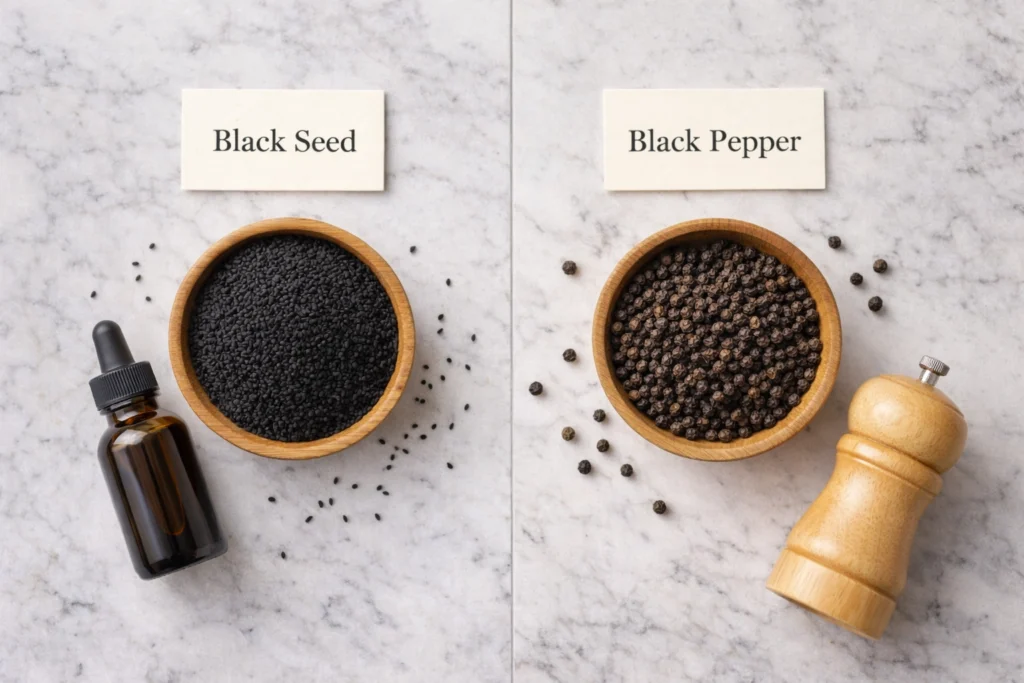
Black seed (Kalonji) and black pepper are two completely different plants with different active compounds and different health benefits. Many people confuse them — but they are not the same thing at all. Here is everything you need to know.
📋 Table of Contents
Are Black Seed and Black Pepper the Same Thing?
No — they are completely different plants. This is one of the most common mix-ups in natural health.
Black seed is Nigella sativa — also called Kalonji in South Asia and Habbatus Sauda in Arabic. It is a small flowering plant whose tiny black seeds are used as a powerful natural medicine.
Black pepper is Piper nigrum — the world’s most traded spice. It comes from a climbing vine. The peppercorns are the dried fruit of this vine, ground into the seasoning you use in cooking every day.
The confusion happens because both produce small black seeds, both are common in South Asian cooking, and both are sometimes called “black cumin” in different regions. But botanically, chemically, and medically — they are entirely different.
🇵🇰 کیا کلونجی اور کالی مرچ ایک ہی چیز ہے؟
نہیں — یہ دونوں بالکل مختلف مصالحے ہیں۔
Is kalonji and kali mirch the same? No. Kalonji (کلونجی) is Nigella sativa — a medicinal seed used on breads, rice, and as a health supplement. Kali mirch (کالی مرچ) means black pepper — Piper nigrum — the common kitchen spice. They look similar but are completely different plants with different health benefits. Never use one in place of the other.
🔗 🌿 Full Guide: All 10 Black Seed Benefits
Want to know everything about black seed? Read our complete guide:
👉 Black Seed (Kalonji): 10 Proven Benefits, Uses & Side Effects →
What Is Each One? A Simple Comparison
| Feature | 🌿 Black Seed (Kalonji) | 🫙 Black Pepper |
|---|---|---|
| Scientific name | Nigella sativa | Piper nigrum |
| Plant family | Ranunculaceae (buttercup family) | Piperaceae (pepper family) |
| Origin | Southwest Asia, Mediterranean, Africa | South India (Kerala) |
| Main active compound | Thymoquinone (TQ) | Piperine |
| Taste | Earthy, bitter, slightly oniony | Sharp, pungent, hot |
| Primary use | Medicinal supplement + cooking spice | Cooking spice + some medicinal use |
| Common forms | Whole seeds, ground powder, cold-pressed oil, capsules | Whole peppercorns, ground powder, essential oil |
| Known in Islam as | Habbatus Sauda — “a cure for every disease except death” | Not specifically mentioned in Islamic medicine |
| No. of studies (PubMed) | 1,265 per year (2025) | Several hundred per year |
What Is Black Seed Good For?
Black seed has a very wide range of benefits backed by clinical studies. Its main active compound, thymoquinone, is one of the most researched natural compounds in modern pharmacology.
Blood Sugar & Diabetes
A 2025 review of 16 clinical trials confirmed black seed significantly lowers fasting blood sugar and HbA1c in type 2 diabetics. This is its most well-proven benefit.
Cholesterol & Heart Health
Studies show black seed reduces bad LDL cholesterol and total cholesterol. It also helps lower blood pressure — making it useful for overall heart health.
Immunity & Infections
Black seed boosts the immune system and fights bacteria and viruses. It was found effective at improving outcomes in hospitalised COVID-19 patients in a 2024 review.
Skin, Hair & Breathing
Black seed helps with acne, eczema, hair loss, dandruff, and asthma. It works both internally as a supplement and externally when applied as oil to the skin or scalp.
What Is Black Pepper Good For?
Black pepper is far more than just a kitchen spice. Its main active compound, piperine, has genuine and well-documented health properties — some of which are completely unique.
Boosts Absorption of Other Nutrients
This is black pepper’s most unique benefit. Piperine dramatically increases how much of other nutrients your body absorbs. The most famous example: black pepper increases the absorption of curcumin (from turmeric) by up to 2,000%. This is why turmeric and black pepper are always taken together.
Supports Digestion
Black pepper stimulates digestive enzymes and helps your stomach break down food more efficiently. It reduces bloating, gas, and digestive discomfort. It has been used as a digestive aid in Ayurvedic medicine for thousands of years.
Anti-Inflammatory & Antioxidant
Piperine is a natural anti-inflammatory and antioxidant. Studies show it can help with joint pain and reduce inflammation markers in the body — though its anti-inflammatory effects are generally considered less potent than thymoquinone.
Cholesterol Support
A clinical trial found that piperine supplementation for 12 weeks significantly reduced total cholesterol, LDL, and triglycerides in people with fatty liver disease. So like black seed, black pepper also has some cholesterol-lowering evidence.
Head-to-Head Comparison
| Health Goal | 🌿 Black Seed | 🫙 Black Pepper | Winner |
|---|---|---|---|
| Blood sugar control | ✅ Strong clinical evidence | ❌ No significant evidence | 🌿 Black Seed |
| Cholesterol reduction | ✅ Strong — LDL drops 19.53 mg/dL | ✅ Moderate — piperine helps | 🌿 Black Seed |
| Blood pressure | ✅ Confirmed in multiple RCTs | ⚠️ Limited evidence | 🌿 Black Seed |
| Immunity & infections | ✅ Very strong | ✅ Moderate antioxidant + antimicrobial | 🌿 Black Seed |
| Inflammation | ✅ Strong — NF-κB inhibition | ✅ Moderate — piperine anti-inflammatory | 🌿 Black Seed |
| Digestion | ✅ Good | ✅ Excellent — enzyme stimulation | 🤝 Both equal |
| Nutrient absorption | ❌ No significant effect | ✅ Excellent — piperine boosts absorption | 🫙 Black Pepper |
| Skin conditions | ✅ Strong — acne, eczema, wounds | ⚠️ Limited topical evidence | 🌿 Black Seed |
| Hair growth | ✅ Clinical trial evidence | ❌ No evidence | 🌿 Black Seed |
| Asthma & breathing | ✅ Clinical trial confirmed | ⚠️ Aromatic use only | 🌿 Black Seed |
| Cooking versatility | ✅ Good — adds flavour to many dishes | ✅ Excellent — universal seasoning | 🫙 Black Pepper |
| Research depth | ✅ 1,000+ studies | ✅ Hundreds of studies | 🌿 Black Seed |
Can You Use Both Together?
Yes — and combining them is actually a smart idea. They complement each other perfectly.
Black pepper’s piperine has been shown to improve the absorption of many natural compounds. While most research focuses on curcumin and turmeric, some researchers suggest piperine may also improve the absorption of thymoquinone from black seed.
A clinical trial actually tested a combination of standardised black seed oil with piperine together for seasonal allergies — and found significant improvement in allergy symptoms compared to placebo. This suggests the two work well in combination.
| Combination | Why It Works | Good For |
|---|---|---|
| Black seed + black pepper | Piperine may boost black seed absorption. Combined anti-inflammatory effect. | Immunity, inflammation, allergies |
| Black seed + turmeric + black pepper | Three of the most researched anti-inflammatory natural compounds combined. Black pepper boosts turmeric absorption dramatically. | Inflammation, arthritis, metabolic health |
| Black seed + black pepper in cooking | Simply adding both to food gives you the digestive and anti-inflammatory benefits of both without any supplement | Daily health maintenance |
Which One Should You Choose?
The honest answer is: it depends on your goal. Here is a simple guide:
Choose Black Seed if you want to:
Lower blood sugar or manage type 2 diabetes, reduce cholesterol and blood pressure, boost your immune system, help with asthma or breathing problems, treat acne, eczema, or hair loss, or take a natural supplement with broad clinical evidence behind it.
Choose Black Pepper if you want to:
Improve digestion, get more from your turmeric or other supplements (piperine boosts absorption), add natural antioxidants to your diet easily, or simply season your food with something that has health benefits beyond just flavour.
Use Both if you want to:
Get the best of both worlds — the therapeutic range of black seed plus the absorption-boosting digestion support of black pepper. This is perfectly safe and potentially more effective than either alone.
💊 Important Safety Note
Black seed can interact with diabetes and blood pressure medications — lowering levels too much if combined. Black pepper at normal culinary amounts is safe for everyone. But piperine in supplement form may affect how your body processes certain medications — including blood thinners and some antibiotics. If you take any regular medication, speak to your doctor before starting either as a therapeutic supplement.
Try Our Free Herb & Tea Benefit Finder
Type black seed, black pepper, or any herb to instantly compare benefits, dosage, and safety.
🔍 Open the Herb & Tea Benefit Finder →Frequently Asked Questions
No — they are completely different plants. Black seed is Nigella sativa (called Kalonji in South Asia). Black pepper is Piper nigrum — the common kitchen spice. They look similar and both appear in South Asian cooking, but they come from unrelated plant families, contain different active compounds, and have different health benefits. Black seed’s active compound is thymoquinone. Black pepper’s active compound is piperine. Never substitute one for the other in a health context.
For most health conditions, black seed has stronger and broader clinical evidence — especially for blood sugar, cholesterol, immunity, skin conditions, and respiratory health. Over 1,000 scientific studies have been published on black seed, including multiple large meta-analyses of clinical trials. Black pepper, however, has one unique advantage that black seed lacks — its ability to dramatically boost the absorption of other nutrients, especially curcumin from turmeric. Ideally, you use both for different purposes rather than choosing one over the other.
Yes — taking both together is safe and may be more beneficial than either alone. A 2024 clinical trial specifically tested black seed oil combined with piperine (black pepper extract) and found significant improvement in seasonal allergy symptoms. Black pepper’s piperine may also improve the absorption of thymoquinone from black seed. You can combine them by taking black seed oil in the morning and simply using freshly ground black pepper on your food throughout the day.
No — kalonji (کلونجی) and kali mirch (کالی مرچ) are completely different spices. Kalonji is Nigella sativa — the black seed used as medicine and in cooking on breads and rice. Kali mirch literally means “black pepper” in Hindi and Urdu — this is Piper nigrum, the standard kitchen pepper. Both are commonly used in South Asian cooking but they taste completely different and have different health properties. Kalonji tastes earthy and slightly bitter. Kali mirch is sharp, hot, and pungent.
Possibly — though this has not been as extensively studied as piperine’s effect on turmeric. Piperine in black pepper works by inhibiting enzymes that break down compounds in the digestive tract, allowing more of them to be absorbed into the bloodstream. Since it has this effect on many different plant compounds, it may also improve how much thymoquinone from black seed your body absorbs. A 2024 clinical trial used a combination of black seed oil and piperine together and found good results — though the study focused on allergy symptoms rather than absorption specifically.
Kalonji and black cumin are two names for the same plant — Nigella sativa. The name “black cumin” is also sometimes used for a completely different plant called Bunium bulbocastanum or Carum carvi (caraway). This creates a lot of confusion. When you see “black cumin” in a health context, it almost always refers to Nigella sativa (kalonji) — not the other plants. Always check the botanical name on any product label. Only Nigella sativa has the health benefits described in research studies.
📚 Related Health Guides
Black Seed (Kalonji): 10 Proven Benefits
The complete black seed guide — all benefits, uses, dosage, and safety information.
Black Seed Oil Benefits: 8 Proven Uses
How to choose quality oil and use it for health, skin, and hair.
How to Use Black Seed Daily: 7 Simple Methods
Step-by-step guide to all 7 ways to take kalonji daily.
Cumin (Jeera) Benefits, Uses & Side Effects
Another commonly confused spice — discover cumin’s distinct digestive and metabolic benefits.