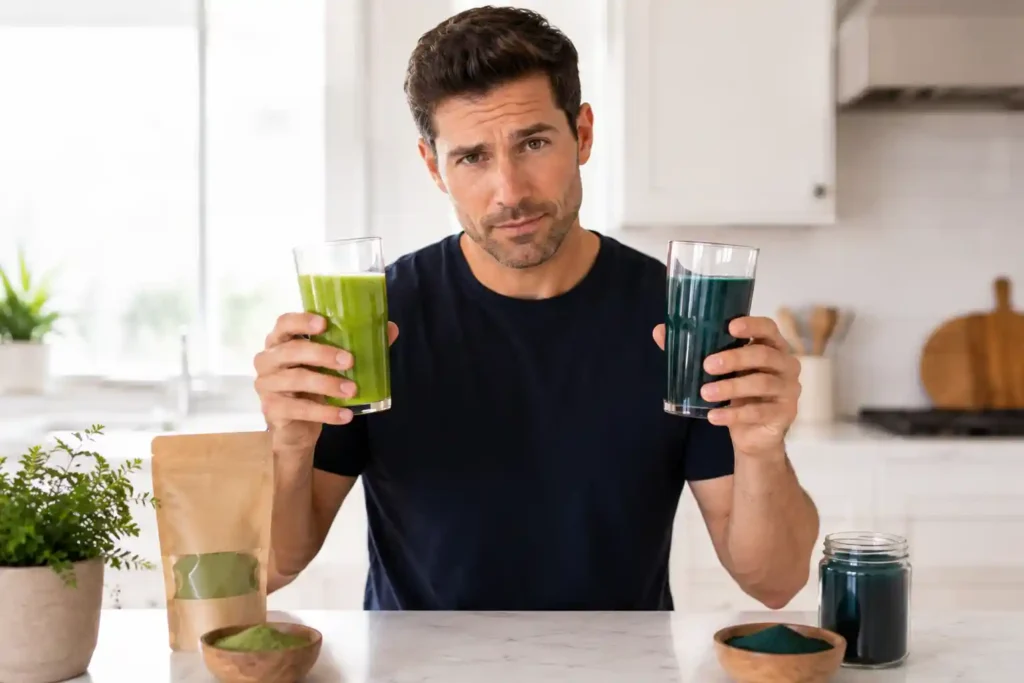
Moringa and spirulina are both remarkable superfoods — but they have very different strengths. The best choice depends entirely on what your body needs most right now.
📋 Table of Contents
Introduction
You are standing in a health food shop holding two bags of green powder. One says moringa. One says spirulina. Both claim to be superfoods. Both look like pond water when mixed. Both promise incredible results.
Which one should you buy? Which one is actually worth your money? And is one clearly better than the other — or does it depend on what you need?
🛠️ Free Health Tools — BMI Calculator, Blood Sugar Risk Assessment, Water Intake Calculator & more
🔍 Browse All Free Health Tools →In this guide we give you an honest, direct comparison — nutrition, benefits, taste, side effects, and our final verdict. This article is part of our complete Moringa series. For the full moringa benefits overview see our complete Moringa Benefits guide.
What Are They?
Moringa and spirulina come from completely different parts of nature. Understanding where they come from helps explain why their nutritional profiles are so different.
The Miracle Tree
Moringa (Moringa oleifera) is a fast-growing tropical tree native to India. Its leaves are dried at low temperature and ground into a bright green powder. It is a whole food — a real plant leaf that humans have eaten for thousands of years. Ayurvedic medicine has used moringa for over 4,000 years. It contains over 90 bioactive compounds including vitamins, minerals, antioxidants, and complete protein. The World Health Organization recognises it as a key tool against malnutrition.
The Blue-Green Algae
Spirulina is a type of cyanobacteria — a microscopic blue-green algae that grows in alkaline freshwater lakes. It is one of the oldest life forms on earth — estimated to be 3.5 billion years old. The Aztecs harvested and dried it as a protein source 400 years ago. NASA has studied it as a space food for astronauts. Spirulina is extraordinarily high in protein and contains unique pigments and antioxidants not found in any other food. It has been used as a dietary supplement since the 1970s.
Nutrition Comparison
Here is how moringa and spirulina compare on key nutrients per 10g serving — roughly one tablespoon of powder.
| Nutrient | Moringa (10g) | Spirulina (10g) | Winner |
|---|---|---|---|
| Protein | 2.7g | 5.7g (complete protein) | 🏆 Spirulina |
| Vitamin A | 38% DV | 1% DV | 🏆 Moringa |
| Vitamin C | 40% DV | 0% DV | 🏆 Moringa |
| Vitamin E | 27% DV | 2% DV | 🏆 Moringa |
| Vitamin B12 | Minimal | Significant (though debated) | 🏆 Spirulina |
| Calcium | 27% DV | 1% DV | 🏆 Moringa |
| Iron | 36% DV | 15% DV | 🏆 Moringa (higher total) |
| Fibre | 1.7g | 0.3g | 🏆 Moringa |
| Antioxidants | Quercetin, chlorogenic acid, isothiocyanates | Phycocyanin, zeaxanthin, beta-carotene | 🤝 Different types |
| Calories | ~37 kcal | ~29 kcal | 🤝 Both very low |
🔬 The Key Difference in Plain Language
Moringa is a vitamin and mineral powerhouse. It gives you A, C, E, calcium, fibre, and iron in one serving. Spirulina is a protein and unique antioxidant powerhouse. It gives you significantly more protein, B12, and unique pigments like phycocyanin that moringa simply does not contain. Think of moringa as a multivitamin from a tree. Think of spirulina as a concentrated protein and antioxidant shot from algae. They are complementary — not competing.
Benefits Comparison — Head to Head
Here is how the two superfoods compare across the most important health areas.
| Health Goal | Moringa | Spirulina | Verdict |
|---|---|---|---|
| Blood sugar control | ✅ Strong — chlorogenic acid and isothiocyanates lower post-meal glucose by up to 21% | 🟡 Limited evidence | 🏆 Moringa wins |
| Protein supplementation | 🟡 Good — complete protein but lower amount | ✅ Excellent — 57g per 100g (60–70% protein) | 🏆 Spirulina wins |
| Bone health | ✅ Excellent — rich in calcium, vitamin K, and magnesium | ❌ Very little calcium | 🏆 Moringa wins |
| Immunity | ✅ Excellent — high vitamin C, A, zinc, iron | 🟡 Good — phycocyanin and beta-carotene support immunity | 🏆 Moringa wins |
| Anti-inflammatory | ✅ Strong — isothiocyanates, quercetin — 26-study review confirmed | ✅ Strong — phycocyanin is a potent anti-inflammatory | 🤝 Both excellent |
| Heavy metal detox | 🟡 Mild — some detox properties | ✅ Excellent — spirulina binds to heavy metals and supports elimination | 🏆 Spirulina wins |
| Skin health | ✅ Excellent — vitamins A, C, E + clinical collagen study | 🟡 Good — antioxidants support skin but less vitamin research | 🏆 Moringa wins |
| Energy and fatigue | ✅ Good — iron, B vitamins, mitochondrial support | ✅ Good — high protein and B12 support energy | 🤝 Both good |
| Weight management | ✅ Good — fibre, blood sugar, anti-inflammatory | 🟡 Modest — protein reduces appetite, some fat-reducing evidence | 🏆 Moringa wins slightly |
| Athletic performance | 🟡 Moderate — iron and energy support | ✅ Excellent — high protein, B12, endurance benefits in studies | 🏆 Spirulina wins |
Taste and Ease of Use
This is where moringa and spirulina are very different — and it matters more than most people realise. The best supplement is the one you will actually take every single day.
| Factor | Moringa | Spirulina |
|---|---|---|
| Taste | Earthy, slightly bitter — like spinach or watercress | Strong fishy, seaweed taste — very hard to mask |
| Smell | Pungent earthy — manageable | Strong pond or sea smell — unpleasant for many |
| Mixes in water | ✅ Dissolves easily — blends smoothly | 🟡 Dissolves but leaves strong colour and taste |
| In smoothies | ✅ Easy to mask with banana or fruit | ⚠️ Fishy taste breaks through even sweet smoothies |
| In food / cooking | ✅ Blends well in soups, dals, curries | ❌ Very difficult — ruins most savoury dishes |
| Daily habit ease | ✅ Easy to build consistent daily routine | ⚠️ Many people quit because of taste |
| Capsule option | ✅ Available — eliminates taste completely | ✅ Available — most spirulina users prefer capsules |
💡 The taste truth: Moringa tastes like strong spinach. Spirulina tastes like the ocean. Most people can manage moringa in a daily smoothie or water. Most people cannot manage spirulina powder in food — which is why spirulina capsules are far more popular than spirulina powder for daily use.
📖 Complete Moringa Guide
This article compares moringa and spirulina. For the complete guide to all moringa benefits, nutrition facts, and daily usage tips, read our complete Moringa Benefits guide. For how to use moringa powder daily see our How to Use Moringa guide.
Who Should Choose Which
There is no single winner. The best choice depends on your specific health goals and lifestyle. Here is a clear guide.
Moringa Is Right for You
You want broad daily nutrition from a single supplement. You are managing blood sugar or have prediabetes. You want to support bone health — especially after menopause. You have iron deficiency or low energy from nutritional gaps. You want better skin, hair, and immunity. You cook South Asian food and want to add it naturally. You are a beginner to green superfoods. You want the most versatile, easy-to-use option.
Spirulina Is Right for You
You are an athlete or serious gym-goer who needs more plant protein. You are vegan or vegetarian and struggle to get enough protein and B12. You want to support heavy metal detoxification. You have allergies — spirulina has clinical evidence for reducing hay fever. You want targeted antioxidant benefits from phycocyanin — a compound only found in algae. You are already getting enough vitamins from diet and want something different.
Can You Take Moringa and Spirulina Together?
Yes — and for many people this is actually the best approach. Moringa and spirulina complement each other perfectly. They cover completely different nutritional gaps with no overlap in active compounds or mechanisms.
💡 The Moringa + Spirulina Daily Stack
Combined in a single daily smoothie: moringa provides vitamins A, C, E, calcium, fibre, and blood sugar support. Spirulina adds high-quality complete protein, B12, and phycocyanin antioxidants. Together they create one of the most comprehensive plant-based nutritional combinations available. Start with a small dose of each — both are “cleansing” supplements and combining full doses on day one may cause significant digestive upset. Start with half a teaspoon of each and build up over 2 weeks. A simple green smoothie with banana, half a teaspoon of moringa, half a teaspoon of spirulina, and oat milk covers both simultaneously with minimal taste issue.
🥤 The Ultimate Green Superfood Smoothie
- 1Add 1 ripe banana and 200ml oat milk or coconut water to a blender.
- 2Add ½ teaspoon of moringa powder and ½ teaspoon of spirulina powder.
- 3Add a handful of spinach and a teaspoon of honey optionally.
- 4Blend for 30 seconds until completely smooth.
- 5Drink after breakfast every morning — the banana completely masks both the earthy and fishy taste.
Side Effects & Safety
Both moringa and spirulina are safe for most healthy adults at recommended doses. But each has specific safety considerations to know.
| Safety Factor | Moringa | Spirulina |
|---|---|---|
| Common side effects | Nausea, loose stools if taken on empty stomach or too high a dose | Nausea, headache, digestive upset if started too high |
| Pregnancy | Leaf powder safe in food amounts. Root bark must be avoided. | Generally considered safe — but consult doctor first |
| Autoimmune conditions | Generally safe | ⚠️ May stimulate immune system — avoid with autoimmune disease or immunosuppressants |
| Blood thinners | High vitamin K — keep intake consistent | Generally safe at normal doses |
| Diabetes medication | ⚠️ Lowers blood sugar — monitor closely | May have mild blood sugar lowering effect — monitor |
| Heavy metal risk | Low risk with quality leaf powder | ⚠️ Some spirulina products contaminated with heavy metals — always buy tested brands |
| Phenylketonuria (PKU) | Safe | ⚠️ Avoid — contains phenylalanine |
⚠️ Quality warning for spirulina: Spirulina grows in water and can absorb toxins and heavy metals from its environment. Some spirulina products — particularly from unregulated sources — have been found to contain lead, arsenic, and microcystin contamination. Always buy spirulina from brands with third-party Certificate of Analysis (COA) confirming heavy metal testing. This is just as important for spirulina as it is for shilajit.
Conclusion — Our Verdict
If you can only choose one — choose moringa. It is more versatile, easier to use every day, better for blood sugar, bone health, immunity, and skin, and provides a broader nutritional spectrum. For most people’s everyday health goals, moringa delivers more of what they need.
But spirulina is not the loser. If protein is your priority, if you are an athlete, if you want heavy metal detox support, or if you are vegan struggling with B12 — spirulina is the stronger choice for those specific goals.
And the best answer for many people is actually both. Together they cover almost every nutritional base in two teaspoons per day. Start with moringa alone, build your routine, then add spirulina after 4 weeks. That is the simplest path to getting the benefits of both.
Try Our Free Herb & Tea Benefit Finder
Type Moringa, Spirulina, or any herb to instantly see its benefits, how to use it, and who should be careful.
🔍 Open the Herb & Tea Benefit Finder →Frequently Asked Questions
It depends on your goals. Moringa is better for vitamins, minerals, blood sugar control, bone health, skin, and general daily nutrition. Spirulina is better for protein, B12, heavy metal detox, and athletic performance. For most people’s everyday health goals, moringa is the more practical and versatile choice. For athletes and vegans needing more protein, spirulina has the edge. Using both together gives you the best of both worlds.
Yes — they complement each other perfectly and have no known negative interactions. Start with half a teaspoon of each and build up gradually over two weeks — both are cleansing and starting at full doses of both simultaneously can cause significant digestive upset. A banana-based smoothie is the easiest way to combine them as it masks both tastes effectively.
Spirulina wins by a significant margin. Spirulina is 60–70% protein by weight — about 5.7g per 10g serving. Moringa powder is around 25–30% protein — about 2.7g per 10g serving. Both contain all nine essential amino acids making them complete proteins. If protein is your priority — especially for athletic performance or vegan protein supplementation — spirulina is the stronger choice.
Moringa has a slight edge for weight loss because of its fibre content, blood sugar-stabilising chlorogenic acid, and stronger anti-inflammatory effect — all key factors in metabolic health. Spirulina’s high protein content can also support weight loss by reducing appetite. Both can support weight management as part of a healthy diet and exercise plan. Neither is a standalone weight loss solution. See our Moringa for Weight Loss guide for the full breakdown.
Moringa is better for skin. It has a 14-week clinical trial specifically showing collagen and elastin gene activation in women’s skin. Its vitamins A, C, and E, zinc, and antioxidants address the main drivers of skin aging and acne. Spirulina has antioxidant properties but much less clinical evidence for skin specifically. For skin health — moringa is the clear choice, both orally and topically as moringa oil.
Moringa tastes better for most people. It has a strong earthy, slightly bitter taste similar to spinach or watercress — which most people can manage in a smoothie or warm water with lemon. Spirulina has a very strong fishy or seaweed taste that is very difficult to mask even in sweet smoothies. This practical difference is significant — the best supplement is the one you can take consistently every day.
Both are good plant sources of iron but in different ways. Moringa has more total iron per serving — around 36% DV per 10g vs spirulina’s 15% DV. However, spirulina’s iron is considered more bioavailable — meaning your body may absorb it more efficiently. Moringa has an advantage when taken with lemon juice or vitamin C-rich foods — as the vitamin C in moringa itself further boosts iron absorption from the same serving.
Both support energy but through different pathways. Moringa boosts energy by correcting nutritional deficiencies — particularly iron, B vitamins, and magnesium — that commonly cause fatigue. Spirulina boosts energy through its high protein content and B12 — particularly useful for athletes and vegans. For iron-deficiency-related fatigue in women, moringa is likely more effective. For athletic performance and recovery energy, spirulina has the edge.