
Cumin tea and cumin water are both made from cumin seeds (Cuminum cyminum) — but preparation method, compound concentration, flavour intensity, and best use cases differ meaningfully. Knowing which to use and when helps you get the most from each.
📋 Table of Contents
- Introduction
- What Is Cumin Water?
- What Is Cumin Tea?
- How Preparation Affects Active Compounds
- Nutritional Comparison
- Taste, Aroma & Colour
- How to Make Each — Step by Step
- Key Benefits Comparison
- Best Timing & Traditional Uses
- Head-to-Head Comparison Table
- Which Should You Choose?
- Who Should Be Careful?
- FAQs
- Related Health Guides
Introduction
At first glance, cumin tea and cumin water sound almost identical — both are made from the same seeds, both are herbal drinks, and both have been used in traditional wellness practices for centuries. But spend a few minutes with both in hand and the differences become immediately clear: one is a light, subtle daily hydration habit; the other is a warm, aromatic, noticeably stronger beverage that behaves more like a medicinal herbal tea.
The distinction matters more than most people realise. The temperature of the water used, the steeping time, and whether seeds are crushed or left whole all significantly affect which bioactive compounds are extracted — and in what concentrations. Cumin tea, steeped in near-boiling water for 5–10 minutes, extracts substantially more of the seeds’ volatile oils (thymol, cuminaldehyde) than a cold overnight soak. This makes cumin tea a more potent preparation — beneficial in the right context, but not necessarily the better choice for everyday use.
This guide breaks down every meaningful difference between the two — preparation, compound extraction, taste, best timing, and which to choose for your specific situation — so you can use both deliberately and effectively.
For the complete nutritional profile, health benefits, and traditional uses of cumin itself, see our comprehensive guide to cumin (Jeera / Zeera) benefits, nutrition, and traditional uses. For cumin water’s specific role in digestive health, see our cumin water benefits for digestion guide.
What Is Cumin Water?
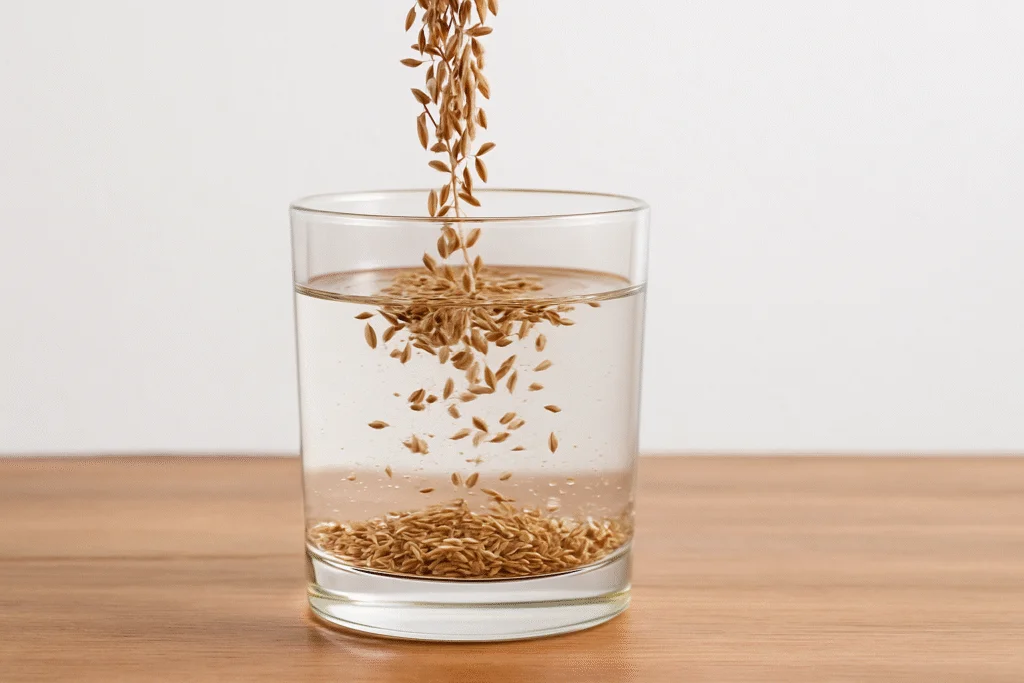
Cumin water is an infusion of cumin seeds (Cuminum cyminum) in water — prepared either by soaking the seeds overnight in cold or room-temperature water, or by briefly boiling them for 3–5 minutes. The result is a pale golden liquid with a mild, earthy flavour and a subtle warm aroma.
It is the more traditional everyday preparation across South Asia — known as jeera pani or zeera pani — and is most commonly drunk first thing in the morning, unsweetened, as part of a daily health routine. Because the extraction is gentle, the drink is mild enough for most people to tolerate on a regular basis, including those with sensitive stomachs.
What Is Cumin Tea?
Cumin tea is prepared by steeping whole or lightly crushed cumin seeds in near-boiling water (90–100°C) for 5–10 minutes — similar to how you would prepare any herbal tea. The high temperature and extended steeping time extract significantly more of the seeds’ volatile oil compounds, producing a darker, more aromatic, noticeably stronger drink.
Cumin tea is typically consumed warm in smaller quantities and less frequently than cumin water. It is more commonly used when a specific therapeutic effect is desired — for acute digestive discomfort, bloating relief after a heavy meal, or as a warming drink during cold or flu season. Its stronger flavour means it is not typically the drink of choice for daily hydration.
How Preparation Affects Active Compounds
This is the most important — and most overlooked — difference between the two drinks. The same seeds produce meaningfully different compound profiles depending on how they are prepared.
| Factor | 💧 Cumin Water | ☕ Cumin Tea |
|---|---|---|
| Water temperature | Cold / room temp (soak) or 100°C brief boil | 90–100°C near-boiling steep |
| Steeping / soak time | 8–10 hours (soak) or 3–5 min (boil) | 5–10 minutes active steep |
| Seeds preparation | Whole seeds | Whole or lightly crushed |
| Thymol extraction | Low–moderate | Moderate–high |
| Cuminaldehyde extraction | Low–moderate | Moderate–high |
| Flavonoid extraction | Moderate (cold soak extracts well) | Moderate–high |
| Overall potency | Mild | Strong |
| Suitable for daily use | ✅ Yes | ⚠️ Occasional use recommended |
Nutritional Comparison (Per 250ml Cup)
Both drinks are extremely low in calories. The difference in nutritional content is subtle but meaningful in terms of bioactive compound concentration.
| Nutrient / Property | 💧 Cumin Water | ☕ Cumin Tea |
|---|---|---|
| Calories | ~5–7 kcal | ~6–8 kcal |
| Carbohydrates | <1 g | <1 g |
| Protein | Trace | Trace |
| Fat | Trace | Trace |
| Volatile oils (thymol etc.) | Low–moderate concentration | Moderate–high concentration |
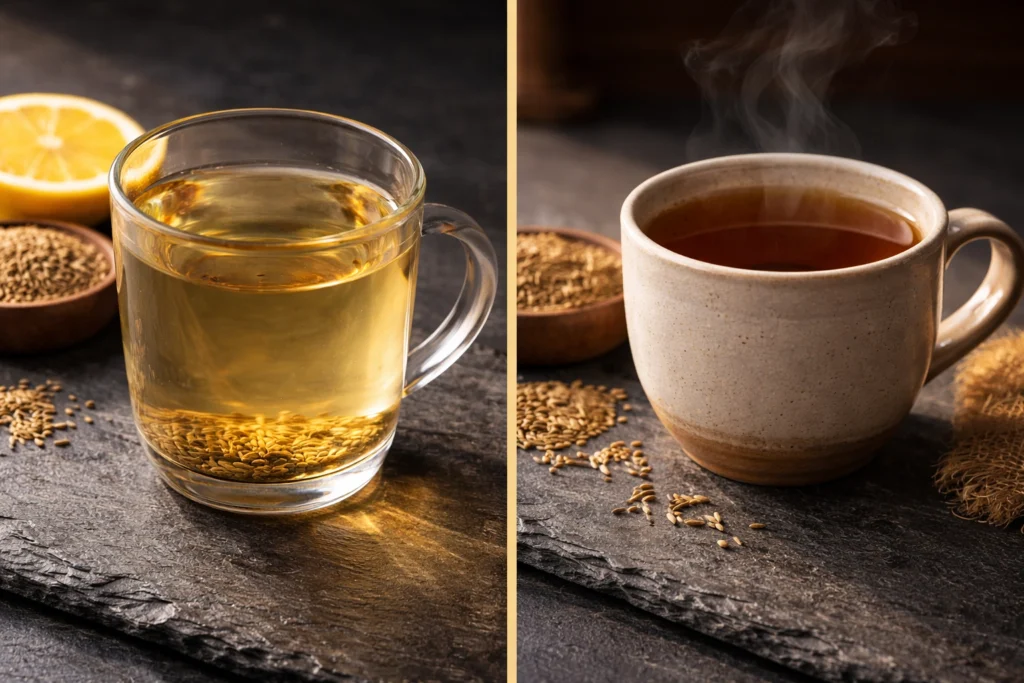
| Colour | Pale golden / clear | Amber to golden-brown |
| Aroma intensity | Subtle, mild | Strong, pungent |
Taste, Aroma & Colour
| Feature | 💧 Cumin Water | ☕ Cumin Tea |
|---|---|---|
| Taste | Mild, earthy, slightly bitter | Strong, warm, bitter-spicy |
| Aroma | Subtle, gentle earthy note | Bold, pungent, unmistakably cumin |
| Colour | Pale golden to near-clear | Amber to golden-brown |
| Aftertaste | Clean, mild | Lingering warm spice |
| Palatability for beginners | More accessible — milder | Stronger — takes getting used to |
| Best additions | Lemon juice, pinch of black salt | Honey (add after steeping), lemon |
| Serving temperature | Warm or room temperature | Always warm — loses character when cold |
How to Make Each — Step by Step
💧 Cumin Water — Method 1: Overnight Soak (Recommended)
Ingredients:
- 1 tsp whole cumin seeds
- 250–300ml water (room temperature)
- Optional: squeeze of lemon, pinch of black salt
- 1 Add 1 tsp cumin seeds to a glass of water in the evening.
- 2 Cover and leave at room temperature overnight (8–10 hours).
- 3 In the morning, strain the seeds and drink the infusion warm or at room temperature.
- 4 Add lemon juice if desired. Avoid sugar to keep it calorie-minimal.
💧 Cumin Water — Method 2: Quick Boil (5 Minutes)
Ingredients:
- 1 tsp whole cumin seeds
- 300ml cold water
- 1 Add cumin seeds to cold water in a small saucepan.
- 2 Bring to a boil over medium heat, then reduce and simmer 3–5 minutes.
- 3 Remove from heat, cool slightly, then strain and drink warm.
☕ Cumin Tea — Standard Method
Ingredients:
- 1 tsp cumin seeds (lightly crushed optional — increases extraction)
- 250ml near-boiling water (90–100°C)
- Optional: ½ tsp honey added after steeping, slice of fresh ginger
- 1 Lightly crush cumin seeds in a mortar or with the back of a spoon — this is optional but increases volatile oil release.
- 2 Place seeds in a cup or tea infuser.
- 3 Pour near-boiling water over the seeds.
- 4 Cover and steep for 5–10 minutes. Longer steeping = stronger taste.
- 5 Strain, add honey or lemon if desired, and drink warm.
How Much Water Should You Drink Daily?
Both cumin water and cumin tea count toward your daily fluid intake. Use our free Water Intake Calculator to find your personalised hydration target based on your weight and activity level.
💧 Calculate My Water Intake →Key Benefits Comparison
Both drinks share the same base ingredient and therefore many of the same potential benefits — but the concentration difference means each shines in slightly different contexts.
💧 Gentle Daily Digestive Support
The mild volatile oil concentration in cumin water makes it ideal for gentle, consistent digestive enzyme stimulation over time. Drinking it every morning before breakfast builds a steady habit of supporting the body’s natural digestive readiness without overwhelming a sensitive stomach. Its consistency is its advantage — cumulative daily use is where cumin water performs best.
⚖️ Weight Management Support
Cumin water is more commonly associated with weight management routines due to its role as a daily low-calorie morning drink that replaces higher-calorie beverages. A 2014 randomised controlled trial found regular cumin consumption linked to reduced body fat percentage. The overnight soak method also preserves more of cumin’s flavonoids, which are studied for their role in insulin sensitivity and metabolic support.
🔥 Fast-Acting Digestive Relief
Because cumin tea extracts higher concentrations of thymol and cuminaldehyde in a short steeping time, it delivers more immediate digestive enzyme stimulation than cumin water. For acute bloating, post-meal heaviness, or sudden indigestion, a cup of warm cumin tea often works faster and more noticeably than cumin water. This is its primary advantage — speed and potency when you need it most.
🤒 Cold, Flu & Nausea Relief
Warm cumin tea is the preferred preparation during illness. The combination of higher thymol concentration (known antimicrobial compound), the warmth of the drink itself, and the stronger aromatic steam all contribute to its traditional use as a remedy for sore throats, congestion, nausea, and cold symptoms. A cup of cumin tea with honey and a slice of ginger is one of the most widely used home remedies across South Asia, the Middle East, and North Africa.
🔗 🌿 Full Guide: Cumin (Jeera / Zeera) — Benefits, Nutrition & Side Effects
Both cumin tea and cumin water draw their benefits from the same seed. For the complete picture — full nutritional data, all 10+ health benefits, bioactive compounds, Ayurvedic uses, and side effects — read our full pillar guide:
👉 Cumin (Jeera / Zeera): Benefits, Uses, Nutrition & Side Effects →
Best Timing & Traditional Uses
| Timing / Situation | 💧 Cumin Water | ☕ Cumin Tea |
|---|---|---|
| 🌅 Morning — empty stomach | ✅ Ideal — gentle daily habit | ⚠️ Can be too strong on empty stomach for sensitive individuals |
| 🍽️ Before a meal | ✅ Primes digestion gently | ✅ More powerful enzyme activation |
| 🍽️ After a heavy meal (bloating) | ✅ Good for regular use | ✅ Better for acute, immediate relief |
| 🤒 During cold / flu / sore throat | ⚠️ Less concentrated — milder effect | ✅ Best choice — higher antimicrobial concentration |
| 🌙 Evening / before bed | ✅ Gentle — suitable for most | ⚠️ Strong flavour may be stimulating for some |
| 📅 Daily regular habit | ✅ Designed for this | ❌ Not recommended daily — too concentrated |
| 🏋️ Post-exercise recovery | ✅ Good hydration base | ✅ Anti-inflammatory compounds more concentrated |
| 🤰 Pregnancy | ✅ Culinary amounts safe | ⚠️ Stronger concentration — use moderately, consult doctor |
Head-to-Head Comparison Table
| Feature | 💧 Cumin Water | ☕ Cumin Tea |
|---|---|---|
| Base ingredient | Cuminum cyminum seeds | Cuminum cyminum seeds |
| Preparation method | Cold soak or brief boil | Hot steep 5–10 minutes |
| Water temperature | Cold / room temp or 100°C | 90–100°C near-boiling |
| Compound concentration | Low–moderate | Moderate–high |
| Flavour intensity | Mild, subtle | Strong, pungent |
| Colour | Pale golden / clear | Amber / golden-brown |
| Calories (250ml) | ~5–7 kcal | ~6–8 kcal |
| Frequency of use | Daily — 1–2 cups | Occasional — 1 cup when needed |
| Best for | Daily habit, weight management, hydration | Acute relief, illness, targeted use |
| Digestive action | Gentle, cumulative | Fast, stronger |
| Suitable for beginners | ✅ More accessible | ⚠️ Strong taste — start slowly |
| Preparation time | Overnight (8–10h) or 5 min boil | 10–15 minutes total |
| Safe for sensitive stomachs | ✅ Generally yes | ⚠️ May irritate some — take with food |
| During illness | ⚠️ Mild effect | ✅ Preferred preparation |
Which Should You Choose?
| Your Situation | Best Choice | Why |
|---|---|---|
| Building a daily morning habit | 💧 Cumin water | Mild enough for daily use, easy to prepare overnight |
| Acute bloating after a large meal | ☕ Cumin tea | Higher concentration works faster for immediate relief |
| Weight management routine | 💧 Cumin water | Better suited for consistent daily use; more studied for this |
| Cold, sore throat, or nausea | ☕ Cumin tea | Higher antimicrobial thymol concentration; warmth helps |
| Sensitive stomach | 💧 Cumin water | Gentler extraction — less likely to irritate |
| New to cumin drinks | 💧 Cumin water | More accessible flavour — better starting point |
| Post-exercise recovery | ☕ Cumin tea | Higher anti-inflammatory compound concentration |
| Pregnancy (moderate amounts) | 💧 Cumin water | Lower concentration — safer for regular use |
Who Should Be Careful?
Both drinks are generally safe for healthy adults in moderate amounts. Cumin tea warrants slightly more caution due to its higher compound concentration.
Frequently Asked Questions
Try Our Free Herb & Tea Benefit Finder
Type cumin, fennel, ginger, or any herb or tea to instantly see its benefits, best time to use, preparation method, and who should be careful.
🔍 Open the Herb & Tea Benefit Finder →