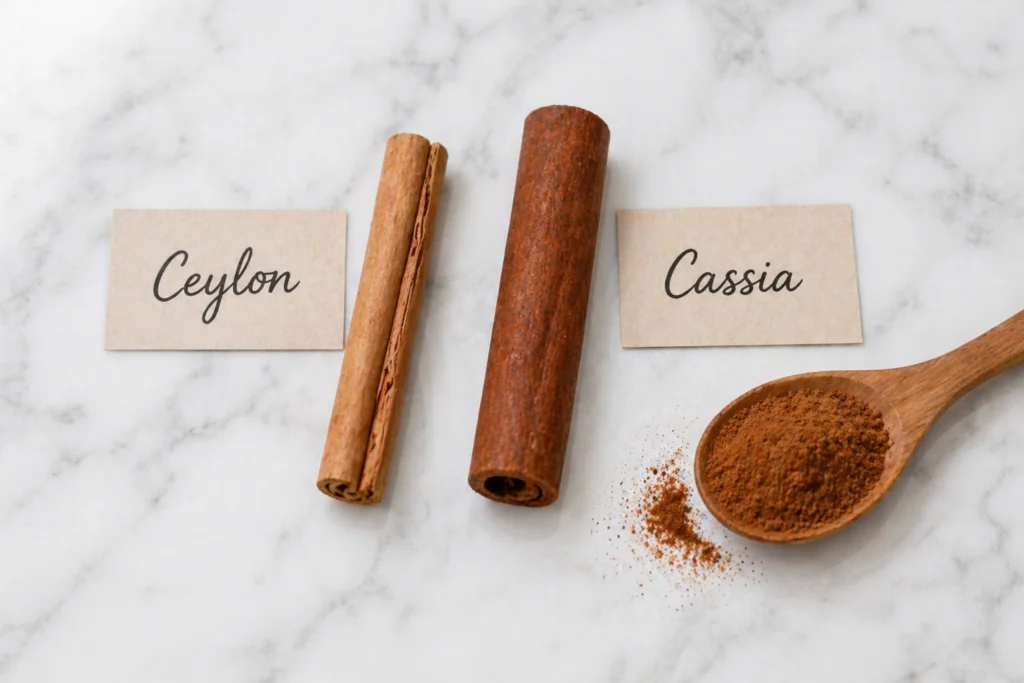
Ceylon and Cassia are two distinct types of cinnamon with very different safety profiles. For occasional cooking either is fine — but for daily therapeutic use the difference matters significantly.
📋 Table of Contents
Introduction
Walk into any supermarket and pick up a jar of cinnamon. There is a very good chance the label just says “cinnamon” — with no mention of which type. But there are two very different kinds of cinnamon sold worldwide, and they are not the same thing.
The difference between Ceylon and Cassia cinnamon is not just about flavor — it is about safety. Cassia contains approximately 250 times more coumarin than Ceylon. At high daily doses, coumarin can stress and damage the liver. For occasional cooking use this is not a concern. But if you use cinnamon every day for health purposes — in supplements, cinnamon water, or large food amounts — the type you choose matters significantly.
🛠️ Free Health Tools — BMI Calculator, Calorie Calculator, Water Intake Calculator & more
🔍 Browse All Free Health Tools →This guide covers everything you need to know about the two types of cinnamon — their origins, the coumarin difference, how to tell them apart, how their flavors differ, how their health benefits compare, and which one to use for what purpose. For the full health benefits of cinnamon, see our pillar guide on cinnamon benefits, nutrition, and uses.
What Is Ceylon Cinnamon?
Ceylon cinnamon — botanical name Cinnamomum verum, which literally means “true cinnamon” — is native to Sri Lanka (formerly called Ceylon) and small regions of southern India. Its cultivation is highly specific to these tropical coastal environments, which is why it is rarer and more expensive than Cassia.
Ceylon cinnamon sticks have a distinctive appearance: they are made of multiple thin, papery layers rolled tightly together — like a rolled-up newspaper. The color is a light tan to beige. The flavor is mild, delicate, and naturally sweet with subtle floral notes — noticeably different from the strong, sharp taste of Cassia.
🌱 Ceylon Cinnamon Quick Facts
Botanical name: Cinnamomum verum · Also called: True cinnamon, Mexican cinnamon, soft-stick cinnamon · Origin: Sri Lanka, southern India · Coumarin level: 0.004–0.05mg/kg (trace amounts) · Flavor: Mild, sweet, delicate, slightly floral · Color: Light tan / beige · Stick texture: Multiple thin soft layers — crumbles easily
What Is Cassia Cinnamon?
Cassia cinnamon refers to several related species — most commonly Cinnamomum cassia (Chinese cinnamon), Cinnamomum burmannii (Indonesian cinnamon), and Cinnamomum loureiroi (Vietnamese cinnamon). These are hardier, faster-growing trees cultivated across China, Indonesia, and Vietnam — which makes Cassia far more abundant and cheaper than Ceylon.
Cassia sticks are noticeably different from Ceylon — they are made of a single thick, hard piece of bark rolled into a tube. The color is a darker reddish-brown. The flavor is stronger, spicier, and more pungent than Ceylon — which is why Cassia dominates in cooking and baking where a bold cinnamon flavor is desired.
🌱 Cassia Cinnamon Quick Facts
Botanical names: Cinnamomum cassia / burmannii / loureiroi · Also called: Chinese cinnamon, Indonesian cinnamon, Vietnamese cinnamon · Origin: China, Indonesia, Vietnam · Coumarin level: 1–12mg per teaspoon (high) · Flavor: Strong, bold, spicy, slightly bitter · Color: Dark reddish-brown · Stick texture: Single thick hard tube — does not crumble easily
Full Side-by-Side Comparison
| Feature | 🟡 Ceylon Cinnamon | 🟤 Cassia Cinnamon |
|---|---|---|
| Botanical name | Cinnamomum verum | C. cassia / burmannii / loureiroi |
| Common name | True cinnamon | Regular cinnamon |
| Origin | Sri Lanka, southern India | China, Indonesia, Vietnam |
| Coumarin content | Trace (0.004–0.05mg/kg) | High (1–12mg per tsp) |
| Cinnamaldehyde | 50–63% | ~69% (stronger flavor) |
| Flavor | Mild, sweet, delicate, floral | Strong, bold, spicy, sharp |
| Color | Light tan / beige | Dark reddish-brown |
| Stick appearance | Multiple thin soft layers | Single thick hard tube |
| Price | Higher — specialty stores | Lower — most supermarkets |
| Safe for daily therapeutic use? | ✅ Yes | ⚠️ Limit to ½–1 tsp/day |
| Safe for occasional cooking? | ✅ Yes | ✅ Yes |
| Market share | ~10% of global market | ~90% of global market |
The Coumarin Difference — Explained
Coumarin is the most important safety difference between the two types of cinnamon. Understanding it helps you make the right choice for your situation.
What Is Coumarin?
Coumarin is a naturally occurring plant compound. In small amounts it is harmless. At high daily doses over time, it can cause liver inflammation and damage — particularly in people who are genetically more sensitive to it. It also has mild blood-thinning properties.
How Much Is in Each Type?
| Cinnamon Type | Coumarin per 1 tsp (2.6g) | EFSA Safe Daily Limit* | Risk at 1 tsp/day? |
|---|---|---|---|
| Ceylon cinnamon | Trace — ~0.0001mg | Well within limit | ✅ No risk |
| Cassia cinnamon | 1–12mg (varies by brand) | ~6mg for a 60kg adult | ⚠️ May exceed limit |
*EFSA (European Food Safety Authority) safe daily coumarin limit: 0.1mg per kg of body weight per day.
🔬 How Different Are They?
Research confirms that Cassia cinnamon contains approximately 250 times more coumarin than Ceylon. A 2025 multivariate analysis in a peer-reviewed journal confirmed this dramatic difference between the two varieties. This is not a minor variation — it is the reason regulatory bodies across Europe specifically flag Cassia when setting cinnamon supplement safety guidelines.
Who Is Most at Risk from Cassia Coumarin?
People taking cinnamon supplements daily
Supplement doses of Cassia can easily exceed safe coumarin limits — especially higher-dose products.
People adding large amounts to food or drinks daily
Adding multiple teaspoons of Cassia to smoothies, oatmeal, and cinnamon water every day compounds coumarin intake quickly.
People with liver conditions
Pre-existing liver issues make coumarin accumulation more dangerous.
Genetically sensitive individuals
Some people metabolize coumarin more slowly — making them more vulnerable at the same dose.
Flavor & Culinary Differences
The flavor difference between Ceylon and Cassia is significant and immediately noticeable. Each suits different culinary purposes.
| Culinary Use | 🟡 Ceylon | 🟤 Cassia |
|---|---|---|
| Delicate baked goods (cinnamon rolls, apple pie) | ✅ Best — floral notes shine without overpowering | ⚠️ Can overpower delicate flavors |
| Savoury dishes (curries, stews, rice) | ⚠️ Too mild — flavor gets lost | ✅ Best — bold flavor holds up to strong spices |
| Cinnamon water or tea (daily health use) | ✅ Best — mild, pleasant, safe for daily use | ⚠️ Fine occasionally — but coumarin risk at high daily amounts |
| Smoothies and oatmeal | ✅ Great — subtle sweetness | ✅ Good — stronger cinnamon hit |
| Warm milk / golden milk | ✅ Best — gentle and aromatic | ✅ Good for occasional use |
| Holiday baking | ✅ Good | ✅ Traditional choice — stronger scent and flavor |
Health Benefits — How They Compare
Both Ceylon and Cassia contain cinnamaldehyde and polyphenols — the active compounds responsible for cinnamon’s health benefits. For most health outcomes, both types show similar effects. The key difference is safety profile, not effectiveness.
🌿 Which cinnamon suits your health goal? Type it in our free Herb & Tea Benefit Finder — get preparation method, timing, dosage, and safety notes instantly.
🔍 Try the Herb & Tea Benefit Finder →| Health Benefit | 🟡 Ceylon | 🟤 Cassia |
|---|---|---|
| Blood sugar regulation | ✅ Effective | ✅ Effective — more studies used Cassia |
| Antioxidant protection | ✅ High | ✅ High — slightly higher cinnamaldehyde |
| Anti-inflammatory | ✅ Yes | ✅ Yes |
| Heart health (cholesterol) | ✅ Yes | ✅ Yes |
| Germ-fighting properties | ✅ Yes | ✅ Yes — slightly stronger |
| Safe for daily long-term use | ✅ Yes | ⚠️ Limit amounts — coumarin risk |
| Liver safe at therapeutic doses | ✅ Yes | ❌ Risk at high daily doses |
How to Tell Them Apart
This is a practical and important skill — especially since studies have found that 70% of products labeled as “Ceylon” in one analysis actually contained Cassia blends. Here is how to verify what you are buying.
| Test | 🟡 Ceylon Result | 🟤 Cassia Result |
|---|---|---|
| Label check | Cinnamomum verum on label | Cinnamomum cassia / burmannii — or just “cinnamon” |
| Stick appearance | Multiple thin soft layers rolled together — crumbles easily when pressed | Single thick hard tube — does not crumble easily |
| Color | Light tan / beige | Dark reddish-brown |
| Flavor | Mild, delicate, slightly sweet and floral | Strong, bold, spicy — the familiar “cinnamon” flavor |
| Price | Noticeably more expensive | Cheap — standard supermarket price |
| Where to buy | Specialty food stores, health stores, online | Every supermarket |
Which Should You Choose?
The answer depends entirely on what you are using cinnamon for.
| Situation | Best Choice | Why |
|---|---|---|
| Occasional cooking and baking | Either — your preference | Coumarin at cooking amounts is not a concern for either type |
| Bold savory dishes (curries, stews) | 🟤 Cassia | Stronger flavor holds up better in savory cooking |
| Delicate sweet baking (rolls, pies) | 🟡 Ceylon | Milder flavor does not overpower |
| Daily cinnamon water or tea | 🟡 Ceylon only | Safe coumarin level for long-term daily use |
| Cinnamon supplements | 🟡 Ceylon only | Supplement doses of Cassia can exceed coumarin limits |
| Blood sugar management | 🟡 Ceylon (preferred) | Same effects — but safe for the daily consistent use needed |
| You have a liver condition | 🟡 Ceylon only | Cassia coumarin poses specific liver risk |
| You take blood thinners | 🟡 Ceylon preferred | Lower coumarin reduces additive anticoagulant risk |
Conclusion
Ceylon and Cassia are both real cinnamon — but they are not interchangeable for every purpose. For everyday cooking, either type is safe and appropriate. For daily therapeutic use — supplements, cinnamon water, or large amounts added to food every day — Ceylon is the clear choice. Its coumarin level is trace compared to Cassia’s potentially liver-stressing amounts.
The most important practical step is checking your label. Most cinnamon sold in supermarkets worldwide is Cassia — and 70% of products labeled as Ceylon in one study were found to contain Cassia blends. When buying Ceylon for health purposes, choose reputable brands with third-party testing and look for Cinnamomum verum on the label.
For a full list of cinnamon’s health benefits, see our complete cinnamon benefits guide. For the full safety profile including coumarin risks, see cinnamon side effects and safety.
Try Our Free Herb & Tea Benefit Finder
Type cinnamon, turmeric, ginger, or any herb to instantly see its benefits, best time to use, preparation method, and who should be careful.
🔍 Open the Herb & Tea Benefit Finder →Frequently Asked Questions
The main difference is coumarin content. Cassia contains approximately 250 times more coumarin than Ceylon. Coumarin can stress and damage the liver at high daily doses. For occasional cooking use, both types are safe. For daily therapeutic use — supplements, cinnamon water, or large daily amounts — Ceylon is the significantly safer choice. They also differ in flavor: Ceylon is mild and sweet; Cassia is bold and spicy.
Almost certainly Cassia. Cassia dominates approximately 90% of the global cinnamon market. If the label just says “cinnamon” without specifying a botanical name — it is Cassia. Check for Cinnamomum verum on the label to confirm Ceylon. Ceylon is typically found in health food stores, specialty spice shops, and online — and costs noticeably more than standard supermarket cinnamon.
For health benefits — both types are broadly similar. Both contain cinnamaldehyde and polyphenols that support blood sugar, heart health, and antioxidant protection. Cassia actually has slightly more cinnamaldehyde, which is why most clinical research used Cassia. But for daily long-term use, Ceylon is healthier because of its dramatically lower coumarin — making it safe for the consistent daily use needed to experience cinnamon’s health benefits.
Check the label for the botanical name — Cinnamomum verum for Ceylon, Cinnamomum cassia or burmannii for Cassia. If buying sticks, look at the cross-section: Ceylon has multiple thin soft layers that crumble easily; Cassia is a single thick hard tube. Ceylon is light tan; Cassia is dark reddish-brown. If the price is very low, it is almost certainly Cassia — Ceylon costs significantly more.
In small amounts — yes. Keeping Cassia to a maximum of half a teaspoon per day for regular use keeps coumarin exposure within safe limits for most healthy adults. But for daily therapeutic amounts — in supplements or cinnamon water — switch to Ceylon. At the doses used in cinnamon health research (1–6g per day), Cassia coumarin intake would exceed safe limits. Ceylon gives you the same health benefits without the liver risk.
Both types show similar blood sugar benefits in research — most clinical trials actually used Cassia because it is more widely available. But for daily blood sugar management where consistent long-term use is needed, Ceylon is the better practical choice. It lets you take the therapeutic daily dose without the liver risk that comes with equivalent daily amounts of Cassia. For more detail, see our guide on cinnamon for diabetes and blood sugar.
Yes — if you use cinnamon daily for health purposes. The extra cost of Ceylon is minimal compared to the liver safety benefit. A good-quality Ceylon cinnamon powder typically costs 2–3 times more than Cassia — but for daily therapeutic use (cinnamon water, supplements, or large daily food amounts), that cost difference is worth the peace of mind on coumarin safety. For occasional cooking use, Cassia at standard supermarket prices is perfectly fine.
Dalchini (the Hindi and Sanskrit name for cinnamon, called darchini in Urdu) most commonly refers to Cassia cinnamon in South Asian markets — particularly the Indonesian Cassia variety (Cinnamomum burmannii) which is the most widely sold cinnamon across India, Pakistan, and the wider South Asian region. True Ceylon cinnamon is available in South Asian specialty stores and online but is less common. When buying dalchini for daily therapeutic use, check the label for Cinnamomum verum to confirm it is the safer Ceylon variety.