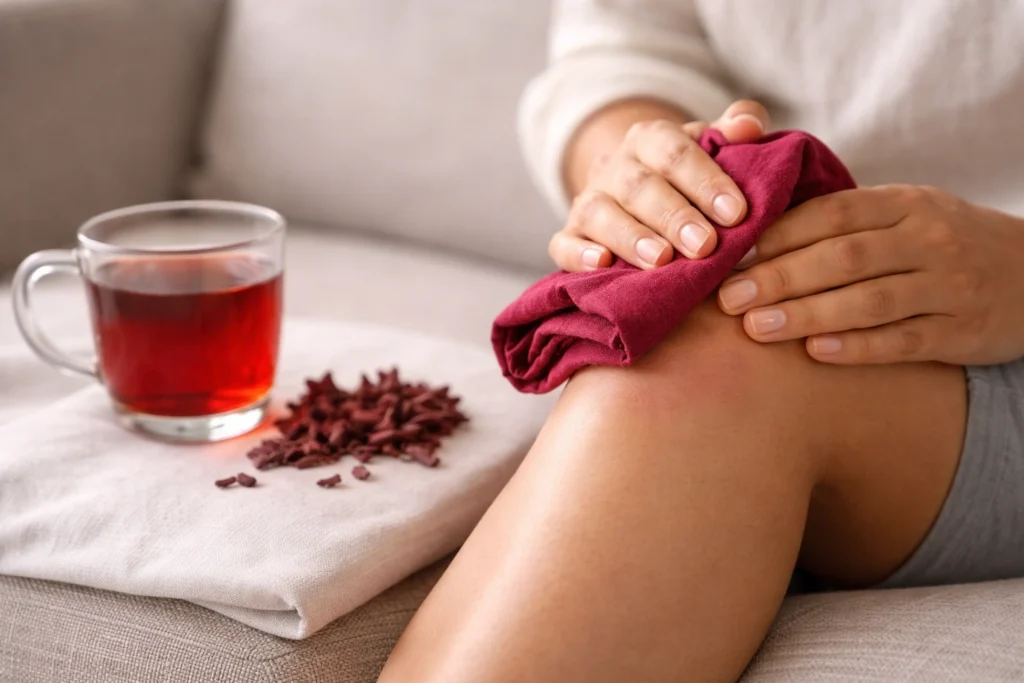
A hibiscus tea compress puts the plant’s healing compounds directly on psoriasis plaques. It softens thick skin, calms redness, and reduces itch where you need it most.
📋 Table of Contents
- Why Use a Hibiscus Compress?
- How a Hibiscus Compress Works on Psoriasis
- What You Need
- Step-by-Step: How to Make & Apply the Compress
- Variations — Bath Soak, Spray, & Scalp Rinse
- How Often & When to Use It
- What to Expect — Timeline & Results
- Safety Rules — When NOT to Use It
- Pro Tips for Better Results
- Conclusion
- Frequently Asked Questions
Why Use a Hibiscus Compress on Psoriasis Plaques?
Most people think of hibiscus tea as just a drink. But applying it to your skin is one of the oldest and most effective ways to deliver its healing compounds.
When you drink hibiscus tea, the compounds travel through your gut and reach your skin slowly. When you apply it directly, you skip that journey. The active compounds go straight to the plaque that needs them.
🛠️ Free Health Tools — Water Intake Calculator, BMI Calculator, Intermittent Fasting Calculator & more
🔍 Browse All Free Health Tools →For psoriasis, topical hibiscus tea offers something drinking it cannot. It softens plaque buildup directly. Psoriasis makes skin cells grow up to 10 times faster than normal, building thick scales on the surface. The natural fruit acids in hibiscus gently dissolve these scales without scrubbing.
Scrubbing matters here. In psoriasis, physical scrubbing can trigger new plaques at the rubbed spot. Hibiscus avoids this risk by working chemically, not mechanically.
This guide walks you through exactly how to make and apply a hibiscus tea compress. We cover the right concentration, temperature, technique, and safety rules.
How a Hibiscus Compress Works on Psoriasis
Understanding how the compress works helps you use it correctly. A hibiscus compress works through four actions at once on psoriasis skin.
Natural Fruit Acids Soften Plaque Buildup
Hibiscus contains gentle natural fruit acids called AHAs. When you apply them to skin, they loosen the bonds between dead skin cells on the plaque surface.
Over time, this gentle action reduces plaque thickness. The rough, scaly texture softens. Healthier skin shows through underneath. Unlike harsh exfoliants, hibiscus AHAs are delivered alongside calming compounds, so they rarely sting sensitive skin.
🔬 The Compounds at Work
Hibiscus contains malic acid and citric acid — both alpha-hydroxy acids (AHAs). The mild acidity (pH ~2.5–3.5) also helps restore the skin’s natural acid mantle (ideal pH 4.5–5.5), which is disrupted in psoriasis.
Plant Pigments Calm Inflammation at the Skin Surface
The deep red pigments in hibiscus are not just antioxidants. They actively reduce inflammation when applied to the skin.
A 2025 study found hibiscus pigments cut key immune signaling molecules by 71–73%. With consistent use, the result is less redness, less warmth, and calmer plaque tissue.
🔬 The Science
The deep red color comes from anthocyanins — mainly delphinidin-3-sambubioside and cyanidin-3-sambubioside. These suppress TARC/CCL17 chemokines (by 73%) and MDC/CCL22 (by 71%) — key drivers of inflammation in skin conditions.
Antibacterial Protection on Vulnerable Skin
Cracked psoriasis plaques are easy targets for bacteria. The bacteria Staphylococcus aureus doesn’t just cause infection — it actively makes psoriasis worse by triggering more immune reactions.
A 2024 review confirmed hibiscus fights this bacteria along with several others. Regular topical use creates a mildly acidic, germ-fighting layer on the skin without the resistance risk of antibiotics.
Cold Temperature Stops Itch Instantly
When you use a refrigerated hibiscus compress, the cold itself calms itch right away. This is a separate effect from the chemical actions above.
Cold activates special temperature-sensing nerves in your skin. These send a cooling signal that overrides the itch signal in your spinal cord. You feel relief within seconds. Combined with the chemical antihistamine action, the cold compress is the fastest itch relief from any topical herbal remedy.
🔬 How It Works
Cold activates TRPM8 receptors on sensory nerve fibres. The cooling signal competes with and overrides the itch signal at the spinal cord level — a real, measurable mechanism.
| Compound or Effect | What It Does on Psoriasis | How Fast It Works |
|---|---|---|
| Malic acid (fruit acid) | Dissolves dead cell bonds; softens scales | 2–4 weeks of regular use |
| Citric acid (fruit acid) | Gentle exfoliation; restores skin pH | pH balance: instant; exfoliation: 2–4 weeks |
| Red plant pigments | Calms inflammation; reduces redness | Less redness in 1–2 weeks |
| Phenolic acids | Fights bacteria on plaque surface | Instant surface action; ongoing protection |
| Cold temperature | Stops itch by overriding nerve signals | Seconds — instant relief |
| Vitamin C | Supports collagen; protects from damage | Builds up over weeks of use |
The full science of how hibiscus stops itch — including antibodies, mast cells, and the itch-scratch cycle — is covered in our deep dive: does hibiscus tea stop eczema itching?
What You Need
Here is everything you need to make a proper hibiscus compress. Quality of ingredients matters — see why each one is on the list.
| Item | What to Get | Why It Matters |
|---|---|---|
| Hibiscus calyxes | Loose-leaf dried calyxes — NOT tea bags | Tea bags have 3–5× less active compounds than loose-leaf |
| Filtered water | Filtered or bottled — not heavily chlorinated tap | Chlorine can damage the active plant compounds |
| Kettle or small pot | Any — with a thermometer if possible | Water temp must be 85–90°C, not fully boiling |
| Tea strainer | Fine mesh strainer or French press | Removes all calyx particles that could irritate skin |
| Clean cotton cloth | Soft, lint-free, washed without fabric softener | Fabric softener residue can irritate psoriasis skin |
| Glass or ceramic container | For cooling and storing the tea | Plastic can leach compounds; glass keeps the tea pure |
| Fragrance-free moisturizer | Your usual prescribed or OTC moisturizer | Applied right after compress to seal in moisture |
Step-by-Step: How to Make & Apply the Compress
Follow these 10 steps for the most effective compress. Don’t skip the patch test or the cooling time — both are critical for safety and results.
🌺 Hibiscus Tea Compress — Complete Method
Prep: 5 minutes | Brew: 10 minutes | Cool: 20 minutes | Apply: 10–15 minutes | Total: ~45 minutes
Makes: Enough for one session (store leftover up to 48 hours in fridge)
Ingredients:
- 3–4 teaspoons loose-leaf dried hibiscus calyxes (double strength for skin)
- 240ml filtered water
- Optional: 1 tsp raw honey (extra antibacterial benefit)
- Optional: 2–3 drops pure aloe vera gel (extra soothing effect)
-
1
Patch test first — always
If this is your first time using hibiscus on skin, test it first. Brew a small amount, cool it, apply to your inner wrist, and wait 24 hours. If you see redness, stinging, or rash, do not proceed. Hibiscus allergy is rare but possible.
-
2
Brew double-strength tea
Boil 240ml of filtered water. Take it off the heat and wait 2–3 minutes until it drops to about 85–90°C. Add 3–4 teaspoons of loose hibiscus to a strainer over a glass container. Pour the cooled water over it. Cover and steep for a full 10 minutes — longer than for drinking, to extract the most compounds.
-
3
Strain thoroughly
Remove the strainer and press the calyxes gently. Strain a second time through a fine mesh if needed. You want completely smooth liquid with no particles. The tea should be a deep ruby-red — that’s a sign of high active compound content.
-
4
Cool completely in the fridge
Let the tea cool to room temperature (about 15 minutes). Then put it in the fridge for another 15–20 minutes. The tea must be cold — not just room temperature. Cold delivers the instant itch-relief effect.
-
5
Optional: enhance the tea
You can add 1 teaspoon of raw honey to the cooled tea — it’s antibacterial and helps wound healing. Or add 2–3 drops of pure aloe vera gel for extra soothing. These are optional. Plain hibiscus tea works fully on its own.
-
6
Prepare the skin area
Gently clean the plaque area with plain lukewarm water. Pat dry with a soft towel. Don’t use soap, harsh cleansers, or other exfoliating products before the compress. The hibiscus AHAs will provide the exfoliation. Doing it after a bath or shower is ideal — your skin is slightly more absorbent then.
-
7
Apply the compress
Fold a clean cotton cloth into a pad about the size of your palm or larger. Soak it in the cold tea, then wring out gently — damp but not dripping. Lay the cloth flat on the plaque. Don’t rub or press. For knees or elbows, you can secure it with a soft bandage.
-
8
Leave for 10–15 minutes
Keep the compress on for a full 10–15 minutes. If it warms up, re-soak and reapply halfway through. You may feel mild tingling — that’s the fruit acids working. If you feel burning or stinging, remove right away and rinse with cool water.
-
9
Air dry briefly, then moisturize
Remove the compress and let your skin air dry for 60–90 seconds. Don’t towel dry. While the skin is still slightly damp, apply your usual moisturizer or prescribed cream. The compress has loosened the plaque surface, making it more receptive to moisture. This step is essential — it prevents post-compress dryness.
-
10
Store leftover tea for next time
Pour any remaining tea into a clean glass container with a tight lid. Refrigerate right away. The tea stays potent for up to 48 hours. The deep red color is your quality indicator. If it fades to pale pink, the active compounds may have degraded. Always store covered, away from light, in glass or ceramic.
🔗 🌺 Full Guide: Hibiscus Tea for Psoriasis & Eczema — 7 Proven Benefits
This article covers the topical compress method. For the complete picture — all 7 benefits, nutrition, dosage, traditional uses, and side effects — read our full pillar guide:
👉 7 Proven Benefits of Hibiscus Tea for Psoriasis & Eczema →
Variations — Bath Soak, Spray Bottle & Scalp Rinse
The compress method works best for small plaques on elbows, knees, or other localized areas. For wider psoriasis or specific body parts, these adapted methods deliver the same benefits more practically.
🌿 How should you use hibiscus for your skin? Type it into our free Herb & Tea Benefit Finder — get topical methods, timing, dosage, and safety notes instantly.
🔍 Try the Herb & Tea Benefit Finder →| Method | Best For | How to Prepare | Instructions |
|---|---|---|---|
| Hibiscus Bath Soak | Wide-area plaques on torso, legs, back | Brew 4–6 cups of double-strength tea; strain; cool to lukewarm | Add to a lukewarm (not hot) bath. Soak 15–20 minutes. Pat dry gently. Moisturize right away. Use 2–3× per week. |
| Hibiscus Spray Bottle | Quick relief during the day; flare onset | Brew double-strength, strain, cool, pour into a clean spray bottle | Spritz onto plaque or itchy area. Wait 30–60 seconds. Pat in with fingertips — don’t rub. Moisturize. Refrigerate; use within 48 hours. |
| Scalp Rinse | Scalp psoriasis and itching | Brew double-strength, strain, cool to room temperature | After shampooing, pour cooled tea over scalp. Massage gently. Leave 2–3 minutes. Rinse with cool water. Use 3–4× per week. |
| Hand or Foot Soak | Hand or foot plaques | Brew 3–4 cups double-strength; strain; cool to comfortably cool | Pour into a basin big enough for hands or feet. Soak 15–20 minutes. Pat dry. Apply thick moisturizer. Use 3–4× per week. |
How Often & When to Use a Hibiscus Compress
Here is the recommended schedule and the best times of day to apply.
| Best Time to Apply | Why |
|---|---|
| After showering or bathing | Best window — your skin absorbs better right after washing |
| Before bed | Skin repairs itself overnight; less risk of staining clothes |
| During an itch attack | Cold compress gives fastest combined cooling and chemical relief |
| Avoid: before sun exposure | Fruit acids increase sun sensitivity — apply in evening or use SPF after |
What to Expect — Realistic Timeline & Results
Here is what you can realistically expect at each stage of regular use.
📅 Week-by-Week Expectations
Session 1 (Day 1): Instant cooling itch relief during application. Mild tingling from fruit acids — normal. Pink tinting on skin fades within 30 minutes.
Week 1–2: Less itch between applications. Plaque surface feels slightly softer after each session. Redness around plaques may start to calm.
Week 2–4: Visible improvement in plaque texture. Scales become softer, thinner, less raised. Itch episodes shorter and less intense. Plaque edges may begin to soften.
Week 4–8: Continued plaque thinning. Some people see measurable size reduction at the edges. Skin tone around healed plaques may begin to normalize.
Important: Topical hibiscus does not clear plaques completely. It reduces severity, thickness, and itch. Complete clearance needs prescribed treatment. Hibiscus works well as a preparation step before applying your prescribed cream — it gently softens the plaque so the medication penetrates better.
Safety Rules — When NOT to Use a Hibiscus Compress
Most people can use hibiscus compresses safely. But there are six situations where you must not apply one.
⚠️ Know the Full Safety Profile Before Starting
Beyond topical safety, hibiscus tea has important drug interactions and rules for drinking it. Read our complete safety guide before using it daily:
👉 Hibiscus Tea Side Effects: What to Know Before Drinking Daily →
❌ Open, broken, or weeping skin
Never apply to skin that is cracked, bleeding, oozing, or has open wounds. The acidity will burn and sting on broken skin and may delay healing. Wait until the skin surface has closed before resuming.
❌ Signs of skin infection
If a plaque shows signs of infection — extra warmth, pus, severe tenderness, spreading redness, or fever — do not self-treat. See your doctor for proper antibiotic treatment first.
❌ Right before sun exposure
Fruit acids temporarily increase sun sensitivity. Don’t apply within 2 hours of going outside in direct sunlight without SPF. Apply in the evening or after sun exposure instead.
❌ Near eyes or mouth
Keep hibiscus tea away from your eye area, lips, and any mucous membranes. If accidental contact happens, rinse with cool water right away.
❌ Known plant allergy
If you are allergic to mallow family plants (okra, cotton, hollyhock), don’t use hibiscus on skin without talking to your doctor first. A patch test alone may not catch a delayed reaction.
❌ Children under 2
Don’t use hibiscus on infants under 2 without pediatric guidance. For older children, dilute the tea with equal water and watch closely for any reaction.
Pro Tips for Better Results
These five tips help you get the most out of every compress session.
Conclusion — Is a Hibiscus Compress Worth It for Psoriasis?
A hibiscus tea compress is one of the simplest, cheapest, and most evidence-supported topical approaches you can add to your psoriasis routine. For under $1 per session, using ingredients from any health food store, you deliver healing compounds directly to the plaques that need them — without harsh chemicals, without stinging, and without the side-effect risks of long-term steroid use.
The key things to remember: brew double-strength, cool completely in the fridge, apply only to intact, non-infected skin, and always follow with your fragrance-free moisturizer. Consistency matters more than perfection — 3–4 sessions per week for 4–8 weeks is where real plaque improvement shows.
Used alongside your prescribed treatments — never instead of them — a hibiscus compress adds a real layer of topical support. It addresses plaque texture, itch, redness, and bacteria all at once. Start with the basic compress method, watch your skin’s response over 2 weeks, and build from there.
Try Our Free Herb & Tea Benefit Finder
Type hibiscus or any herb to instantly see its full benefits, best preparation method, topical uses, and safety notes.
🔍 Open the Herb & Tea Benefit Finder →Frequently Asked Questions
You’ll feel cooling itch relief within seconds of the cold compress touching your skin. For real changes in plaque texture (softer scales, less thickness), expect 2–4 weeks of regular use 3–4 times per week.
Bigger plaque thinning and less redness shows up at 4–8 weeks. Be patient and consistent — the fruit acid effect is gentle and builds up with each session.
Yes — and the combination may actually help. Apply the hibiscus compress first. Let the skin air dry for 60–90 seconds. Then apply your prescribed cream. The softened plaque may let your medication penetrate better.
Always check with your dermatologist before changing your routine. Don’t apply hibiscus tea directly on top of your medication — leave at least 60–90 seconds between them.
Mild tingling is normal — it’s the fruit acids gently working on the plaque surface. The same feeling happens with store-bought AHA products, but milder because hibiscus delivers them naturally.
If the tingling stays mild, it’s fine. If you feel burning or stinging within 2–3 minutes, remove the compress, rinse with cool water, and dilute the tea more next time.
Your skin may turn pale reddish-pink for 20–30 minutes after the compress. This is harmless and fades completely. It will not permanently stain your skin.
Hibiscus can stain light-colored fabrics — especially cotton. Wear dark clothing after applying or do it before bed when clothing contact isn’t an issue. If a compress cloth gets stained, rinse with cold water right away. Dried stains are harder to remove.
You can, but it’s much weaker. A 2024 study found loose-leaf hibiscus has 3–5 times more active compounds than tea bags. For drinking, the difference matters; for a topical compress where you need maximum strength, it’s critical.
If loose-leaf isn’t available, use 4–5 tea bags per 240ml and steep 15 minutes to make up some of the difference.
Yes — the scalp rinse method works well. After shampooing, pour cooled double-strength hibiscus tea over your scalp. Massage gently with fingertips (don’t scrub). Leave 2–3 minutes, then rinse with cool water. Use 3–4 times per week.
The fruit acids loosen scalp plaques while the plant pigments calm inflammation. Note: the tea may temporarily tint very light or grey hair slightly reddish — it rinses out. Don’t use on a scalp with open sores or infection.
Both help psoriasis but in different ways. Aloe vera is mostly soothing — it cools, calms inflammation, and supports the skin barrier. Studies confirm it reduces psoriasis discoloration and scaling.
Hibiscus goes further. It adds fruit acid exfoliation (which aloe doesn’t have), stronger antibacterial action, and antihistamine effects. The two work well together — many people use aloe vera as a moisturizer right after the hibiscus compress.
No — don’t rinse. You want the active compounds to stay on your skin and keep working after you remove the cloth. Just air dry for 60–90 seconds, then apply your moisturizer over the slightly damp skin.
The remaining hibiscus compounds will absorb naturally over the next 30–60 minutes. Rinsing right after would wash away most of the benefit.
📚 Related Health Guides
7 Proven Benefits of Hibiscus Tea for Psoriasis & Eczema
The full pillar guide — all benefits, nutrition, dosage, and internal + topical use overview.
Does Hibiscus Tea Stop Eczema Itching? What the Research Says
The science behind why hibiscus calms itch — antibodies, histamine, and the itch-scratch cycle.
7 Best Herbal Teas for Psoriasis Flare-Up Relief (Ranked)
How hibiscus compares to green tea, oolong, chamomile and more for psoriasis.
Turmeric Milk (Golden Milk): Benefits, Recipe & How to Make It
Curcumin works with hibiscus pigments for a complete anti-inflammatory skin approach.