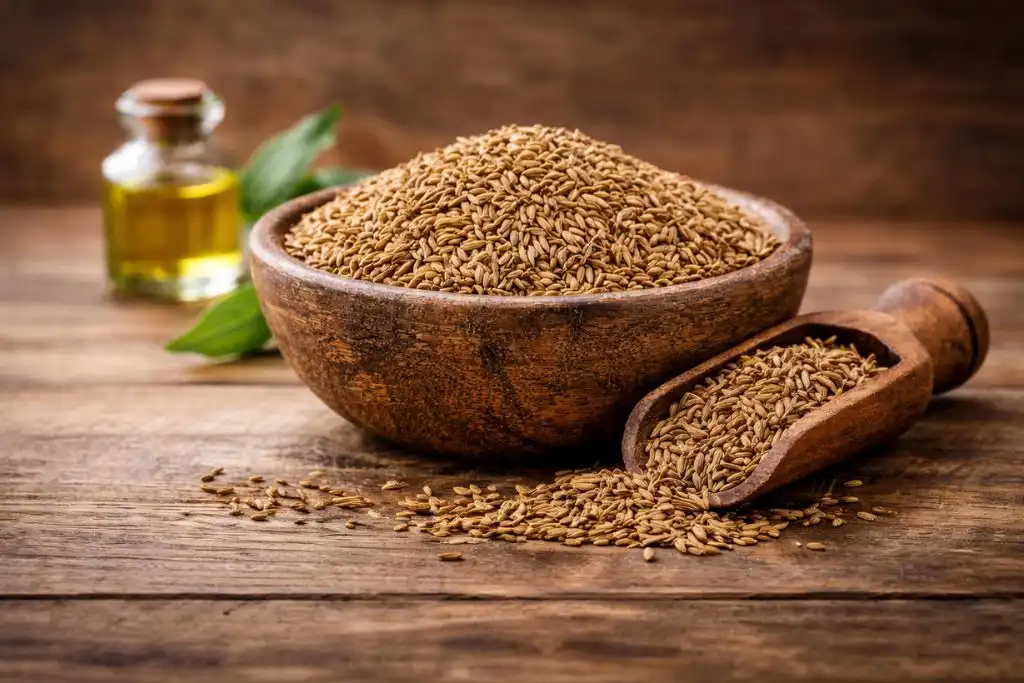

Cumin water and fennel water are two of the most popular herbal drinks in South Asia. Both support digestion and cost almost nothing to make — but they work in different ways and suit different times of day.
📋 Table of Contents
- Introduction
- What Is Cumin Water?
- What Is Fennel Water?
- Active Compounds Compared
- Nutritional Comparison
- Taste, Aroma & Preparation
- Key Benefits of Cumin Water
- Key Benefits of Fennel Water
- Best Times to Drink Each
- Head-to-Head Comparison
- Which Should You Choose?
- Can You Use Both Together?
- Who Should Be Careful?
- FAQs
- Related Health Guides
Introduction
Walk into any traditional South Asian kitchen and you will find them both. A jar of cumin seeds (jeera or zeera). A jar of fennel seeds (saunf). These two spices have been used in Ayurvedic and Unani medicine for thousands of years.
Their infused waters are drunk by millions of people every day. But they are not the same drink. They taste different, work differently in the body, and suit different times of day.
This guide explains clearly what makes each one special — and when to choose one over the other.
For the full story on each spice, see our complete guide to cumin (Jeera / Zeera) benefits and nutrition and our complete guide to fennel seeds (Saunf) benefits and nutrition.
🛠️ Free Health Tools — Water Intake Calculator, BMI Calculator, Intermittent Fasting Calculator & more
🔍 Browse All Free Health Tools →What Is Cumin Water?
Cumin water is made by soaking or boiling cumin seeds in water. You strain the seeds out and drink the liquid. It has an earthy, slightly bitter taste and a warm, spicy smell.
It is most often drunk first thing in the morning or after a heavy meal. Traditional medicine in South Asia has used it for at least 3,000 years to help with digestion.
Cumin Water — Names Around the World
| Language / Region | Name |
|---|---|
| English | Cumin Water / Jeera Water |
| Hindi / Urdu | Jeera Pani / Zeera Pani |
| Tamil | Seeragam Tanner |
| Telugu | Jeelakarra Neeru |
| Sanskrit / Ayurvedic | Jeeraka Jala |
| Punjabi | Zeera Da Pani |
What Is Fennel Water?
Fennel water is made the same way — soak or boil fennel seeds in water, then strain and drink. But it tastes completely different. It is mildly sweet, fresh, and a little like anise or liquorice.
People drink it mainly after meals to settle the stomach and relieve bloating. In South Asian restaurants, whole fennel seeds are often offered after a meal as a palate cleanser.
In Ayurvedic medicine, fennel is called a cooling herb. That is the opposite of cumin, which is warming. This single difference explains a lot about when to use each one.
Fennel Water — Names Around the World
| Language / Region | Name |
|---|---|
| English | Fennel Water / Saunf Water |
| Hindi / Urdu | Saunf Ka Pani / Saunf Pani |
| Tamil | Sombu Tanner |
| Telugu | Sopu Vittanala Neeru |
| Sanskrit / Ayurvedic | Shatapushpa Jala |
| Punjabi | Sounf Da Pani |
Active Compounds Compared
The two drinks contain different active compounds. This is why they feel and work differently in the body.
📊 What the Research Shows
Cumin’s main compound is thymol. It stimulates the digestive system — like an activator. Fennel’s main compound is anethole. It relaxes the digestive system — like a calmer. This is the key reason cumin water works best before meals and fennel water works best after.
| Compound | Found In | What It Does |
|---|---|---|
| Thymol | Cumin | Helps digestion, fights bacteria and fungi |
| Cuminaldehyde | Cumin | Reduces inflammation, studied for blood sugar support |
| Anethole | Fennel | Relieves cramps and gas, gives fennel its sweet taste |
| Fenchone | Fennel | Reduces trapped gas, gives a cooling sensation |
| Rosmarinic Acid | Fennel | Antioxidant, reduces inflammation |
| Flavonoids | Both | Antioxidant, supports immune health |
Nutritional Comparison (Per 250ml Cup)
Both drinks are almost calorie-free. The figures below are for plain seed-infused water — not eating the seeds whole.
| Nutrient | 🌿 Cumin Water | 🌾 Fennel Water |
|---|---|---|
| Calories | ~5–7 kcal | ~5–8 kcal |
| Carbohydrates | Less than 1 g | Less than 1 g |
| Protein | Trace | Trace |
| Fat | Trace | Trace |
| Taste | Earthy, warm, slightly bitter | Sweet, cooling, anise-like |
| Ayurvedic nature | Warming (Ushna) | Cooling (Sheeta) |
Taste, Aroma & Preparation
The two drinks are easy to make. The method is the same — only the seeds are different.
| Feature | 🌿 Cumin Water | 🌾 Fennel Water |
|---|---|---|
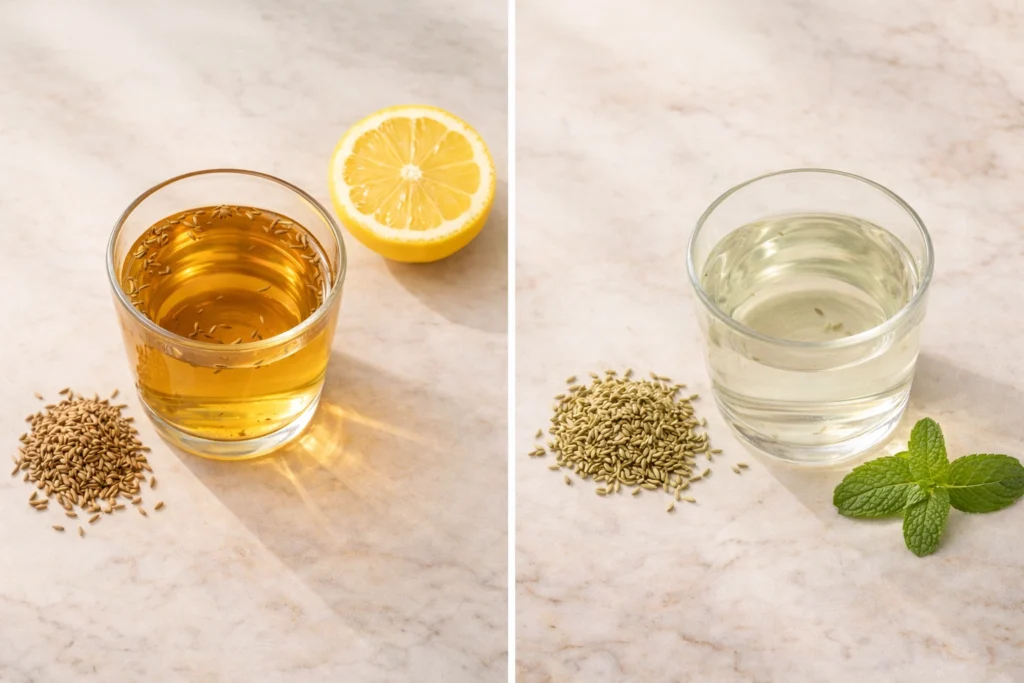
| Taste | Earthy, warm, slightly bitter | Mildly sweet, fresh, anise-like |
| Aroma | Strong, pungent, spicy | Light, floral, gentle |
| Colour | Pale golden-brown | Very pale yellow to clear |
| Good for beginners? | Strong taste — takes getting used to | Gentle taste — most people like it |
| Soak time | 8–10 hours overnight | 8–10 hours overnight |
| Boil time | 3–5 minutes | 3–5 minutes |
| Good to add | Lemon juice, black salt | Lemon juice, a little honey |
Key Benefits of Cumin Water
These benefits are based on research and traditional use. Talk to your doctor before using cumin water for a health condition.
🔥 Helps Your Digestion
Cumin water wakes up your digestive system. It helps your body break down food more easily — especially proteins and fats.
This is why so many people drink it first thing in the morning. It prepares your gut for the day ahead.
🔬 How It Works
Thymol in cumin stimulates pancreatic enzyme secretion. This improves breakdown of proteins, fats, and carbohydrates at the molecular level.
💉 May Support Blood Sugar
Some studies suggest cumin may help keep blood sugar more stable after meals. It does not replace diabetes medication — but it may be a helpful daily habit.
Always talk to your doctor if you manage blood sugar with medication.
📊 Clinical Study Result
A 2014 randomised controlled trial found cumin consumption was linked to significant improvements in metabolic markers after 8 weeks.
⚖️ Good for Weight-Conscious Routines
At just 5–7 calories per cup, cumin water is a great replacement for sugary morning drinks. It helps you start the day with fewer empty calories.
It also supports digestion, which is part of many weight management routines.
🛡️ Natural Antimicrobial Properties
Cumin has been used for centuries as a home remedy for mild stomach upsets. It has natural antibacterial and antifungal activity.
The concentration in cumin water is low — but its traditional use for gut protection has a real scientific basis.
Key Benefits of Fennel Water
These benefits are based on research and traditional use. Talk to your doctor before using fennel water for a health condition.
🫁 Relieves Bloating & Gas
This is fennel water’s biggest strength. It relaxes the muscles in your gut and lets trapped gas escape more easily.
It also helps with the cramping that goes with bloating — not just the gas itself. This is where fennel clearly beats cumin water.
🔬 How It Works
Anethole and fenchone are well-studied natural antispasmodics. They relax smooth muscle in the intestinal wall, relieving both gas and cramp sensations.
❄️ Cooling & Soothing
Fennel water has a cooling effect on the body. It is a great choice in hot weather or when you feel overheated after a meal.
In Ayurveda, fennel is recommended for people prone to acidity or heat-related stomach discomfort.
🌸 May Help With Hormonal Symptoms
Fennel has been used traditionally to ease period pain and PMS symptoms. Early research looks promising.
This benefit is unique to fennel — cumin water does not have the same effect. Women managing hormonal symptoms may find fennel water particularly useful.
🔬 How It Works
Anethole has mild phytoestrogenic activity — it weakly mimics oestrogen in the body. This is the basis for fennel’s traditional use for menstrual discomfort and menopausal symptoms.
😮 Freshens Breath
Fennel seeds have been used as a natural breath freshener across South Asia and the Middle East for centuries. Drinking fennel water after meals carries this benefit too.
Cumin water — with its strong, pungent smell — is not used for this purpose at all.
🌿 How should you use cumin or fennel water? Type either herb into our free Herb & Tea Benefit Finder — get preparation method, timing, dosage, and safety notes instantly.
🔍 Try the Herb & Tea Benefit Finder →Best Times to Drink Each
The timing makes a real difference. Each drink has a moment where it works best.
| Situation | 🌿 Cumin Water | 🌾 Fennel Water |
|---|---|---|
| 🌅 Morning (empty stomach) | ✅ Ideal — kick-starts digestion | ⚠️ Fine but less traditional |
| 🍽️ Before a heavy meal | ✅ Best choice — primes digestion | ✅ Acceptable |
| 🍽️ After a meal (bloating) | ✅ Good | ✅ Best choice — top pick for gas relief |
| 🌙 Evening / before bed | ⚠️ Can be too stimulating for some | ✅ Ideal — cooling and calming |
| ☀️ Hot summer days | ⚠️ Warming — less suited in heat | ✅ Cooling — great in summer |
| ❄️ Cold weather / winter | ✅ Warming — perfect for winter | ⚠️ Less warming than cumin |
| 🤢 Nausea / upset stomach | ✅ Traditional remedy | ✅ Excellent for nausea & cramps |
| 🩺 Blood sugar management | ✅ More researched for this | ⚠️ Less evidence |
| 🌸 Menstrual / hormonal support | ❌ Not used for this | ✅ Traditional and research-supported |
Head-to-Head Comparison
| Feature | 🌿 Cumin Water | 🌾 Fennel Water |
|---|---|---|
| Plant name | Cuminum cyminum | Foeniculum vulgare |
| Local names | Jeera / Zeera pani | Saunf pani |
| Taste | Earthy, warm, slightly bitter | Sweet, cooling, anise-like |
| Ayurvedic nature | Warming (Ushna) | Cooling (Sheeta) |
| Main active compound | Thymol, cuminaldehyde | Anethole, fenchone |
| Calories (250ml) | ~5–7 kcal | ~5–8 kcal |
| Best time to drink | Morning / before meals | After meals / evenings |
| How it helps digestion | Activates enzymes — stimulating | Relaxes gut muscles — soothing |
| Bloating & gas relief | ✅ Good | ✅ Excellent |
| Blood sugar support | ✅ More researched | ⚠️ Limited evidence |
| Hormonal / menstrual support | ❌ Not applicable | ✅ Supported by research |
| Breath freshening | ❌ Not suitable | ✅ Classic post-meal use |
| Weight management | ✅ More commonly used | ✅ Good as a low-calorie drink |
| Taste for beginners | Strong — acquired taste | Gentle — most people like it |
| Safe in pregnancy | ✅ Small culinary amounts fine | ⚠️ Avoid large medicinal amounts |
🔗 🌿 Full Guide: Cumin (Jeera / Zeera) — Benefits, Nutrition & Side Effects
This article compares both drinks. For everything about cumin — full nutrition, all benefits, dosage, and side effects — read our full guide:
👉 Cumin (Jeera / Zeera): Benefits, Uses, Nutrition & Side Effects →
🔗 🌾 Full Guide: Fennel Seeds (Saunf) — Benefits, Nutrition & Side Effects
For everything about fennel seeds — all benefits, nutrition, preparation methods, and who should be careful — read our full guide:
👉 Fennel Seeds (Saunf): Benefits, Uses, Nutrition & Side Effects →
Which Should You Choose?
It depends on your goal and the time of day. Here is a simple guide:
| Your Situation | Best Choice | Why |
|---|---|---|
| Morning routine / weight management | 🌿 Cumin water | Activates digestion, supports metabolism |
| After a heavy or oily meal | 🌾 Fennel water | Best for relieving bloating and cramps |
| Evening wind-down | 🌾 Fennel water | Cooling and calming — not stimulating |
| Hot summer days | 🌾 Fennel water | Cooling nature suits warm weather |
| Cold winter mornings | 🌿 Cumin water | Warming nature suits cool weather |
| Managing blood sugar | 🌿 Cumin water | Better researched for glucose support |
| Menstrual or hormonal discomfort | 🌾 Fennel water | Has mild hormone-like activity |
| New to herbal drinks | 🌾 Fennel water | Sweeter, milder taste — easier to start |
| Freshening breath after meals | 🌾 Fennel water | Classic use — cumin is not suited for this |
Can You Use Both Together?
Yes — cumin and fennel are often combined in South Asian cooking. A blend of both seeds in water is a traditional digestive tonic used in several regional traditions.
⭐ Cumin + Fennel Blend Water
What you need:
- ½ tsp cumin seeds
- ½ tsp fennel seeds
- 300ml water
- Optional: a squeeze of lemon
How to make it:
- 1 Add both seeds to a glass of water in the evening.
- 2 Leave to soak overnight (8–10 hours) at room temperature.
- 3 Strain the seeds and drink the water warm or at room temperature in the morning.
- 4 Add lemon juice if you like. Avoid sugar to keep it low in calories.
Who Should Be Careful?
Both drinks are safe for most healthy adults at 1–2 cups per day. But some groups should take care.
| Who | Cumin Water | Fennel Water |
|---|---|---|
| Blood thinner users | ⚠️ May have mild blood-thinning effect — ask your doctor | ✅ Fine in moderation |
| Diabetics on medication | ⚠️ May lower blood sugar further — monitor carefully | ✅ Fine in moderation |
| Pregnant women | ✅ Small culinary amounts are fine | ⚠️ Avoid large amounts — may stimulate the uterus |
| Hormone-sensitive conditions | ✅ No concern | ⚠️ Contains mild oestrogen-like compound — ask your doctor |
| Acid reflux / heartburn | ⚠️ May make symptoms worse in some people | ✅ Generally soothing for acidity |
| Before surgery | ⚠️ Stop 2 weeks before any surgery | ✅ No known clotting effects |
| Iron deficiency / anaemia | ⚠️ May mildly reduce iron absorption — avoid with iron-rich meals | ✅ No known interaction |
Try Our Free Herb & Tea Benefit Finder
Type cumin, fennel, ginger, or any herb to instantly see its benefits, how to prepare it, and who should be careful.
🔍 Open the Herb & Tea Benefit Finder →Frequently Asked Questions