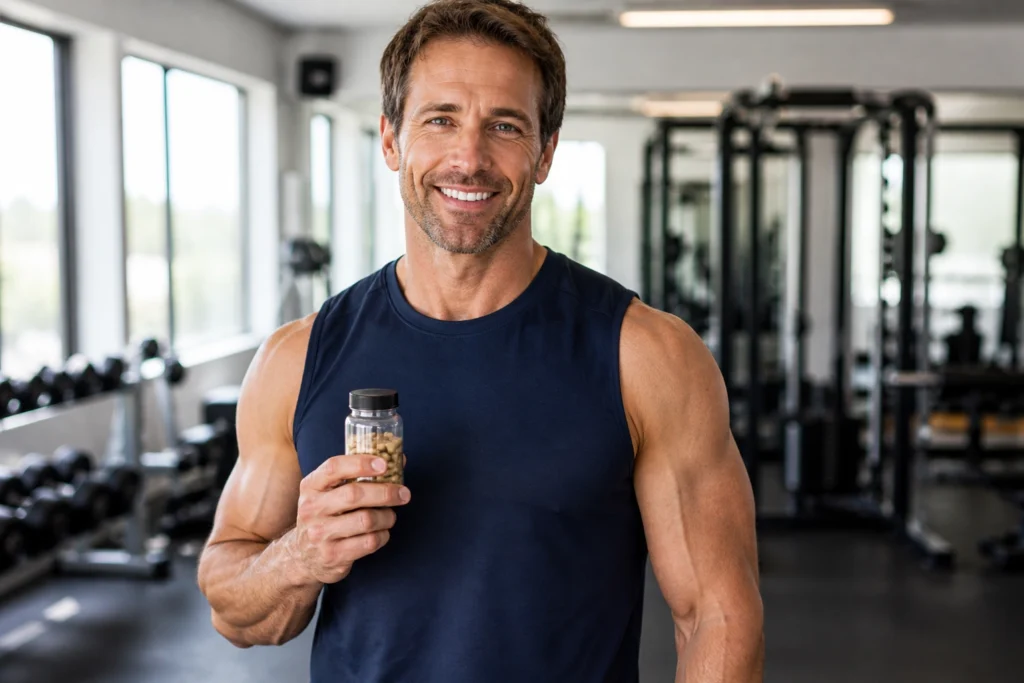

Ashwagandha has more clinical evidence for men’s health than almost any other herbal supplement. From testosterone and sexual health to muscle strength and fertility — the research is specific and meaningful.
📋 Table of Contents
Introduction
Ashwagandha is one of the most searched supplements among men in 2026 — and the research behind it is more specific and credible than most people realize. It is not just a general wellness herb. It has been studied directly for testosterone levels, sexual function, sperm quality, muscle strength, and male fertility.
The results are real — but they are also honest. Ashwagandha produces meaningful improvements in men who are stressed, training hard, or dealing with fertility challenges. For healthy young men with already-normal hormone levels, the effects are more modest. Understanding who benefits most helps you set the right expectations.
🛠️ Free Health Tools — BMI Calculator, Sleep Calculator, Intermittent Fasting Calculator & more
🔍 Browse All Free Health Tools →This guide covers all the key ashwagandha benefits for men — backed by the latest clinical research including a 2026 RCT published in Frontiers in Reproductive Health. For the complete ashwagandha health profile, see our pillar guide on ashwagandha benefits, dosage, and side effects.
Ashwagandha and Testosterone
This is the most searched question about ashwagandha for men — and the answer is yes, with important context.
A 2019 systematic review in the American Journal of Men’s Health analyzed 5 clinical trials and found ashwagandha supplementation increased testosterone levels by an average of 14.7% compared to placebo. A KSM-66 ashwagandha trial found a 17% increase in testosterone alongside significant improvements in other male health markers — findings strong enough for Health Canada to approve KSM-66 with the claim that it “helps promote healthy testosterone production in males.”
📊 Who Benefits Most from Testosterone Support
The testosterone-boosting effect of ashwagandha is strongest in: men under chronic stress, men with fertility challenges, overweight men aged 40+, and men doing resistance training. In healthy young men with already-normal testosterone levels, the effect is more modest. This is because ashwagandha works mainly by reducing cortisol — and cortisol only suppresses testosterone significantly in men who are already stressed or hormonally imbalanced.
How Does Ashwagandha Raise Testosterone?
The main reason is cortisol. When you are under chronic stress, your body produces high levels of cortisol — the stress hormone. High cortisol directly blocks testosterone production. Ashwagandha lowers cortisol, which frees up the hormonal environment for testosterone to rise naturally.
This is not the same as testosterone replacement therapy. Ashwagandha supports the body’s own natural testosterone production — it does not add external hormones.
| Study | Participants | Dose | Testosterone Change |
|---|---|---|---|
| American Journal of Men’s Health meta-analysis | 5 RCTs combined | Varied | +14.7% average |
| KSM-66 RCT (Ixoreal Biomed) | 46 males, 22–44 years | 300mg twice daily | +17% |
| Overweight men RCT (Shoden extract) | 57 overweight men, 40–70 years | 21mg withanolide glycosides | Significant increase vs placebo |
| Resistance training RCT (Wankhede 2015) | 57 men, 18–50 years | 300mg twice daily, 8 weeks | Significant increase vs exercise alone |
Sexual Health Benefits for Men
Ashwagandha has been used as a natural aphrodisiac in Ayurvedic medicine for thousands of years — and modern clinical trials are now confirming this traditional use.
A 2026 randomized, double-blind, placebo-controlled trial published in Frontiers in Reproductive Health studied 76 healthy men aged 30–50 over 8 weeks. The ashwagandha group showed significant improvements in sexual desire, the number of satisfying sexual events per week, and erectile function scores compared to the placebo group.
A separate study found that ashwagandha root extract increased the chance of improving male sexual function by 88.5% and was significantly more effective than placebo for both sexual performance and sexual desire in men.
🔥 Improves Sexual Desire (Libido)
Low libido in men is often driven by high stress and low testosterone — both of which ashwagandha directly addresses. By reducing cortisol and supporting natural testosterone levels, ashwagandha helps restore the hormonal conditions needed for healthy sexual desire.
The 2026 Frontiers RCT specifically measured sexual desire using a validated scoring tool and found significant improvements in the ashwagandha group compared to placebo after just 8 weeks.
💪 Supports Erectile Function
Ashwagandha may help men with stress-related erectile difficulties. Stress and high cortisol reduce blood flow and impair the hormonal signals needed for normal erectile function. By calming the stress system and supporting testosterone, ashwagandha addresses several root causes of this problem.
The 2026 RCT measured erectile function using the International Index of Erectile Function (IIEF) and found meaningful improvements in the ashwagandha group. These benefits are most relevant for stress-related erectile difficulties — not for cases with a physical underlying cause.
😊 Improves Sexual Confidence
Beyond physical metrics, the same 2026 trial measured quality of life scores and found significant improvements in the ashwagandha group. Reduced anxiety, better energy, and improved physical performance all contribute to greater confidence — which itself plays a meaningful role in sexual health.
This mind-body connection is one of the reasons ashwagandha’s sexual health benefits are so consistent — it addresses both the physical and psychological aspects of male sexual function.
⚡ Boosts Energy and Vitality
Chronic fatigue and low energy are among the most common complaints that affect men’s sexual health and overall quality of life. Ashwagandha has been shown to significantly reduce fatigue scores and improve overall vitality in multiple clinical trials — including a 16-week RCT in overweight men aged 40–70.
Better energy and less fatigue directly support a more active, satisfying lifestyle — inside and outside the bedroom.
Ashwagandha for Male Fertility
This is one of the areas where ashwagandha’s research is most impressive. Multiple clinical trials have found meaningful improvements in sperm quality in men with fertility challenges.
| Sperm Parameter | Improvement Found | Source |
|---|---|---|
| Sperm concentration | +167% | KSM-66 RCT — 46 males with low sperm count |
| Sperm motility | +57% | KSM-66 RCT |
| Semen volume | +53% | KSM-66 RCT |
| Testosterone (supporting fertility) | +17% | KSM-66 RCT |
| Luteinizing hormone | +34% | KSM-66 RCT |
🧬 Why These Numbers Are So Large
The KSM-66 trial participants had low sperm count to begin with — meaning there was more room for improvement. Men with already-normal sperm parameters are unlikely to see 167% improvements. But for men with low sperm count or poor sperm motility, these are genuinely meaningful clinical findings. The improvements were statistically significant and reproducible across multiple studies.
Muscle Strength & Athletic Performance
Ashwagandha is one of the few herbal supplements with genuine clinical evidence for physical performance — not just wellness claims.
A randomized, double-blind, placebo-controlled study published by the International Society of Sports Nutrition found that men taking 300mg of ashwagandha twice daily during an 8-week resistance training program showed significantly greater gains in muscle strength compared to the placebo group. The ashwagandha group gained up to 46kg more on bench press strength than those who only trained without the supplement.
| Performance Benefit | What Research Shows |
|---|---|
| Muscle strength | Significantly greater gains during resistance training vs placebo |
| Muscle recovery | Reduced exercise-induced muscle damage markers |
| Cardiorespiratory endurance | Significant improvements in VO2 max (oxygen uptake during exercise) |
| Testosterone during training | Higher testosterone levels vs exercise-alone group |
| Fatigue reduction | Significant reduction in fatigue scores during training periods |
Stress, Cortisol & Energy in Men
Chronic stress is one of the biggest threats to men’s hormonal health. High cortisol suppresses testosterone, reduces sperm quality, impairs sexual function, and reduces muscle-building potential — all at the same time.
Ashwagandha addresses this directly. Clinical trials have confirmed cortisol reductions of 14–27% in men taking ashwagandha consistently. This single effect cascades into improvements across testosterone, sexual health, fertility, and physical performance — which is why the benefits for men are so wide-ranging.
For the full evidence on ashwagandha’s stress and cortisol effects, see our dedicated guide on ashwagandha for stress and anxiety.
How It Works — Simply Explained
Most of ashwagandha’s male health benefits come from one central effect: lowering cortisol.
| The Problem | Root Cause | How Ashwagandha Helps |
|---|---|---|
| Low testosterone | High cortisol suppresses testosterone production | Lowers cortisol → testosterone rises naturally |
| Poor sexual function | Stress, anxiety, and low testosterone | Reduces stress + supports testosterone = improved sexual health |
| Low sperm quality | Oxidative stress and poor hormonal environment | Antioxidant protection + hormone support = better sperm parameters |
| Slow muscle gains | High cortisol breaks down muscle tissue | Lower cortisol + testosterone support = better muscle building environment |
| Low energy and fatigue | Adrenal stress and poor hormonal balance | Adaptogenic effect restores energy regulation |

Dosage Guide for Men
🌿 How should you use ashwagandha? Type it in our free Herb & Tea Benefit Finder — get preparation method, timing, dosage, and safety notes instantly.
🔍 Try the Herb & Tea Benefit Finder →| Goal | Best Dose | Best Timing | Duration |
|---|---|---|---|
| Testosterone support | 300mg twice daily | Morning + evening with food | 8–12 weeks |
| Sexual health | 300mg twice daily | Morning + evening with food | 8 weeks minimum |
| Fertility | 300–600mg daily | With meals | 90 days (3 months) |
| Muscle and performance | 300mg twice daily | With breakfast + post-workout meal | 8 weeks minimum |
| Stress and energy | 300–600mg daily | Morning or split dose | 8+ weeks |
Side Effects & Safety for Men
Ashwagandha is well tolerated by most healthy men at recommended doses for up to 3 months. Here are the key things men specifically should know:
🤢 Nausea
Most common side effect — almost always avoidable by taking with food. Never take on an empty stomach.
🫀 Liver injury (rare)
Rare case reports — mainly linked to high doses, leaf-containing products, or low-quality supplements. Use root-only standardized extract at 300–600mg. Stop immediately if you notice yellowing of skin or dark urine.
🦋 Thyroid effects
Ashwagandha may raise thyroid hormone levels. Men with thyroid conditions should check with their doctor before use.
💊 Interactions with testosterone therapy
If you are already on prescribed testosterone replacement therapy (TRT), inform your doctor before adding ashwagandha — the combined hormonal effect needs to be monitored.
😴 Drowsiness
More common at evening doses. Useful for sleep but avoid driving until you know how it affects you.
Conclusion
Ashwagandha has more specific clinical evidence for men’s health than almost any other herbal supplement. The testosterone, sexual health, fertility, and muscle strength benefits are backed by real randomized controlled trials — including a 2026 study published in Frontiers in Reproductive Health.
The key is realistic expectations. Ashwagandha works best for men who are stressed, training hard, or dealing with fertility challenges. It supports your body’s own natural hormone production rather than replacing it. Results build over 8–12 weeks with consistent daily use.
Choose root-only KSM-66 or Sensoril extract at 300–600mg per day, always take with food, and give it a minimum of 8 weeks before evaluating results. For stress specifically, see ashwagandha for stress and anxiety. For sleep, see ashwagandha for sleep.
Try Our Free Herb & Tea Benefit Finder
Type ashwagandha, bacopa, black seed, or any herb to instantly see its benefits, best time to use, preparation method, and who should be careful.
🔍 Open the Herb & Tea Benefit Finder →Frequently Asked Questions
Yes — but the effect depends on who you are. A meta-analysis of 5 clinical trials found an average 14.7% testosterone increase. The KSM-66 trial found a 17% increase. The benefits are strongest in men who are stressed, overweight, older (40+), or have fertility challenges. In healthy young men with already-normal testosterone, the effect is more modest. Ashwagandha supports natural testosterone production — it does not add external hormones.
Yes — particularly for stress-related erectile difficulties. A 2026 RCT in 76 healthy men found significant improvements in erectile function scores after 8 weeks of ashwagandha. A separate study found it improved male sexual function by 88.5% more than placebo. These benefits are most relevant when stress, anxiety, or low testosterone are contributing factors — not for erectile dysfunction caused by physical conditions like cardiovascular disease. Always consult a doctor for diagnosed ED.
Most clinical studies show measurable testosterone changes after 8–12 weeks of consistent daily use. Some men report improvements in energy and mood within 2–4 weeks — but for measurable hormonal changes, give it the full 8–12 weeks. Do not judge it at 2–3 weeks. Consistency every day matters more than the exact dose within the recommended range.
Yes — the fertility evidence is particularly strong. The KSM-66 trial in men with low sperm count found a 167% increase in sperm concentration, 57% improvement in sperm motility, and 53% increase in semen volume. These are large improvements — though it is important to note participants started with below-normal sperm counts, so there was more room to improve. For men with normal sperm parameters, improvements will be more modest. For fertility treatment, always work with a specialist alongside any supplementation.
Yes — a well-designed RCT found that men taking ashwagandha during 8 weeks of resistance training gained significantly more muscle strength than the placebo group — with bench press strength increases up to 46kg greater. The benefit comes from lower cortisol (which reduces muscle breakdown), higher testosterone (which supports muscle building), and faster recovery. It is a meaningful supporting tool for men who train — not a replacement for proper nutrition and progressive training.
Yes — for up to 3 months at the recommended dose of 300–600mg per day from a root-only standardized extract. Most side effects (nausea, loose stools) are mild and avoidable by taking with food. The most serious concern is rare liver injury — mainly linked to high doses or low-quality products. Use a reputable brand with stated withanolide content. If you take any prescription medication, inform your doctor before starting.
KSM-66 and Sensoril are the two best-studied branded ashwagandha extracts — both have male-specific clinical trials behind them. KSM-66 has the most research for testosterone and fertility specifically. Look for root-only extract (not leaf), a stated withanolide percentage (2.5–5%), and third-party testing for quality assurance. Generic ashwagandha without a stated withanolide content may contain very little active compound.
Yes — asgandh is the Hindi and Urdu name for ashwagandha (Withania somnifera) and has been used in traditional Ayurvedic and Unani medicine across South Asia for centuries specifically for male vitality, strength, and reproductive health. The Sanskrit classification of ashwagandha as Vajikari — meaning a reproductive and sexual tonic — reflects this long history. Modern clinical research now confirms these traditional uses. When buying asgandh, look for root-only standardized extract with the botanical name Withania somnifera on the label.