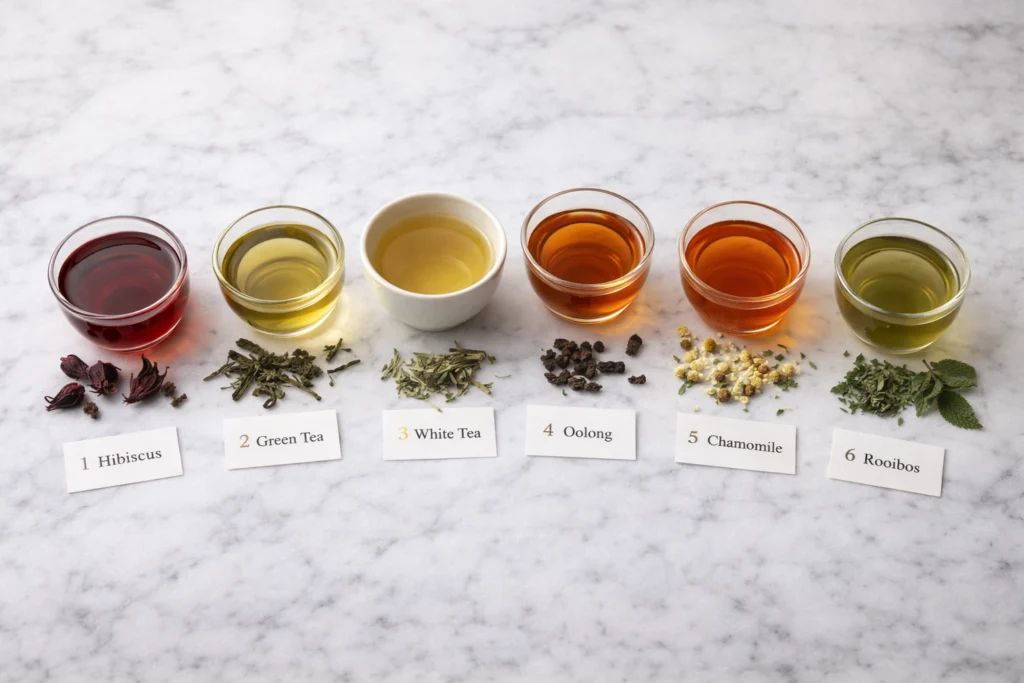
Several herbal teas contain plant compounds that help calm the inflammation, oxidative stress, and immune problems behind psoriasis. Here are the top 7, ranked from most to least proven.
📋 Table of Contents
- Why Herbal Tea for Psoriasis?
- How We Ranked These 7 Teas
- #1 Green Tea — Best Overall
- #2 Hibiscus Tea — Best for Itch + Inflammation
- #3 White Tea — Strongest in Direct Study
- #4 Oolong Tea — Only Tea with Human Trial
- #5 Chamomile Tea — Best for Stress-Triggered Flares
- #6 Rooibos Tea — Best Caffeine-Free Daily Option
- #7 Nettle Tea — Best for Immune Support
- Full Comparison Table
- How to Combine Teas for Best Results
- Brewing Tips
- Dosage Guide
- Side Effects & Who Should Be Careful
- Conclusion
- Frequently Asked Questions
Why Herbal Tea for Psoriasis? The Science Behind It
Psoriasis affects about 125 million people worldwide. It’s a chronic autoimmune condition where your immune system makes skin cells grow too fast. The result is thick, scaly plaques and constant itching.
Standard treatments like steroid creams and biologics work, but they can be expensive and have side effects. Many people want safer natural support to use alongside their treatment.
🛠️ Free Health Tools — Water Intake Calculator, BMI Calculator, Intermittent Fasting Calculator & more
🔍 Browse All Free Health Tools →Herbal teas deliver plant compounds straight into your bloodstream. From there, they can calm the same immune signals that drive psoriasis. A 2025 review of 20 trials confirmed certain herbal teas show real promise for psoriasis.
This guide ranks the 7 best herbal teas for psoriasis. The ranking is based on the strength of the science behind each one. We explain exactly how each tea works at the cell level so you can choose the right one for you.
This is part of our pillar guide: 7 Proven Benefits of Hibiscus Tea for Psoriasis & Eczema.
How We Ranked These 7 Teas
We rated each tea on four factors. Here is how the ranking was decided.
| Ranking Factor | Weight | What We Looked For |
|---|---|---|
| Psoriasis-specific evidence | 40% | Studies done directly on psoriasis — not just general anti-inflammatory research |
| How it works | 30% | Does it target the specific pathways behind psoriasis? |
| Quality of evidence | 20% | Human trials beat animal studies; animal studies beat lab tests |
| Safety & cost | 10% | Is it safe for daily long-term use? Is it affordable? |
#1 Green Tea — Best Overall for Psoriasis
Botanical name: Camellia sinensis | Key compound: EGCG | Caffeine: Low–moderate
Green tea earns the top spot because it directly targets the root cause of psoriasis. Researchers found that green tea regulates a key gene called Caspase-14. This gene controls how skin cells grow and die.
In psoriasis, this process is broken. Skin cells grow up to 10 times faster than normal. Green tea’s main compound — EGCG — helps restore normal cell growth by acting on this gene.
🔬 The Science Explained
Green tea’s EGCG (epigallocatechin-3-gallate) restores normal Caspase-14 expression — the protein controlling the skin cell life cycle. EGCG also blocks NF-κB and reduces TNF-α, IL-6, and IL-17 — the main cytokines driving plaque formation. A 2024 PMC study confirmed significant improvement in psoriasis markers (p<0.01).
A 2024 study showed EGCG significantly reduced skin thickness, redness, and scaling in psoriasis models. Another study found that applying green tea solution to psoriasis lesions in mice cleared them up.
How to use: Brew 1–2 tsp of loose-leaf green tea in 80–85°C water (never boiling — this destroys EGCG). Steep 2–3 minutes. Drink 2 cups daily, 30 minutes after meals. If you are caffeine-sensitive, switch to decaf green tea or limit to morning use.
#2 Hibiscus Tea — Best for Itch + Inflammation Combined
Botanical name: Hibiscus sabdariffa | Key compounds: Anthocyanins, fruit acids | Caffeine: Zero
Hibiscus tea ranks second because it combines several actions no other tea matches. While green tea targets cell growth, hibiscus tackles inflammation, itch, plaque texture, and bacteria all at once.
This makes hibiscus especially valuable if your main complaints are intense itching and thick plaques. A 2025 study found hibiscus reduced skin thickness by 62.9% in eczema models — beating the steroid drug prednisolone (48.6%).
🔬 Hibiscus Research Snapshot
The 2025 study reduced serum IgE by 26.6%, scratching dropped significantly, and TARC/CCL17 chemokines were suppressed by 73%. The natural AHAs (malic acid, citric acid) gently dissolve the bonds between dead skin cells in psoriasis plaques.
🔬 Deep Dive: Does Hibiscus Tea Stop Eczema Itching?
Want to understand how hibiscus stops the itch cycle? We cover the full science of histamine, antibodies, and itch pathways:
How to use: Brew 1–2 tsp of loose-leaf hibiscus in 85–90°C water, steep 7–8 minutes. Drink 1–2 cups daily. Also use cooled double-strength hibiscus tea as a compress on plaques for 10–15 minutes, 3–4 times per week. For our full guide, see 7 proven benefits of hibiscus tea for psoriasis & eczema.
#3 White Tea — Strongest in Direct Comparison Study
Botanical name: Camellia sinensis (minimally processed) | Key compounds: EGCG, catechins, rutin | Caffeine: Low
White tea deserves more attention than it usually gets. A 2024 study tested black, green, and white tea against psoriasis in mice. White tea showed the best effect on psoriasis severity scores. It also showed the strongest action against skin thickening.
Why does white tea perform so well? It’s the least processed of all teas from the Camellia sinensis plant. The leaves are simply dried, not steamed or fermented. This preserves the highest levels of natural plant compounds.
🔬 White vs Green vs Black Tea for Psoriasis (2024 Study)
White tea: Best effect on PASI scores (p<0.01); strongest against skin thickening
Green tea: Best effect on PASI scores (p<0.01) — tied with white tea
Black tea: Good effect (p<0.05) — works but less strongly
All three: Reduced IL-17 and TNF-α — the main cytokines driving plaques
How to use: Brew 1–2 tsp of loose-leaf white tea in 75–80°C water (white tea is delicate). Steep 4–5 minutes. Drink 1–2 cups daily. White tea has a mild, slightly sweet flavor that pairs well with hibiscus.
#4 Oolong Tea — The Only Tea with Human Trial Data
Botanical name: Camellia sinensis (semi-fermented) | Key compounds: Polyphenols, theaflavins | Caffeine: Moderate
Oolong tea is special. It is the only tea on this list with a human clinical trial for psoriasis and eczema. In a Japanese study, patients drank 3 cups of oolong tea daily.
After just one week, they had significantly less itching. After one month, half of the participants reported real improvement in their condition. No other herbal tea has matched this in a human trial.
Researchers credit oolong’s anti-allergy plant compounds. These reduce the histamine response and calm the overactive immune system behind psoriasis and eczema.
How to use: Brew 1–2 tsp of loose-leaf oolong in 85–90°C water, steep 3–5 minutes. Drink 3 cups daily for the first 4 weeks. Note: oolong has moderate caffeine — avoid after 3pm if you have sleep issues. Use it as your morning and midday tea.
#5 Chamomile Tea — Best for Stress-Triggered Flare-Ups
Botanical name: Matricaria chamomilla | Key compounds: Bisabolol, apigenin | Caffeine: Zero
Chamomile attacks psoriasis through a different angle: stress relief. Stress is one of the biggest triggers for psoriasis flares. It raises stress hormones and triggers immune problems that worsen the skin.
If your psoriasis gets worse during stressful times, chamomile is a smart addition.
🌿 Which tea is right for your symptoms? Type any tea — green tea, hibiscus, chamomile — into our free Herb & Tea Benefit Finder for instant prep methods, timing, and safety notes.
🔍 Try the Herb & Tea Benefit Finder →🔬 How Chamomile Works
Chamomile’s main compound, apigenin, binds to GABA-A receptors in the brain — the same receptors targeted by anti-anxiety medications. This produces real, measurable calming effects without sedation. Bisabolol blocks cyclooxygenase enzymes, reducing skin redness and swelling.
A 2019 human trial confirmed chamomile reduces anxiety significantly. At the same time, it directly calms inflammation in the skin. A 2025 review of herbal psoriasis trials included chamomile as one of the studied options.
How to use: Brew 1–2 tsp of loose-leaf chamomile (or 1 tea bag) in 90°C water, steep 5–7 minutes. Drink 1 cup in the evening, 1 hour before bed. You can also use cooled chamomile tea as a compress on itchy patches. Note: people allergic to ragweed, daisies, or marigolds should patch test first.
#6 Rooibos Tea — Best Caffeine-Free Daily Foundation
Botanical name: Aspalathus linearis | Key compounds: Aspalathin, quercetin, luteolin | Caffeine: Zero
Rooibos (say ROY-boss) is a South African herbal tea. It earns its spot on this list as one of the safest, most versatile daily teas for psoriasis patients. It’s a great choice if you’re sensitive to caffeine, take many medications, or don’t like the tart taste of hibiscus or green tea.
Rooibos contains aspalathin — a unique flavonoid found nowhere else in nature. It also has quercetin and luteolin, which calm allergy reactions and reduce inflammation chemicals.
Rooibos has another advantage. It’s very low in tannins, so it doesn’t block your body from absorbing iron or zinc. These minerals are often low in psoriasis patients. It’s also low in histamine, making it safe for low-histamine diets.
How to use: Brew 1–2 tsp of loose-leaf rooibos in 95–100°C water (rooibos is robust — boiling water is fine), steep 5–7 minutes. Drink 1–2 cups daily anytime. Its mild, naturally sweet, vanilla-like flavor makes it the easiest tea to drink long-term.
#7 Nettle Tea — Best for Immune Support
Botanical name: Urtica dioica | Key compounds: Quercetin, kaempferol, beta-sitosterol | Caffeine: Zero
Stinging nettle tea has been used for inflamed skin for centuries in European and Middle Eastern traditions. It ranks at #7 because the evidence for psoriasis specifically is thinner than for the teas above. But its mechanisms are promising.
Nettle contains quercetin and kaempferol — flavonoids that calm inflammation. It also contains beta-sitosterol, a plant compound that helps balance immune responses and reduces skin redness.
What makes nettle interesting for psoriasis is its broader immune effect. Rather than just reducing inflammation, it gently helps balance the overactive immune system that causes psoriasis. Traditional herbalists called this “blood purifying.”
How to use: Brew 1–2 tsp of dried nettle leaf in 95°C water, steep 5–10 minutes. Drink 1–2 cups daily. Nettle has a pleasant, slightly earthy flavor that pairs well with lemon and honey. It’s one of the most mineral-rich herbal teas — high in iron, magnesium, and potassium. Avoid during pregnancy.
Full Comparison Table — 7 Best Teas for Psoriasis
Here is the full ranking at a glance. Use this table to pick the best tea for your specific symptoms.
| Rank | Tea | Main Compound | How It Helps Psoriasis | Best Evidence | Caffeine | Best For |
|---|---|---|---|---|---|---|
| #1 | 🍃 Green Tea | EGCG | Normalizes skin cell growth; calms inflammation | Animal studies + lab data (2024) | Low–moderate | Targeting fast skin cell growth |
| #2 | 🌺 Hibiscus Tea | Anthocyanins, fruit acids | Antihistamine; softens plaques; fights bacteria | Reviews + animal studies (2024–2025) | Zero | Itch, plaque texture, inflammation |
| #3 | 🤍 White Tea | EGCG, catechins | Reduces severity scores; thins plaques | Direct psoriasis study (2024) | Low | Overall plaque reduction |
| #4 | 🍂 Oolong Tea | Polyphenols, theaflavins | Anti-allergy; calms histamine; broad immune effect | Human trial — 50% improvement | Moderate | Proven results; itch reduction |
| #5 | 🌼 Chamomile | Apigenin, bisabolol | Stress relief; reduces redness and swelling | Human anxiety trial; herbal review (2025) | Zero | Stress-triggered flares; nighttime |
| #6 | 🌿 Rooibos | Aspalathin, quercetin | Anti-allergy; preserves mineral absorption | Lab + anti-allergy studies | Zero | Daily maintenance; medication-sensitive |
| #7 | 🌱 Nettle | Quercetin, beta-sitosterol | Balances immunity; reduces inflammation | Traditional use + lab data | Zero | Immune support; mineral boost |
🔗 🌺 Full Guide: Hibiscus Tea for Psoriasis & Eczema — 7 Proven Benefits
For the complete deep-dive on hibiscus — the #2 ranked tea here — including all benefits, dosage, traditional uses, and the compress method:
👉 7 Proven Benefits of Hibiscus Tea for Psoriasis & Eczema →
How to Combine Teas for Maximum Benefit
No single tea covers every part of psoriasis. The smartest approach is to combine 2–3 teas across the day. Each one targets a different mechanism.
| Time of Day | Best Tea | Why This Timing |
|---|---|---|
| Morning | 🍃 Green Tea or 🍂 Oolong Tea | Caffeine is fine in morning; starts cell-cycle regulation early |
| Midday | 🌺 Hibiscus or 🤍 White Tea | Caffeine-free or low-caffeine; keeps anti-inflammatory effects steady through afternoon |
| Evening | 🌼 Chamomile, 🌿 Rooibos, or 🌱 Nettle | All caffeine-free; chamomile calms stress before sleep |
| During flare-up | 🌺 Hibiscus (drink + compress) | Fastest combined inside-and-outside relief |
🏆 Best 3-Tea Combination for Psoriasis
Based on the evidence and how these teas complement each other, the most effective combination is:
Morning: Green Tea — targets the skin cell growth problem at its root
Midday: Hibiscus Tea — handles itch, plaque texture, and bacteria
Evening: Chamomile Tea — reduces stress and supports sleep
Together these three cover skin cell regulation, inflammation, itch, plaque softening, antibacterial action, stress reduction, and immune balance — all without too much caffeine.
Brewing Tips for Maximum Benefit
How you brew makes a huge difference. The wrong temperature destroys plant compounds. Too short a steep extracts too little. Tea bags are weaker than loose-leaf. Follow these guidelines for every cup.
| Tea | Water Temp | Steep Time | Amount | Key Tip |
|---|---|---|---|---|
| 🍃 Green Tea | 80–85°C | 2–3 min | 1–2 tsp / 240ml | Never use boiling water — destroys EGCG |
| 🌺 Hibiscus Tea | 85–90°C | 7–8 min | 1–2 tsp / 240ml | Longer steep gets more red plant compounds |
| 🤍 White Tea | 75–80°C | 4–5 min | 1–2 tsp / 240ml | Most delicate — needs the lowest temperature |
| 🍂 Oolong Tea | 85–90°C | 3–5 min | 1–2 tsp / 240ml | Can be re-steeped 2–3 times |
| 🌼 Chamomile | 90°C | 5–7 min | 1–2 tsp / 240ml | Cover while steeping to keep volatile oils in |
| 🌿 Rooibos | 95–100°C | 5–7 min | 1–2 tsp / 240ml | Most robust — handles full boiling temperature |
| 🌱 Nettle | 95°C | 5–10 min | 1–2 tsp / 240ml | Longer steep releases more minerals |
For hibiscus specifically, double-strength brew is best for topical use. See our guide on how to make a hibiscus tea compress for psoriasis.
Dosage Guide
Here are the recommended amounts. Start with the lower end and adjust based on your response.
📅 Realistic Timeline
Week 1–2: Possible reduction in itch and background inflammation (oolong and hibiscus drinkers report this earliest)
Week 3–4: Noticeable improvement in plaque texture with hibiscus topical use
Week 4–8: Measurable drop in flare frequency; less redness and scaling
Week 8–12: Full assessment of benefit — most studies ran for 4–12 weeks
Herbal teas need consistency over time. Skipping days resets the benefit. Treat them like a daily supplement — not an as-needed remedy.
Side Effects & Who Should Be Careful
Each tea has its own safety considerations. Here are the key ones.
🩸 Blood pressure medication
Hibiscus tea lowers blood pressure. Avoid combining with BP medication without doctor guidance. Other teas don’t share this issue.
🤰 Pregnancy
Avoid hibiscus and nettle during pregnancy — both may stimulate uterine contractions. Chamomile, rooibos, and white tea in moderate amounts are generally safer, but always check with your doctor.
💊 Blood thinners (warfarin)
Green tea contains vitamin K and can affect warfarin. Talk to your doctor before adding green tea if you take blood thinners.
🌿 Daisy family allergies
Chamomile is in the daisy family. People allergic to ragweed, daisies, or chrysanthemums should avoid chamomile or use very carefully. Patch test nettle topically first.
☕ Caffeine sensitivity
Green tea and oolong contain caffeine. If sensitive, limit to morning, switch to decaf, or pick from the caffeine-free options (hibiscus, chamomile, rooibos, nettle).
🦷 Tooth enamel (hibiscus)
Hibiscus tea is naturally acidic. Drink through a straw and rinse with water after. Don’t brush right after drinking.
Before starting any of these teas daily, check the full safety profile. Hibiscus has specific drug interactions: see hibiscus tea side effects and who should avoid it.
Conclusion
The seven herbal teas in this guide each work differently to support psoriasis management. Green tea targets the root skin cell problem. Hibiscus calms itch and softens plaques. White tea has the strongest direct study evidence. Oolong has proven human results. Chamomile, rooibos, and nettle add stress relief, daily maintenance, and immune support.
The best approach is not to pick one — it’s to combine 2–3 teas across the day. Green tea in the morning, hibiscus or white tea at midday, and chamomile or rooibos in the evening cover almost every angle of psoriasis that herbal tea can reach.
None of these teas replace your prescribed treatment. But used consistently alongside your medical care, they give your body real support against the inflammation, itch, and immune problems behind psoriasis. Start with one tea for 4 weeks and see how you respond. Then build your daily plan from there.
Try Our Free Herb & Tea Benefit Finder
Type any tea from this list — hibiscus, green tea, chamomile, rooibos — to instantly see its full benefits, best time to use, and safety notes.
🔍 Open the Herb & Tea Benefit Finder →Frequently Asked Questions
Green tea ranks #1 because its EGCG compound directly targets the skin cell growth problem at the root of psoriasis. No other tea has this specific, well-documented action.
But “best” depends on your main symptom. If itch is your biggest problem, hibiscus may help more. If stress triggers your flares, chamomile may make the biggest difference. The most effective approach is combining green tea (morning) + hibiscus (midday) + chamomile (evening).
Oolong tea has the strongest human evidence. A Japanese study found patients drinking 3 cups daily had significantly less itching after one week. After one month, 50% reported real improvement.
Green tea, white tea, and hibiscus have strong animal and lab evidence. Hibiscus has been studied in reviews of its anti-inflammatory effects. But direct human psoriasis trials are still limited for most herbal teas.
Yes — combining 2–3 teas daily is actually the recommended approach. Each tea targets different parts of psoriasis. The ideal combination is green tea in the morning, hibiscus or white tea at midday, and chamomile or rooibos in the evening.
Keep total consumption to 3–4 cups across all teas. Avoid combining teas that share the same risks — for example, if you’re on blood pressure medication, limit hibiscus across all daily cups.
Oolong tea reduced itching after just one week in the human trial. For most other teas, expect 2–4 weeks before noticing changes in itch and redness. Bigger improvements in plaques usually take 6–12 weeks.
For topical use (hibiscus or green tea compress), you can feel soothing effects within minutes. But structural plaque improvement takes weeks of consistent use. Think of these teas as long-term daily support — not fast-acting treatments.
They work differently and are best used together, not chosen between. Green tea’s EGCG normalizes the fast skin cell growth that defines psoriasis. Hibiscus is better for managing itch, softening plaques with its natural fruit acids, and fighting skin bacteria.
If you can only choose one, green tea has the stronger psoriasis-specific evidence. If itch and plaque texture are your priorities, hibiscus wins.
No. Herbal teas are complementary support — they help calm inflammation and may reduce flare frequency, but they cannot replace prescribed biologics, methotrexate, or steroid creams for moderate-to-severe psoriasis.
Never stop prescribed treatments without talking to your dermatologist. The smartest approach is to use herbal teas as part of a broader plan — alongside medical care, stress management, and good skin care.
The evidence is mixed. Some research shows moderate caffeine has no real effect on psoriasis. But some patients say high caffeine worsens their skin — possibly through stress hormone elevation and sleep problems.
If caffeine seems to trigger your flares, choose caffeine-free options from this list: hibiscus, chamomile, rooibos, and nettle. Green tea has the least caffeine of the Camellia teas (~25–35mg per cup vs 95mg in coffee).
Yes — hibiscus and green tea both work well as cooled topical compresses. Brew double-strength, cool completely, soak a clean cotton cloth, and apply to plaques for 10–15 minutes. Always patch test first. Never apply to open or infected skin.
Hibiscus is especially good topically because its natural fruit acids gently soften plaques while the red plant compounds calm inflammation. Green tea’s EGCG has also worked in animal studies when applied to psoriasis lesions.
📚 Related Health Guides
7 Proven Benefits of Hibiscus Tea for Psoriasis & Eczema
The full deep-dive on hibiscus — the #2 ranked tea in this guide.
Does Hibiscus Tea Stop Eczema Itching? What the Research Says
The science of itch — histamine, IgE, and how hibiscus breaks the itch cycle.
Is Ginger Tea Good for You? Benefits, Best Time & How to Make It
Ginger’s compounds complement green and hibiscus tea for skin health.
Turmeric Milk (Golden Milk): Benefits, Recipe & How to Make It
Curcumin targets the same TNF-α cytokine as green and white tea.