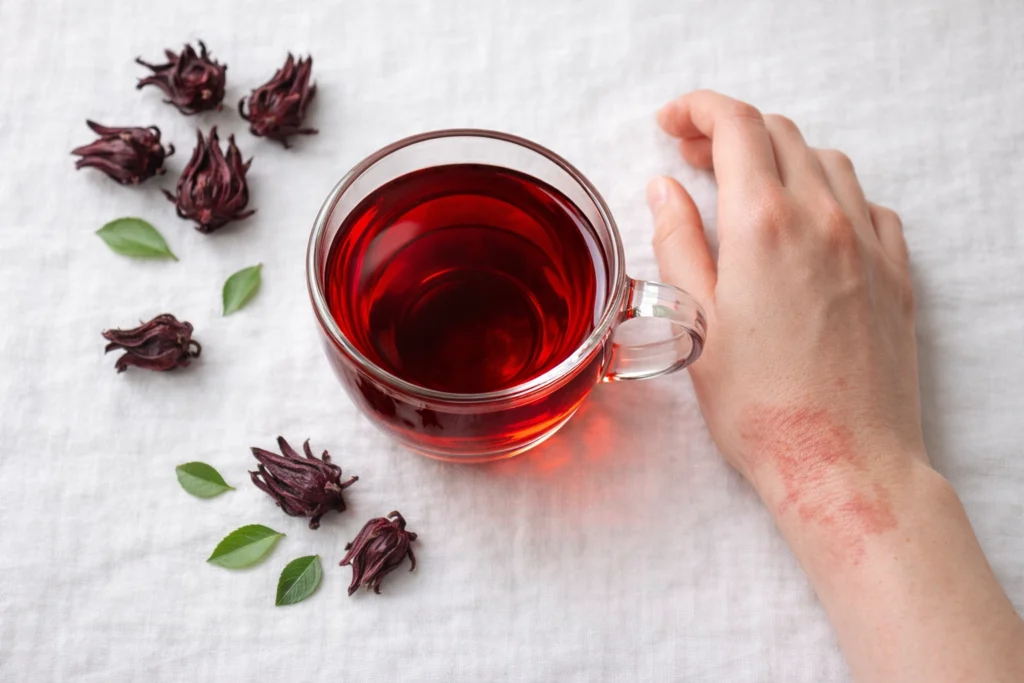
Hibiscus tea contains natural compounds that fight the chemicals behind eczema itch. It works as a gentle natural antihistamine and helps calm the skin from the inside out.
📋 Table of Contents
- Why Eczema Itching Is So Hard to Stop
- The Science of Eczema Itch — What’s Happening
- How Hibiscus Tea Targets Eczema Itching
- What the Research Actually Says
- Hibiscus Tea and the Low-Histamine Approach
- How to Use Hibiscus Tea to Stop Eczema Itch
- Hibiscus Tea vs Antihistamine Pills
- Other Teas That Help Eczema Itching
- Dosage & Timing
- Side Effects & Who Should Avoid It
- Frequently Asked Questions
Why Eczema Itching Is So Hard to Stop
If you have eczema, you know the itch is the worst part. It can feel constant, exhausting, and impossible to ignore. Studies show eczema itch ruins sleep for up to 60% of patients.
The “itch-scratch cycle” makes things worse. You scratch to feel better, but scratching causes more inflammation. More inflammation means more itching. And the cycle keeps going.
Over 31 million Americans live with some form of eczema. For most of them, controlling the itch is the daily priority.
🛠️ Free Health Tools — Water Intake Calculator, BMI Calculator, Intermittent Fasting Calculator & more
🔍 Browse All Free Health Tools →Standard treatments include antihistamine pills, steroid creams, and newer drugs like dupilumab. But antihistamines often disappoint people with eczema. We will explain why later in this article.
Many people want safer natural options to use alongside their treatment. Hibiscus tea is one of the most promising. This article looks at exactly how it works to stop eczema itch — and how to use it for the best results.
This is part of our full pillar guide: 7 Proven Benefits of Hibiscus Tea for Psoriasis & Eczema.
The short answer: Yes, hibiscus tea has real anti-itch effects backed by research. It works differently from antihistamine pills. Knowing how it works helps you use it better.
The Science of Eczema Itch — What’s Happening in Your Skin
To understand why hibiscus works, you need to know what causes eczema itch. It is more complex than most people think. This is also why standard antihistamines often let eczema patients down.
The Histamine Pathway
Eczema is driven by an immune system that overreacts. When you touch something irritating, special skin cells release a chemical called histamine. Histamine then triggers the itch signal that travels to your brain.
People with eczema release nearly twice as much histamine as people with healthy skin. Most also have high levels of an antibody called IgE, which loads up the cells that release histamine.
🧬 The Key Itch Drivers in Eczema
Histamine released by mast cells · IgE antibodies that arm those mast cells · NF-κB inflammatory pathway · IL-31, IL-4, IL-13 cytokines · Nerve growth factor (NGF) and substance P · Staphylococcus aureus bacteria on the skin · Skin barrier dysfunction causing dryness itch
The Non-Histamine Pathways
Here is the catch: eczema itch is not only caused by histamine. Other body chemicals also send itch signals to the brain. These include cytokines like IL-31, nerve growth factor, and substance P.
This is why standard antihistamine pills often fail for eczema. They only block one type of itch signal. A broader approach like hibiscus — which targets several pathways at once — may work better for many people.
| Itch Driver | What It Does in Eczema | Does Hibiscus Target It? |
|---|---|---|
| Histamine | Main itch signal — released when skin reacts to allergens | ✅ Yes — lowers histamine levels |
| IgE antibodies | Loads up cells to release histamine; high in 80%+ of eczema patients | ✅ Yes — reduces IgE in studies |
| NF-κB pathway | Master switch that drives inflammation throughout the body | ✅ Yes — turns down NF-κB |
| Inflammatory cytokines | Chemical messengers that amplify the itch response | ✅ Yes — reduces several at once |
| Staph bacteria | Lives on eczema skin; triggers extra immune activation | ✅ Yes — fights this bacteria |
| Dry skin / barrier loss | Mechanical itch from cracked, dry skin | ✅ Yes — supports skin hydration |
| IL-31 cytokine | Activates nerve fibres directly for non-histamine itch | ⚠️ Indirect — calms the surrounding inflammation |
| Nerve growth factor | Makes nerve fibres more sensitive to itch | ⚠️ Possibly — needs more research |
How Hibiscus Tea Targets Eczema Itching — 5 Ways
Hibiscus tea fights eczema itch through five separate actions. Each one targets a different part of the itch problem.
Lowers IgE and Histamine — Directly
The plant pigments in hibiscus tea lower the antibody (IgE) that loads up your itch cells. They also reduce the histamine those cells release.
This means fewer cells ready to fire histamine the next time you meet a trigger. It is the most direct way hibiscus stops the itch before it starts.
🔬 The Compounds at Work
The main active compounds are delphinidin-3-sambubioside and cyanidin-3-sambubioside. Research on tea polyphenols confirms they lower IgE and histamine while blocking histamine-related transcription factors.
Turns Down the Master Inflammation Switch
Your skin has a master switch that controls inflammation. When this switch turns on, your skin pumps out chemicals that cause itch and swelling.
Hibiscus turns down this master switch. A 2025 study showed hibiscus extracts strongly reduced this switch in skin cells. With the switch off, the whole inflammation cascade quiets down.
🔬 The Pathway Explained
The “master switch” is NF-κB (nuclear factor kappa-B). When activated, it triggers production of pro-inflammatory cytokines like IL-6, TNF-α, and IL-1β. A 2025 study in Frontiers in Pharmacology confirmed tea extract significantly reduced NF-κB activity in treated cells (p<0.01).
Reduces Mast Cells in Your Skin
Mast cells are the main makers of histamine in your skin. People with eczema have way too many of them in affected areas. They are also quicker to release their histamine load.
Studies on hibiscus show it reduces the number of mast cells in skin tissue. Fewer mast cells means less histamine waiting to be released. This is a structural change that builds up over weeks of daily tea drinking.
Heals Damaged Skin to Lower the Itch Threshold
Scratching damages your skin. The damaged skin gets thicker, weaker, and more sensitive. This makes it itch even more — a vicious cycle.
A 2025 study found hibiscus-related plants reduced this skin thickening by 62.9% in eczema mice. That was 1.5 times better than a common steroid drug. By healing the damage, hibiscus raises the itch threshold and makes skin less reactive.
Fights the Bacteria That Make Itch Worse
A specific bacteria called Staphylococcus aureus lives on the skin of over 90% of eczema patients. It does not just cause infections. It actively makes eczema worse by triggering more immune reactions.
A 2024 research review confirmed hibiscus fights this bacteria. Reducing it on your skin removes one of the biggest itch triggers. You can attack it from both sides — by drinking the tea and by rinsing your skin with cooled tea.
What the Research Actually Says
We want to be honest with you. There are no large human trials yet on hibiscus tea for eczema itch. The current evidence comes from animal studies, lab studies, and broader research on hibiscus for inflammation. The picture is still very promising.
| Study | Year | What It Found | Type |
|---|---|---|---|
| Hibiscus in eczema mice (MDPI Plants) | 2025 | Reduced IgE by 26.6%, scratching frequency dropped, skin thickness reduced 62.9% — better than a steroid drug | Animal study |
| Tea extracts in skin allergy model (Pharmaceuticals) | 2024 | Lowered IgE and histamine, reduced mast cells in skin, healed thick skin as well as a steroid (p<0.01) | Animal + lab |
| Anti-eczema potential of teas (Frontiers in Pharmacology) | 2025 | Tea extracts blocked NF-κB, reduced skin thickening, calmed mast cell activity | Animal + lab |
| Hibiscus antimicrobial review (PMC) | 2024 | Strong activity against the staph bacteria that worsens eczema in 90%+ of patients | Systematic review |
| Hibiscus anti-inflammatory review (Food Science & Nutrition) | 2025 | Steady anti-inflammatory effects across 14 studies from 2019–2024 | Systematic review |
| Oolong tea trial (Japanese study) | Earlier | 3 cups daily reduced itching in 1 week; 50% saw eczema improvement after 1 month | Human trial |
| Community reports (online forums) | Ongoing | Many people report itch calming “within an hour” of drinking hibiscus during flares | Anecdotal |
Hibiscus Tea and the Low-Histamine Approach to Eczema
Many people don’t know that some foods and drinks contain histamine themselves. For some eczema patients, eating these foods makes itching worse. One study found 12 of 36 patients improved on a low-histamine diet within just one week.
This is where hibiscus tea has a special advantage. Unlike fermented foods, aged cheese, or wine, hibiscus tea is naturally low in histamine. At the same time, it lowers your body’s own histamine production. That makes it a rare double win.
🍽️ Drinks for Eczema — The Good and the Bad
Make eczema itch worse (high histamine): Red wine, beer, kombucha, black tea, energy drinks, big amounts of citrus juice
Help eczema (low histamine + anti-inflammatory): Hibiscus tea ✅ · Chamomile tea ✅ · Rooibos tea ✅ · Peppermint tea ✅ · Filtered water ✅
Swapping your usual drink for hibiscus tea is a smart two-in-one move. You remove a histamine source and add a histamine-lowering drink at the same time. For people sensitive to histamine, this swap alone can make a real difference.
How to Use Hibiscus Tea to Stop Eczema Itch
You can use hibiscus tea in two ways — drinking it (internal) and applying it to skin (topical). For the best results, do both. Drinking the tea reduces histamine across your whole body. Applying it gives quick local relief.
| Method | How to Do It | When to Use | How Fast It Works |
|---|---|---|---|
| Daily tea (drink) | 1–2 tsp loose hibiscus in 240ml water at 85–90°C, steep 7–8 min, drink 1–2 cups daily | Morning and/or evening every day | 2–4 weeks for less itch; 6–12 weeks for fewer flares |
| Itch compress | Brew double-strength, cool in fridge 20 min, soak cotton cloth, hold on itchy area 10–15 min | During an itch attack or flare | Minutes — instant cooling and calming |
| Skin rinse | Pour cooled hibiscus tea over affected areas after bathing, rest 2 min, pat dry | Daily after showering | Builds up over weeks |
| Bath soak | Add 4–6 cups strong hibiscus tea to a lukewarm (not hot) bath, soak 15–20 min | During bad or widespread flares | Quick relief plus build-up benefit |
🌿 How should you use hibiscus tea? Type it in our free Herb & Tea Benefit Finder — get preparation method, timing, dosage, and safety notes instantly.
🔍 Try the Herb & Tea Benefit Finder →🧴 Want the Step-by-Step Compress Method?
Our dedicated guide covers exact brew strength, cooling time, technique, and safety rules:
Step-by-Step: Quick Hibiscus Compress for Itch Attacks
🌺 Emergency Itch-Relief Hibiscus Compress
Time: 25 minutes total | Cost: Under $1 | Best for: Sudden itching, flare onset, nighttime itch
-
1
Brew double-strength tea
Put 3–4 teaspoons of loose hibiscus (or 2–3 tea bags) in 240ml of water at 85–90°C. Steep for 10 minutes. The stronger the tea, the more active compounds reach your skin.
-
2
Cool it down completely
Let the tea cool to room temperature. Then put it in the fridge for 15–20 minutes. The cold itself helps stop itching by calming sensitive nerves in your skin.
-
3
Apply the compress
Soak a clean cotton cloth or gauze pad in the cold tea. Squeeze out a bit so it’s damp but not dripping. Lay it gently on the itchy area — do not rub. Hold for 10–15 minutes.
-
4
Let skin air dry briefly
Take off the compress and let your skin air dry for 1–2 minutes. The deep red color may stain your skin slightly. This is harmless and fades fast.
-
5
Lock in moisture right away
While your skin is still slightly damp, put on your usual fragrance-free moisturizer. This locks in the hibiscus compounds and stops dryness from triggering more itch.
Hibiscus Tea vs Antihistamine Pills — How They Compare
People often ask: should I just take an antihistamine pill instead? Here is a fair, evidence-based comparison.
| Factor | Hibiscus Tea | Antihistamine Pills |
|---|---|---|
| Targets histamine itch | ✅ Yes — lowers histamine | ✅ Yes — blocks the receptor |
| Targets non-histamine itch | ✅ Yes — many pathways | ❌ No |
| Lowers IgE antibody levels | ✅ Yes | ❌ No |
| Broader anti-inflammatory effect | ✅ Yes | ❌ Minimal |
| Fights skin bacteria | ✅ Yes | ❌ No |
| Causes drowsiness | ✅ No | ⚠️ Yes (especially older types) |
| Speed of relief | ⚠️ Minutes topically; weeks orally | ✅ Fast — 30–60 min orally |
| Long-term safety | ✅ Excellent | ⚠️ Caution with daily long-term use |
| Cost | ✅ Very low | ⚠️ Moderate |
| Evidence in eczema | ⚠️ Strong science, growing clinical data | ⚠️ Limited — reviews show poor results |
Other Teas That Help Eczema Itching
Hibiscus is not the only tea with evidence for eczema. The teas below work in slightly different ways. You can use them along with hibiscus for a fuller approach.
| Tea | Main Compound | How It Helps Itch | Evidence |
|---|---|---|---|
| Hibiscus ⭐ Best for itch | Anthocyanins, fruit acids | Lowers histamine, fights inflammation, repairs skin | Animal studies + reviews (2024–2025) |
| Oolong tea | Tea polyphenols | Reduces allergic histamine response | Human trial — 50% improved in 1 month |
| Green tea | EGCG | Calms inflammation, supports normal skin growth | Animal + clinical studies |
| Chamomile | Bisabolol, apigenin | Calms inflammation and stress | Traditional use + skin cream studies |
| Rooibos | Aspalathin | Anti-allergy, very low in histamine | Lab studies; well tolerated |
| Peppermint | Menthol | Cooling sensation overrides itch signal | Cooling effect well-known |
Dosage & Timing for Eczema Itch Relief
Use the amounts below as your starting point. Always begin with the lower dose and see how your body responds.
| Time of Day | What to Do | Why It Works |
|---|---|---|
| Morning (with breakfast) | 1 cup hot hibiscus tea | Starts lowering histamine for the whole day |
| After your shower | Cooled hibiscus tea rinse | Skin absorbs more right after washing |
| During an itch attack | Cold compress on the spot | Cold + plant compounds = fast double action |
| Evening (1 hr before bed) | 1 cup warm hibiscus tea | Calms stress and supports sleep |
| Nighttime itching | Pre-made spray bottle of cold tea | Instant relief without brewing |
Side Effects & Who Should Avoid Hibiscus Tea
Hibiscus tea is safe for most people at 1–3 cups per day. But some groups need to be careful.
🩸 On Blood Pressure Pills
Hibiscus naturally lowers blood pressure. Combined with your medication, it could drop your pressure too low. Talk to your doctor first.
🤰 Pregnant or Breastfeeding
Hibiscus may trigger uterine contractions. Avoid it during pregnancy. Safety while breastfeeding is unknown — better to skip it.
💊 On Diabetes Medication
Hibiscus may lower blood sugar. If you take insulin or diabetes pills, watch your levels carefully and check with your doctor.
🌿 Plant Allergies
Allergy to hibiscus is rare. But if you react to okra, cotton, or related plants, start slowly. Always do a patch test before applying it to skin.
🦷 Tooth Enamel
Hibiscus tea is acidic. Use a straw and rinse your mouth with water after drinking. Do not brush your teeth right after.
🩹 Open or Infected Skin
Do not put hibiscus tea on weeping, infected, or broken skin without medical advice. See a doctor first if your eczema looks infected.
Before adding hibiscus tea to your daily routine, learn about every safety concern and drug interaction. See our complete safety guide on hibiscus tea side effects and drug interactions.
Try Our Free Herb & Tea Benefit Finder
Type hibiscus, chamomile, rooibos, or any other herb to instantly see its benefits, how to use it, and who should be careful.
🔍 Open the Herb & Tea Benefit Finder →Frequently Asked Questions
For topical use, many people feel relief within minutes. The cold tea cools the skin and the plant compounds calm the itch chemicals.
For drinking, it works more slowly. Most people see less itch within 2–4 weeks of daily use. Bigger improvements in flares show up after 6–12 weeks. For an itch attack, drink a cup AND apply a cold compress at the same time for the fastest combined effect.
For pure speed of relief, antihistamine pills work faster — usually within 30–60 minutes. But studies show they often don’t work well for eczema. That’s because most eczema itch isn’t just histamine-driven.
Hibiscus targets many itch pathways at once. It also calms inflammation, fights skin bacteria, and helps skin heal. Use it as a daily support strategy alongside your prescribed treatment, not as a replacement.
Yes, cooled hibiscus tea is generally safe to apply to eczema skin. Many people find it very soothing.
The rules: always cool the tea first, always do a patch test, and never apply to open or weeping wounds. After applying, follow with your usual moisturizer while skin is still damp. The mild acid in the tea also helps restore your skin’s natural pH balance.
Yes — and at several points in the cycle. It lowers the histamine that triggers itch. The cold compress gives instant relief so you don’t scratch. And over time, it heals the skin damage that scratching causes.
This last point is key. Animal studies showed hibiscus reduced damaged skin thickness by up to 62.9%. Healthier skin means less itch sensitivity going forward. That sets it apart from treatments that only mask the symptom.
Loose-leaf wins by a long way. A 2024 study tested 29 commercial hibiscus products. Loose-leaf hibiscus had the highest levels of active compounds.
Tea bags get ground and exposed to air during making. This destroys the heat-sensitive plant compounds that fight itch. For real benefits, buy whole or roughly chopped dried hibiscus. Store it in a sealed jar away from light and heat.
For applying to skin, diluted hibiscus tea is gentle enough for most children. Mix it with an equal amount of water for kids under 12. Always patch test first.
For drinking, talk to your child’s doctor first. Hibiscus lowers blood pressure, which can be too strong for young kids. Topical use only is the safer choice for younger children — and still gives meaningful relief.
Use 2–3 teaspoons of loose hibiscus per 240ml of water. Heat the water to 85–90°C — not fully boiling, which destroys active compounds. Steep 7–8 minutes.
For a compress, double the strength to 4–5 teaspoons per 240ml. Cool completely before applying. Adding lemon juice to your drinking cup may boost absorption. Don’t add milk — it can block the active compounds.
No — never stop your prescribed treatment without talking to your doctor first. Hibiscus tea is a complement to your treatment plan, not a replacement.
The goal of adding hibiscus is to support your body from a dietary direction. It may reduce background itch and flare frequency over time. Your medical treatment handles the active disease control. Always tell your doctor about any herbal teas you use.
📚 Related Health Guides
7 Proven Benefits of Hibiscus Tea for Psoriasis & Eczema
The full pillar guide — all 7 benefits, traditional uses, dosage, and complete cluster strategy.
Is Ginger Tea Good for You? Benefits, Best Time & How to Make It
Ginger pairs well with hibiscus for added anti-inflammatory effect.
Turmeric Milk (Golden Milk): Benefits, Recipe & How to Make It
Curcumin is one of the most studied natural anti-inflammatories for inflamed skin.
Bacopa Monnieri: The #1 Trending Brain Herb of 2026
Stress is a top eczema flare trigger — Bacopa helps build stress resilience.