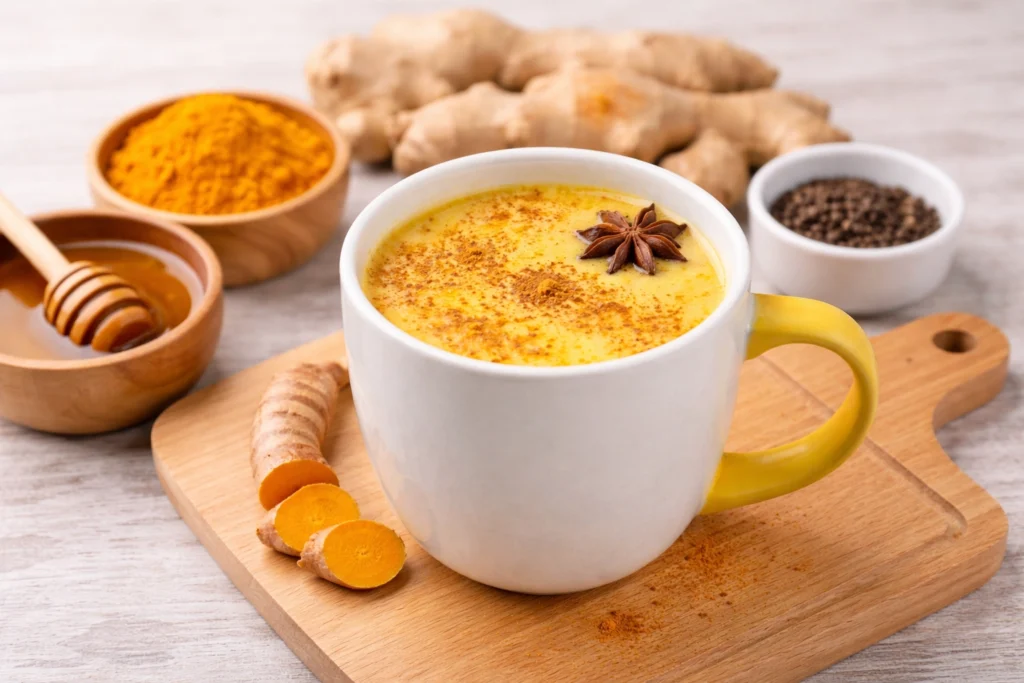
Turmeric milk — also called golden milk or haldi doodh — is a warm drink made by mixing turmeric with milk. Its active compound curcumin is one of the most studied natural antioxidants and anti-inflammatories in the world.
📋 Table of Contents
Introduction
Turmeric milk — known in South Asia as haldi doodh — has been used in Ayurvedic wellness for centuries. In recent years, it has taken off worldwide under the name “golden milk.”
The reason for the buzz is curcumin — the active compound in turmeric. It is one of the most studied natural antioxidants in the world. But is golden milk actually good for you? How do you make it properly? And who should be careful?
🛠️ Free Health Tools — Water Intake Calculator, BMI Calculator, Intermittent Fasting Calculator & more
🔍 Browse All Free Health Tools →This guide covers the evidence-based benefits of turmeric milk, its nutrition, a step-by-step recipe, how much to drink, and important safety rules. If you enjoy warm herbal drinks, you may also like our guides on ginger tea benefits and fennel seeds benefits.
What Is Turmeric Milk (Golden Milk)?
Turmeric milk is a warm drink made by combining turmeric powder — or fresh turmeric root — with milk. It usually includes black pepper, which boosts curcumin absorption dramatically. Many people also add honey, ginger, or cinnamon for flavor.
The golden color comes from curcumin — the main active compound in turmeric (Curcuma longa). Curcumin gives turmeric its yellow-orange color and is responsible for most of its studied health effects.
🌍 Names Around the World
| Language / Region | Name |
|---|---|
| English | Golden Milk / Turmeric Milk / Turmeric Latte |
| Hindi / Urdu | Haldi Doodh / Haldi Wala Doodh |
| Tamil | Manjal Paal |
| Telugu | Pasupu Palu |
| Sanskrit / Ayurvedic | Haridra Dugdha |
| Punjabi | Haldar Da Doodh |
Key Active Compounds in Golden Milk
| Compound | Found In | What It Does |
|---|---|---|
| Curcumin | Turmeric | Main active compound — fights free radicals and inflammation |
| Piperine | Black pepper | Boosts curcumin absorption by up to 2,000% |
| Gingerol | Ginger (optional) | Extra anti-inflammatory support |
| Cinnamaldehyde | Cinnamon (optional) | Antioxidant, blood sugar support, warming |
| Tryptophan | Milk | Building block for sleep hormones serotonin and melatonin |
| Calcium & Vitamin D | Dairy milk | Bone health and immune function |
Nutritional Profile & Calories
How many calories are in turmeric milk? It depends on the milk you use. Turmeric itself adds only about 8 calories per teaspoon. The rest comes from the milk.
| Type of Turmeric Milk | Calories per Cup (250ml) |
|---|---|
| Whole dairy milk | 150–160 kcal |
| Skimmed milk | 90–100 kcal |
| Oat milk | 110–130 kcal |
| Almond milk | 40–60 kcal |
| Coconut milk | 160–200 kcal |
| + 1 tsp honey | +20–25 kcal |
| + 1 tsp sugar | +18–20 kcal |
7 Health Benefits of Turmeric Milk
Here are the seven main reasons people drink golden milk. Each benefit has research or strong traditional evidence behind it. Turmeric milk is not a treatment or cure — always check with your doctor for specific concerns.
🛡️ Rich in Antioxidants
Curcumin is one of the most studied natural antioxidants. It neutralizes free radicals — unstable molecules that damage your healthy cells. It also boosts your body’s own antioxidant defense systems.
Golden milk made with black pepper and warmed milk delivers curcumin in its most absorbable form.
🔥 Calms Inflammation
Curcumin blocks a key molecule that turns on inflammation genes in your body. This is one of the same pathways targeted by anti-inflammatory drugs.
Chronic low-level inflammation is linked to many modern health problems. While turmeric milk alone is not a medical treatment, it supports an anti-inflammatory lifestyle alongside a balanced diet.
🔬 How Curcumin Works
Curcumin blocks NF-κB — a molecule that activates inflammation-related genes. A 2025 review found curcumin reduces key inflammatory markers by 30–60% across clinical trials. This is one of the same pathways targeted by pharmaceutical anti-inflammatory drugs.
🦴 May Support Joint Comfort
Several clinical studies have explored curcumin for joint health. Results are promising — one study found curcumin worked better than diclofenac sodium (a common anti-inflammatory drug) for knee pain.
Turmeric milk has lower curcumin levels than the supplements used in studies. But daily use may still provide meaningful support over time.
🧠 May Support Brain Health
Researchers have explored curcumin’s effect on a brain protein called BDNF. This protein is linked to brain cell growth, memory, and mood. Low levels are connected to depression and mental decline.
Most evidence comes from early-stage studies. But the direction is encouraging for people who consume curcumin regularly over long periods.
😴 Traditional Sleep Support
Warm turmeric milk has been used in Ayurveda for centuries as an evening drink for better sleep. Milk naturally contains tryptophan — a building block for the sleep hormones serotonin and melatonin.
The warmth of the drink adds to the relaxation effect. Many people find it genuinely helpful as a calming bedtime ritual.
🦠 May Support Immune Function
Curcumin helps balance the immune system — boosting it when needed and calming it during overreactions. Haldi doodh has been a first-line home remedy in South Asia for colds, flu, and sore throats for generations.
It is not a cure. But its antioxidant and germ-fighting properties give your immune system meaningful daily support. For another anti-inflammatory herbal drink, see our guide on cumin (jeera) benefits.
💪 Bone Health from Milk
When made with dairy milk, turmeric milk gives you a solid dose of calcium and vitamin D — both essential for strong bones. One cup of whole dairy golden milk delivers about 280–300mg of calcium.
This makes it especially useful for people who struggle to get enough dairy.
Best Time to Drink Turmeric Milk
When you drink turmeric milk affects what you get out of it. Here is the best timing for each goal.
| Time | Purpose | Notes |
|---|---|---|
| 🌙 Evening / Before bed | Sleep support, relaxation, overnight anti-inflammatory action | Most recommended — 30–60 min before sleep |
| 🌅 Morning with breakfast | Antioxidant start to the day, energy, digestion | Always take with food — not on empty stomach |
| 🏃 Post-exercise | Muscle recovery, anti-inflammatory support | Within 1 hour of training |
| ❄️ During illness | Immune support, soothing throat, warmth | Great during cold and flu season |
How to Make Turmeric Milk (Golden Milk Recipe)
This recipe takes just 5 minutes. The black pepper is the most important ingredient after turmeric — without it, most curcumin passes through your body without being absorbed.
🌿 How should you use turmeric? Type it in our free Herb & Tea Benefit Finder — get preparation method, timing, dosage, and safety notes instantly.
🔍 Try the Herb & Tea Benefit Finder →⭐ Classic Golden Milk — 1 Cup
Ingredients:
- 250ml milk of your choice (dairy, oat, almond, or coconut)
- ½ teaspoon ground turmeric powder
- A pinch of black pepper — essential for absorption
- ¼ tsp ground cinnamon (optional)
- Small piece of fresh ginger (optional)
- 1 tsp honey or sweetener — add after heating
Steps:
- 1
Pour 250ml of milk into a small saucepan over medium-low heat.
- 2
Add turmeric, black pepper, cinnamon, and ginger. Whisk well.
- 3
Warm gently for 3–5 minutes, stirring occasionally. Do NOT boil.
- 4
Strain through a fine sieve into your cup.
- 5
Stir in honey after pouring — never add honey to boiling liquid.
- 6
Drink warm, ideally 30–60 minutes before bed.
How Much Turmeric Milk Per Day?
For most healthy adults, one cup per day is the safe and recommended amount.
Who Should Be Careful with Turmeric Milk?
Turmeric milk is safe for most people in moderate amounts. But these groups should be careful or check with their doctor first.
💊 On blood thinners (warfarin, aspirin)
Curcumin has blood-thinning properties that can add to your medication’s effect.
🟡 Gallbladder issues
Turmeric stimulates bile production. This can cause problems if you have gallstones or a blocked bile duct.
💉 On diabetes medication
Curcumin may lower blood sugar further. Watch your levels carefully.
🤰 Pregnant (large amounts)
Normal cooking amounts are fine. But large medicinal doses should be avoided without medical advice.
🩸 Iron deficiency
Curcumin may reduce iron absorption when consumed at the same time as iron-rich foods.
✂️ Surgery scheduled
Stop high-dose turmeric use 2 weeks before any surgery due to blood-clotting effects.
| Who | Why Be Careful | What to Do |
|---|---|---|
| Blood thinner users | May increase bleeding risk | Ask your doctor before daily use |
| Gallbladder conditions | Stimulates bile flow | Avoid or limit; get medical advice |
| Diabetics on medication | Adds to blood sugar lowering | Watch blood glucose closely |
| Pregnant women | High doses may stimulate contractions | Cooking amounts fine; avoid excess |
| Iron deficiency | May block iron absorption | Separate from iron-rich meals |
| Pre-surgery patients | Affects blood clotting | Stop supplements 2 weeks before |
Turmeric Milk vs Plain Milk — Is It Better?
Is golden milk actually better than plain milk? Here is the honest comparison.
| Feature | 🥛 Plain Milk | 🌟 Turmeric Milk |
|---|---|---|
| Calcium & Protein | ✅ High | ✅ Same as base milk |
| Vitamin D | ✅ Good source | ✅ Same as base milk |
| Antioxidants | ❌ Minimal | ✅ Added via curcumin |
| Anti-inflammatory | ❌ None | ✅ Via curcumin + pepper |
| Sleep support | ✅ Mild (tryptophan) | ✅ Enhanced (tryptophan + turmeric warmth) |
| Best time | Any time | Evening / before bed |
| Prep needed | No | Small effort — 5 minutes |
| Cost | Lower | Slightly higher |
Turmeric milk is not “better” than plain milk — it is plain milk with added wellness compounds. Both have their place. If you enjoy warm evening drinks, golden milk is a simple upgrade from plain warm milk.
Conclusion
Turmeric milk is one of the simplest and most time-tested wellness drinks in the world. Backed by centuries of Ayurvedic tradition and growing modern research, its key compound curcumin delivers real antioxidant and anti-inflammatory support in every cup.
The recipe takes 5 minutes. The most important rule is simple: always add black pepper. Without it, most curcumin passes through your body without being absorbed. One cup in the evening, 30–60 minutes before bed, is the most popular and effective timing.
If you enjoy herbal wellness drinks, explore our guides on ginger tea benefits, cumin (jeera) benefits, and fennel seeds (saunf) benefits.
Try Our Free Herb & Tea Benefit Finder
Type turmeric, ginger, cumin, or any herb to instantly see its key benefits, best time to use, preparation method, and who should be careful.
🔍 Open the Herb & Tea Benefit Finder →Frequently Asked Questions
Yes — turmeric milk is generally a healthy drink for most adults. It combines the nutrition of milk with the antioxidant and anti-inflammatory power of curcumin. Adding black pepper makes the curcumin much more absorbable.
It depends on the milk. Whole dairy milk makes it about 150–160 calories per cup. Almond milk brings it down to 40–60 calories. Turmeric powder itself only adds about 8 calories per teaspoon — the milk is where most calories come from.
Evening — about 30–60 minutes before bed — is the most recommended time. The warmth promotes relaxation and the calming properties make it a great bedtime drink. You can also have it in the morning with breakfast for an antioxidant start to the day.
Black pepper contains piperine, which increases curcumin absorption by up to 2,000%. Without it, most curcumin passes through your body without being absorbed. Even a tiny pinch makes a huge difference — never skip it.
Yes — for most healthy adults, one cup per day is safe and well-tolerated. People with gallbladder issues, blood clotting problems, or those on blood thinners should check with their doctor before making it a daily habit.
Yes. Oat milk, almond milk, soy milk, and coconut milk all work well. Soy milk is the best plant-based choice for maximizing antioxidant benefits. Coconut milk pairs nicely with turmeric’s flavor. Almond milk is the lowest-calorie option at 40–60 calories per cup.
Warm turmeric milk has been used in Ayurveda for centuries as an evening sleep drink. Milk contains tryptophan — a building block for the sleep hormone melatonin. While formal research on turmeric milk and sleep is still limited, many people find it genuinely helpful as a calming pre-bed ritual.
Haldi doodh is the traditional South Asian name for turmeric milk. “Haldi” means turmeric and “doodh” means milk in Hindi and Urdu. It is exactly the same as what’s now sold in the West as golden milk or turmeric latte. It has been used in Indian and Pakistani homes for generations.
In moderate amounts (one cup per day), turmeric milk is generally well tolerated. Too much may cause stomach discomfort, nausea, or diarrhea in some people. Those on blood thinners, with gallbladder conditions, or on diabetes medication should check with their doctor before regular use.
Curcumin has been extensively studied for its anti-inflammatory properties. Golden milk with black pepper makes the curcumin much more absorbable. While it is not a medical treatment for inflammatory conditions, it can be a supportive part of an anti-inflammatory diet and lifestyle.
📚 Related Health Guides
Ginger Tea: Benefits, Best Time & How to Make It
Another powerful anti-inflammatory herbal drink — a natural companion to turmeric milk.
Cumin (Jeera / Zeera): 10 Benefits, Uses & Nutrition
A digestive powerhouse — cumin’s benefits for metabolism, iron, and blood sugar.
Fennel Seeds (Saunf): 10 Benefits, Nutrition & Uses
The classic post-meal digestive seed — 10 benefits from gut health to women’s wellness.
7 Proven Benefits of Hibiscus Tea for Psoriasis & Eczema
Curcumin works with hibiscus pigments for a complete anti-inflammatory skin approach.